Rolling Stones BEGGARS BANQUET - UK Mono - Un-Boxed Decca - RARE AFFORDABLE MONO
$
62


Favourite Auctions
To save auctions to your favourites, please login
If you don't have an account, please register
Description
PAYMENT DUE WITHIN
5 DAYS
of
AUCTION CLOSE
ALL RECORDS SHIPPED PROFESSIONALLY
with
TRACKING
in
VINYL PROTECTIVE SLEEVES
SPECIAL, THICK, CARDBOARD MAILERS
and
PROTECTED by a CARDBOARD PAD on EACH SIDE
INTERNATIONAL
and
EXPEDITED SHIPPING RATES
INCLUDE
INSURANCE
RECORDS/VINYL
are
VISUALLY RATED
under
DAYLIGHT
and
100w Incandescent Bulb
See
GOLDMINE'S RECORD GRADING SYSTEM
at very bottom
_______
Up For Auction
is
A VERY RARE
UK
MONO
Pressing
of
The Rolling Stones*
BEGGARS BANQUET
1968
UK Pressing
---Mono---
Un-Boxed Decca Label
Decca - LK4955
MATRIX NUMBERS
Side One: XARL-8476-4A
Side Two: XARL-8477-3A
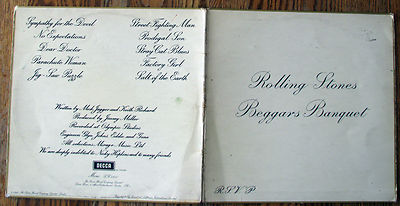
COVER: VG
(writing on inside of cover pocket) -- (separation of glued seam on pocket side of gatefold cover with cello-tape)
PLEASE REVIEW PHOTOS
VINYL: VG+ (wol: writing on Side 2 label)
HEADPHONES PLAY GRADE: VG++
British Vinyl of the 1960s at 44+ years old sounds better than most new vinyl did from 1970 to present, and this record is a testament to that fact - With headphones on you literally feel like you’re in the recording studio as they played the songs -
There is some very slight static/crackling in quietest moments & between trax - no skips, jumps, repeats -
SYMPATHY FOR THE DEVIL: no noticeable flaws
NO EXPECTATIONS: slight “click” early in the song
DEAR DOCTOR: slight “pop” early in the song
PARACHUTE WOMAN: no noticeable flaws
JIG-SAW PUZZLE: no noticeable flaws
STREET FIGHTING MAN: no noticeable flaws
PRODIGAL SON: 1 slight “pop” early and 1 in middle of the song
STRAY CAT BLUES: 3 slight “pops” in the beginning of the song
FACTORY GIRL: no noticeable flaws
SALT OF THE EARTH: slight “pop” in middle of the song
PLEASE REVIEW PHOTOS
A RARE & AFFORDABLE
GLORIOUS
MONO
UK Import Pressing
PLEASE REVIEW PHOTOS
COVER: VG
(writing on inside of cover pocket)
(separation of glued seam on pocket side of gatefold cover with cello-tape)
PLEASE REVIEW PHOTOS
VINYL: VG+ (wol: writing on Side 2 label)
HEADPHONES PLAY GRADE: VG++
British Vinyl of the 1960s at 44+ years old sounds better than most new vinyl did from 1970 to present, and this record is a testament to that fact - With headphones on you literally feel like you’re in the recording studio as they played the songs -
There is some very slight static/crackling in quietest moments & between trax - no skips, jumps, repeats -
SYMPATHY FOR THE DEVIL: no noticeable flaws
NO EXPECTATIONS: slight “click” early in the song
DEAR DOCTOR: slight “pop” early in the song
PARACHUTE WOMAN: no noticeable flaws
JIG-SAW PUZZLE: no noticeable flaws
STREET FIGHTING MAN: no noticeable flaws
PRODIGAL SON: 1 slight “pop” early and 1 in middle of the song
STRAY CAT BLUES: 3 slight “pops” in the beginning of the song
FACTORY GIRL: no noticeable flaws
SALT OF THE EARTH: slight “pop” in middle of the song
PLEASE REVIEW PHOTOS
A RARE & AFFORDABLE COPY
Beggars Banquet
Beggars Banquet Studio album by The Rolling Stones Released 6 December 1968 Recorded 17 March – 25 July 1968, Olympic Studios, London Genre Rock, blues rock, rhythm and blues, hard rock, roots rock Length 39:44 Label London (US), Decca (UK) Producer Jimmy Miller The Rolling Stones chronology Their Satanic Majesties Request
(1967) Beggars Banquet
(1968) Let It Bleed
(1969)
2002 reissue cover Singles from Beggars Banquet
- "Street Fighting Man"/"No Expectations"
Released: 31 August 1968 (US)
Beggars Banquet is the seventh British and ninth American studio album by the English rock band The Rolling Stones. It was released in December 1968 by Decca Records in the United Kingdom and London Records in the United States. It marked a return to the band's R&B roots, generally viewed as more primal than the conspicuous psychedelia of Their Satanic Majesties Request. It also started off a string of four LPs that is usually regarded as the band's finest work.
Following the long sessions for the previous album in 1967 and the departure of producer and manager Andrew Loog Oldham, Mick Jagger and Keith Richards hired producer Jimmy Miller, who had produced the Spencer Davis Group and Traffic. The partnership would prove to be a success and Miller would work with the band until 1973.
In March, the band began recording their new album, aiming for a July release. One of the first tracks cut, "Jumpin' Jack Flash", was released only as a single in May 1968, becoming a major hit.
Beggars Banquet was Brian Jones' last full effort with the Rolling Stones. In addition to his slide guitar on "No Expectations", he played harmonica on "Dear Doctor", "Parachute Woman" (along with Mick Jagger) and "Prodigal Son"; sitar and tambura on "Street Fighting Man"; mellotron on "Jigsaw Puzzle"and "Stray Cat Blues", and sang backing vocals on "Sympathy for the Devil".[7]
On 7 June 1968, a photoshoot for the album, with photographer Michael Joseph, was held at Sarum Chase, a mansion in London.[8] Previously unseen images from the shoot were exhibited at the Blink Gallery in London in November and December 2008.[9]
Critics considered the LP as a return to form.[10] It was also a clear commercial success, reaching No. 3 in the UK and No. 5 in the US (on the way to eventual platinum status).
Early LP pressings of the album did not credit Rev. Robert Wilkins as the writer of "Prodigal Son" although the Stones' original "bathroom" cover did. The error was corrected on later pressings. Wilkins' performance of "Prodigal Son" at the 1964 Newport Folk Festival was included on the Vanguard LP Blues at Newport, Volume 2; that performance is similar to the Stones' cover.
On 10–11 December 1968 the band filmed a television extravaganza entitled The Rolling Stones Rock and Roll Circus featuring John Lennon, Eric Clapton, The Who and Jethro Tull among the musical guests. One of the original aims of the project was to promote Beggars Banquet, but the film was shelved by the Rolling Stones until 1996, when it was finally released officially.
In August 2002, ABKCO Records reissued Beggars Banquet as a newly remastered LP and SACD/CD hybrid disk.[11] This release corrected an important flaw in the original album by restoring each song to its proper, slightly faster speed. Due to an error in the mastering, Beggars Banquet was heard for over thirty years at a slower speed than it was recorded. This had the effect of altering not only the tempo of each song, but the song's key as well. These differences were subtle but important, and the remastered version is about 30 seconds shorter than the original release. It was released once again in 2010 by Universal Music Enterprises in a Japanese only SHM-SACD version.
In 2003, the album was ranked number 57 on Rolling Stone magazine's list of the 500 greatest albums of all time.[12] In the same year the TV network VH1 named Beggars Banquet the 67th greatest album of all time. The album is also featured in the book 1001 Albums You Must Hear Before You Die.
Cover Art
By June, the sessions were nearly completed in England, with some final overdubbing and mixing to be done in Los Angeles during July. However, both Decca Records in England and London Records in the US rejected the planned cover design – a graffiti-covered lavatory wall. The band initially refused to change the cover, resulting in several months' delay in the release of the album. By November, however, the Rolling Stones gave in, allowing the album to be released in December with a simple white cover imitating an invitation card, complete with an RSVP. For those aware of the cover intrigue, an advertisement in the back of Rolling Stone magazine soon announced that "the Stones want you to have the banned cover" allowing completists to buy the original artwork as a full front and back album slick that they could glue or tape over the released version.[citation needed] Meanwhile, the idea of a plain album cover was also implemented by The Beatles for their eponymous white-sleeved double-album, which was released one month prior to Beggars Banquet. The similarity garnered widespread accusations of Beatle-esque imitation when Beggars Banquet was finally released. In 1984, the original cover art was released with the initial CD remastering of Beggars Banquet.
Track listing
All songs written by Mick Jagger and Keith Richards except where noted.
Side oneNo. Title Length
1. "Sympathy for the Devil" 6:18 2. "No Expectations" 3:56 3. "Dear Doctor" 3:22 4. "Parachute Woman" 2:20 5. "Jig-Saw Puzzle" 6:06 Side two
No. Title Length
6. "Street Fighting Man" 3:16 7. "Prodigal Son" (Robert Wilkins) 2:51 8. "Stray Cat Blues" 4:38 9. "Factory Girl" 2:09 10. "Salt of the Earth" 4:48
Personnel
The Rolling Stones- Mick Jagger – lead and backing vocals, harmonica on "Parachute Woman"
- Keith Richards – acoustic, electric and slide guitar, bass guitar on "Sympathy for the Devil" and "Street Fighting Man", backing vocals, lead vocals on opening of "Salt of the Earth"
- Brian Jones – slide guitar on "No Expectations", mellotron on "Jigsaw Puzzle" and "Stray Cat Blues", harmonica on "Dear Doctor", "Parachute Woman", and "Prodigal Son", sitar and tambura on "Street Fighting Man", backing vocals on "Sympathy for the Devil"
- Charlie Watts – drums, tabla on "Factory Girl", backing vocals on "Sympathy for the Devil"
- Bill Wyman – bass guitar, backing vocals and maracas on "Sympathy for the Devil"
- Nicky Hopkins – piano, organ
- Rocky Dijon – congas on "Sympathy for the Devil", "Stray Cat Blues", "Factory Girl"
- Ric Grech – fiddle on "Factory Girl"
- Dave Mason – mellotron on "Factory Girl", shehnai on "Street Fighting Man"
- Jimmy Miller – backing vocals on "Sympathy for the Devil"
- Watts Street Gospel Choir – backing vocals on "Salt of the Earth"
_______________________________________________________
5 DAYS
of
AUCTION CLOSE
GOLDMINE'S RECORD GRADING SYSTEM
How to Grade: Look at everything about a record -- Its playing surface, its label, its edges -- under a strong light. Then, based on your overall impression, give it a grade based on the following criteria:
Mint (M): Absolutely perfect in every way -- certainly never played, possibly even still sealed (More on still sealed under "Other considerations"). Should be used sparingly as a grade, if at all.
Near Mint (NM or M-): A nearly perfect record. Many dealers won't give a grade higher than this, implying (perhaps correctly) that no record is ever truly perfect.
The record should show no obvious signs of wear. A 45 RPM or EP sleeve should have no more than the most minor defects, such as almost invisible ring wear or other signs of slight handling.
An LP jacket should have no creases, folds, seam splits or any other noticeable similar defect. No cut-out holes, either. And of course, the same should be true of any other inserts, such as posters, lyric sleeves and the like.
Basically, an LP in Near Mint condition looks as if you just got it home from a new record store and removed the shrink wrap.
Very Good Plus (VG+): A Very Good Plus record will show some signs that it was played and otherwise handled by a previous owner who took good care of it.
Record surfaces may show some slight signs of wear and may have slight scuffs or very light scratches that don't affect one's listening experience. Slight warps that do not affect the sound are OK.
The label may have some ring wear or discoloration, but it should be barely noticeable. The center hole will not have been misshapen by repeated play.
Picture sleeves and LP inner sleeves will have some slight ring wear, lightly turned-up corners, or a slight seam split. An LP jacket may have slight signs of wear also and may be marred by a cut-out hole, indentation or corner indicating it was taken out of print and sold at a discount.
In general, if not for a couple minor things wrong with it, this would be Near Mint. All but the most mint-crazy collectors will find a Very Good Plus record highly acceptable.
A synonym used by some collectors and dealers for "Very Good Plus" is "Excellent."
Very Good (VG): Many of the defects found in a VG+ record will be more pronounced in a VG disc. Surface noise will be evident upon playing, especially in soft passages and during a song's intro and fade, but will not overpower the music otherwise. Groove wear will start to be noticeable, as will light scratches (deep enough to feel with a fingernail) that will affect the sound.
Labels may be marred by writing, or have tape or stickers (or their residue) attached. The same will be true of picture sleeves or LP covers. However, it will not have all these problems at the same time, only two or three of them.
Good (G), Good Plus (G+): Good does not mean Bad! A record in Good or Good Plus condition can be put onto a turntable and will play through without skipping. But it will have significant surface noise and scratches and visible groove wear (on a styrene record, the groove will be starting to turn white).
A jacket or sleeve will have seam splits, especially at the bottom or on the spine. Tape, writing, ring wear or other defects will start to overwhelm the object.
If it's a common item, you'll probably find another copy in better shape eventually. Pass it up. but if it's something you have been seeking for years, and the price is right, get it... but keep looking to upgrade.
Poor (P), Fair (F): The record is cracked, badly warped, and won't play through without skipping or repeating. The picture sleeve is water damaged, split on all three seams and heavily marred by wear and writing. The LP jacket barely keeps the LP inside it. Inner sleeves are fully seam split, crinkled, and written upon.
Except for impossibly rare records otherwise unattainable, records in this condition should be bought or sold for no more than a few cents each.
Other grading considerations. Most dealers give a separate grade to the record and its sleeve or cover. In an ad, a record's grade is listed first, followed by that of the sleeve or jacket.
With Still Sealed (SS) records, it's safe to assume that they are in Very Good Plus to Near Mint
condition (unless there is notable damage). There are many original factory sealed records still out there (warehouses full)--just be carefull: it's easy to re-seal one. Let the buyer beware!
Abbreviations
brass plug: small brass plug in cover to indicate cut-outcc: cut corner, slice of cover is missing to indicate cut-out
coh: cut-out-hole, small hole in cover
dnap: does not affect play
in shrink: in original shrinkwrap (but not sealed)
in loose bag: in original loose bag (predates shrinkwrap)
noc: name on cover (nobc: name on back cover, nofc: name on front cover)
nol: name on label
re: reissue, not the first pressing
rw: ringwear (wear on cover resembling the shape of the record)
sm: sawmark, small cut in cover to indicate cut-out
soc: sticker on cover (sobc: sticker on back cover, sofc: sticker on front cover)
sol: sticker on label
ss: seam split
toc: tape on cover (tobc: tape on back cover, tofc: tape on front cover)
tol: tape on label
woc: writing on cover (wobc: writing on back cover, wofc: writing on front cover)
wol: writing on label
price rating