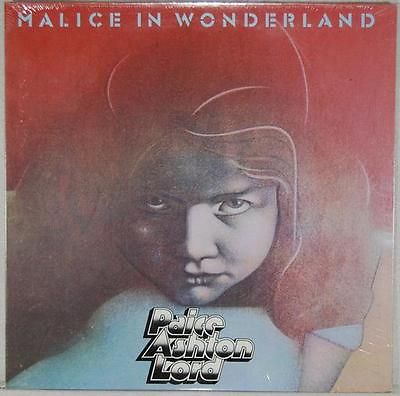
SEALED LP: PAICE, ASHTON & LORD: MALICE IN WONDERLAND
$
48


$ 48
Sold For
Oct 2, 2015
Sold Date
Sep 7, 2015
Start Date
1
Number Of Bids
USA
Country Of Seller
eBay
Sold at
Favourite Auctions
To save auctions to your favourites, please login
If you don't have an account, please register
Description
Paice, Ashton & Lord: Malice in Wonderland
FACTORY SEALED LP
Format: Sealed LPCountry: U.S.A.
Record Company & Release Number: Warner Brothers/Oyster: BS 3038
Original release date/year: 1977
Bar Code: NONE
Condition of the cover: Mint
Condition of the record: Sealed - Assumed Mint
Shipping Weight: 1 pounds, 2 ounces
My inventory number: 208069C
Notes: - - -
Please contact me if you have any difficulty viewing the photos.
Songs
- Ghost Story
- Remember the Good Times
- Arabella [Oh Tell Me]
- Silas and Jerome
- Dance With Me Baby
- On the Road Again, Again
- Sneaky Private Lee
- I'm Gonna Stop Drinking Again
- Malice in Wonderland
- Paul Martinez: Bass, Guitar (Bass)
- Jeanette McKinley: Vocals, Vocals (Background)
- Sheila McKinley: Vocals, Vocals (Background)
- Ian Paice: Percussion, Mixing, Drums
- Simon Robinson: Liner Notes
- Alan Messer: Photography
- Phil Duffy: Photography
- Nick Watson: Remastering
- Jon Lord: Synthesizer, Keyboards, Mixing, Keyboard Accordion
- Bernie Marsden: Guitar, Vocals (Background), Vocals
- PaicAshton & Lord: Main Performer
- Tony Ashton: Organ, Keyboards, Mixing, Vocals
- Reg Brooks: Trombone, Brass
- Howie Casey: Saxophone, Brass, Sax (Tenor)
- Dave Caswell: Trombone, Brass, Trumpet, Piccolo, Horn, Flugelhorn
- Gilbert Dall'Ense: Clarinet, Saxophone, Sax (Alto), Sax (Baritone)
- Paice Ashton Lord's sole album is a rather anonymous-sounding late-197s hard rock/AOR effort. There's more funk, soul, boogie, and jazz influence than you would expect from Deep Purple alumni, but at heart these are typical period mainstream rock songs that don't lend a distinctive personality to the short-lived band. There's an outrageously blatant quote from Blood, Sweat & Tears' "Spinning Wheel" in "Silas & Jerome." The 2001 CD reissue on Purple Records adds eight bonus tracks from the sessions for their unreleased second album, which are of a similar but less polished quality. Some of the songs are instrumentals rather than fully worked-up compositions, and the fidelity on a few of them is substandard, though not truly bad. The liner notes for the reissue give a thorough history of the band. ~ Richie Unterberger, All Music Guide
Paice, Ashton & Lord biography by Richie Unterberger, All Music Guide
- The Deep Purple spin-off project Paice Ashton Lord were formed by ex-Deep Purplers Ian Paice (drums) and Jon Lord (organ) with Tony Ashton, who had been in the Remo Four during the British Invasion era and then in Ashton, Gardner & Dyke (famous for "Resurrection Shuffle"). When they got together in mid-1976, Deep Purple had just broken up; for the sole Paice Ashton Lord album, the sound was filled out by guitarist Bernie Marsden and bassist Paul Martinez. That LP, Malice in Wonderland, was not nearly as heavy as Deep Purple had been, though it still owed much to mainstream British hard rock. However, there was a fair amount of jazz influence in the arrangements (which sometimes included brass) and some soul ingredients to the songwriting. All of this didn't add up to anything more than an average mid-'70s rock album, the kind you could have heard as filler on numerous AOR-oriented FM stations at the time. You didn't, though, since the album didn't sell much, and Paice Ashton Lord disbanded, although they did start work on a second LP. Eight songs from the unreleased second album appeared on the CD reissue of Malice in Wonderland on Purple Records in 2001. Ian Paice biography by Greg Prato, All Music Guide
- Although not as renowned as Ginger Baker or John Bonham, Deep Purple's Ian Paice was one of hard rock/heavy metal's early standout drummers, and like the other two, influenced countless other skinsmen in the process. Born on June 29, 1948 in Nottingham, England, Paice started off playing violin before switching to drums at the age of 15. From the mid- to late '60s, Paice played in a variety of obscure local bands, including such names as Georgie & the Rave Ons, the Shindigs, the MI 5, the Maze, Soul Brothers, and Boz, as well as future guitar hero Albert Lee. It was while playing with one of these groups in Hamburg, Germany that respected session guitarist Ritchie Blackmore took note of Paice and arranged the drummer to audition for his group, Roundabout, in early 1968. Paice got the gig, as Roundabout soon transformed into Deep Purple, along with additional members Rod Evans (vocals), Jon Lord (keyboards), and Nick Simper (bass). It was this lineup that recorded such albums as 1968's Shades of Deep Purple and Book of Taliesyn, plus 1969's self-titled release, but aside from scoring a massive worldwide hit with "Hush," this early lineup of Purple failed to truly ignite.
- Both Evans and Simper were excused from the band shortly before the dawn of the '70s, replaced by Ian Gillan and Roger Glover, respectively. The new lineup got off to a rocky start with the experimental Concerto for Group and Orchestra, but soon after, it was this version of Purple that would be considered the group's definitive one. Along with Blackmore's fluid guitar playing and Gillan's vocals, it was Paice's powerful drumming that served as an important ingredient to Purple's new harder-rocking direction. Over the course of five albums, 1970's In Rock, 1971's Fireball, 1972's Machine Head and Made in Japan, plus 1973's Who Do You Think We Are, Deep Purple became one of the world's top rock bands, but a grueling touring schedule and interband friction led to Gillan and Glover's departure. Between 1974 and 1976, numerous lineup changes occurred, with Paice and Lord being the only original members left in attendance. Four more albums appeared during this turbulent time (1974's Burn and Stormbringer, 1975's Come Taste the Band, and 1976's Made in Europe), before Purple was finally laid to rest.
- Throughout his tenure with Deep Purple, Paice indulged steadily in session work, playing on albums by such artists as the Velvet Underground, Eddie Hardin, Pete York, Elf, and Bobby Harrison, among others. With Purple now dormant, Paice was allowed to play on even more artists' recordings during the late '70s and early '80s, including releases by Maggie Bell, Kirby, Bernie Marsden, and Ken Hensley. Paice also accepted several invitations to join bands full-time, as evidenced by brief stints in the trio Paice, Ashton & Lord (1977's Malice in Wonderland), Whitesnake (1980's Ready an' Willing, 1981's Come an' Get It, and 1982's Saints and Sinners), and Gary Moore's band (1982's Corridors of Power, 1983's Victims of the Future, 1983's Rockin' Every Night, and 1984's We Want Moore!). Rumors of an impending re-formation of the classic Gillan/Glover Deep Purple lineup had been surfacing for several years by this point, and in 1984, the reunion was finally confirmed. The same year saw a new album by the quintet, the surprisingly strong Perfect Strangers, as well as a sold-out supporting tour. Unfortunately, it didn't take long before the same old problems that broke up the band initially appeared once more, as the lineup only managed one more release, the lackluster House of Blue Light, in 1987.
- 1989 saw Paice drum on several songs recorded by ex-Beatle George Harrison for the soundtrack to the movie Lethal Weapon II, before returning back to Deep Purple. Purple continued on throughout the '90s, with such further releases as 1990's Slaves and Masters, 1993's The Battle Rages On, 1996's Purpendicular, and 1998's Abandon, despite continued lineup juggling. In 1999, Paice had the opportunity to play alongside another ex-Beatle, Paul McCartney, on the mostly covers outing, Run Devil Run, as well as the live home video/DVD, Live at the Cavern Club. Paice has also recorded a few instructional videos for fellow drummers over the years, including an episode of the '80s TV program Rock School, and in 2002, the DVD Not for the Pros. Tony Ashton biography by William Ruhlmann, All Music Guide
- British keyboard player and singer Tony Ashton was born in Blackburn, Lancashire, and first gained notice when he replaced Don Andrews in The Remo Four, a Liverpool Mersey Beat group. They played on George Harrison's Wonderwall soundtrack, then Ashton and drummer Roy Dyke quit to form Ashton, Gardner & Dyke in 1968, and the trio scored a hit with "Resurrection Shuffle" in 1971, then split up in 1972. Ashton joined Family for a year, and in 1976 was a member of Paice, Ashton And Lord, after which he went into production. Jon Lord biography by Jason Ankeny, All Music Guide
- A founding member of heavy metal institution Deep Purple, keyboardist/composer Jon Lord was born June 9, 1941, in Leicester, England. He began playing piano at age nine, later forgoing his classical studies to play rock, jazz, and blues. Around 1960, he relocated to London, following a stint with the Bill Ashton Combo by joining Red Bludd's Bluesicians. In 1964, Lord played on the Kinks' eponymous debut LP (retitled You Really Got Me for American consumption); around the same time, his group the Artwoods released their first single "Sweet Mary," issuing several more singles prior to the 1966 full-length Art Gallery. After the 1967 Jazz in Jeans appeared to little response, the band re-christened itself St Valentine's Day Massacre, adopting a gangster-influenced image for their lone single, "Brother, Can You Spare a Dime?"
- Lord next surfaced in the short-lived Santa Barbara Machinehead, and in early 1968 joined Roundabout; after a brief tour of Scandinavia, the group -- also including vocalist Rod Evans, guitarist Ritchie Blackmore, bassist Nick Simper, and drummer Ian Paice -- changed its name to Deep Purple. Originally favoring a classically inspired rock sound dominated by Lord's keyboard flourishes, the group's debut LP Shades of Deep Purple generated the Top Five smash "Hush," while the 1969 follow-up The Book of Taliesyn featured a Top 40 cover of Neil Diamond's "Kentucky Woman." However, in mid-1969. Evans and Simper left Deep Purple, and the arrivals of singer Ian Gillan and bassist Roger Glover heralded a more aggressive, thunderously heavy approach over the course of albums including 1970's Deep Purple in Rock and 1971's Fireball. Although 1972's Machine Head cracked the U.S. Top Ten on the strength of the AOR staple "Smoke on the Water," personality conflicts between Gillan and Blackmore precipitated the singer's departure from the group in mid-1973. Despite the subsequent additions of singer David Coverdale and guitarist Tommy Bolin, Deep Purple never again regained its peak popularity.
- In 1974, Lord cut the solo album Gemini Suite, based on a concerto he'd written for the BBC four years earlier; Sarabande followed in 1975, and in the wake of Deep Purple's demise he joined Coverdale's new band, Whitesnake. Lord's next solo album, Before I Forget, appeared in 1982; two years later, he reunited with Gillan, Blackmore, Glover, and Paice to re-form Deep Purple, issuing the album Perfect Strangers. The re-formed group toured to great success, and in 1987 released The House of Blue Light before frictions again forced Gillan from the group. Roster changes consistently plagued the group throughout the years to come, but as before Lord remained a constant of the lineup. The solo Pictured Within followed in the autumn of 1998.
- This record came from a record store called "Phantasmagoria" which was located in Allentown, Pennsylvania. Phantasmagoria went out of business in 1978. I purchased most of their unsold inventory some years later when I owned "Music Madness" - a new & used record store in Catasauqua, Pennsylvania.
- Phantasmagoria used round colored stickers to indicate the price of the albums. They had a chart on the wall with the color sticker combinations for the customers to use so they knew the price of the albums. Most of the albums still have these stickers on them, and in some rare cases, the stickers are written on. Some of the records have prices on them. This is the price you would have paid for the record in 1978 if you would have bought it at Phantasmagoria. Please don't confuse these prices with their current value.
- All sealed albums are being sold as collector's items and cannot be returned due to manufacturer's defects. It may be almost impossible to replace many of the sealed albums that I am selling.
- If I list an album as "New", but not sealed, it is because the album is probably an import or from a small USA record company. Back in the 70's, many imported albums were not sealed by the record companies, and the importers/distrubutors did not spend the time or money to seal them before being sent to the stores. I will not knowingly misrepresent an album as new if I have any doubts.
- All pictures are of the exact item being sold.
- I always leave feedback before your item ships. Please consider leaving feedback for me after you have had a chance to inspect and enjoy your purchase.
- Please avoid questions on the last day of the auction. I might not have enough time to give you an answer before the auction ends.
- All album reviews, credits and artist biographies are from All Music Guide. If you haven't been to their web site, you have to check it out. It's one of the most comprehensive music references on the internet. In some cases, credits may include reissue (CD) information. Obviously any credits referenced to CDs do not apply to this album release.
Counter by AuctionTamer
price rating


![Arcturus - Aspera Hiems Symfonia [New Vinyl LP] Gatefold LP Jacket](https://www.popsike.mobi/php/thumbnail.php?url=https://www.popsike.pics/pix/20230418/134536813576.jpg)


![SOPHIA: FIXED WATER -LTD [LP vinyl]](https://www.popsike.mobi/php/thumbnail.php?url=https://www.popsike.pics/pix/20190202/163521353302.jpg)