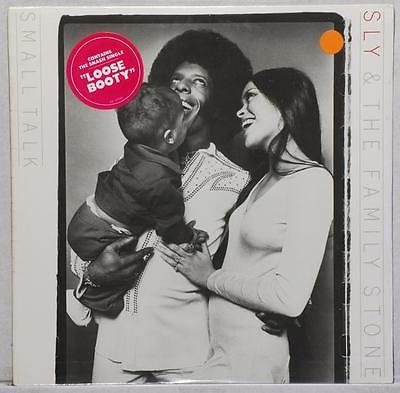
SEALED LP: SLY & THE FAMILY STONE: SMALL TALK
$
20


$ 20
Sold For
Mar 13, 2017
Sold Date
Mar 3, 2017
Start Date
1
Number Of Bids
USA
Country Of Seller
eBay
Sold at
Favourite Auctions
To save auctions to your favourites, please login
If you don't have an account, please register
Description
Sly & the Family Stone: Small Talk
FACTORY SEALED LP
Format: Sealed LPCountry: U.S.A.
Record Company & Release Number: Columbia: PE 32930
Original release date/year: 1974
Bar Code: NONE
Condition of the cover: Mint
Condition of the record: Sealed - Assumed Mint
Shipping Weight: 1 pounds, 2 ounces
My inventory number: 208348C
Notes: Sticker on the shrink wrap as shown in the photos below
Please contact me if you have any difficulty viewing the photos.
IF THIS ITEM DOES NOT SELL IN THIS AUCTION, IT WILL BE RELISTED IN MY STORE AT THE “BUY IT NOW” PRICE IN A WEEK OR TWO. Songs
- Small Talk
- Say You Will
- Mother Beautiful
- Time for Livin'
- Can't Strain My Brain
- Loose Booty
- Holdin' On
- Wishful Thinkin'
- Better Thee Than Me
- Livin' While I'm Livin'
- This Is Love
- Rose Banks
- Karat Faye: Engineer
- Tom Flye: Engineer
- Bill Lordan
- Jerry Martini
- Sid Page
- Pat Rizzo
- Cynthia Robinson
- Sylvester "Sly Stone" Stewart: Guitar, Keyboards, Vocals, Producer
Review by Rob Bowman, All Music Guide
- A new bass player and drummer signaled a toned-down Sly & the Family Stone sound. Partially in keeping with changes in much of popular music in the early '70s, and maybe the result of marriage and a child, Sly became more introspective, quieter, and calmer, even employing a string section on various cuts. A less exhilarating album than earlier efforts, there is still much of merit here, including the Top Ten R&B hit "Time for Livin'."
Sly & the Family Stone biography by Stephen Thomas Erlewine, All Music Guide
- Sly & the Family Stone harnessed all of the disparate musical and social trends of the late '60s, creating a wild, brilliant fusion of soul, rock, R&B, psychedelia, and funk that broke boundaries down without a second thought. Led by Sly Stone, the Family Stone was comprised of men and women, and blacks and whites, making the band the first fully integrated group in rock's history. That integration shone through the music, as well as the group's message. Before Stone, very few soul and R&B groups delved into political and social commentary; after him, it became a tradition in soul, funk, and hip-hop. And, along with James Brown, Stone brought hard funk into the mainstream. The Family Stone's arrangements were ingenious, filled with unexpected group vocals, syncopated rhythms, punchy horns, and pop melodies. Their music was joyous, but as the '60s ended, so did the good times. Stone became disillusioned with the ideals he had been preaching in his music, becoming addicted to a variety of drugs in the process. His music gradually grew slower and darker, culminating in 1971's There's a Riot Going On, which set the pace for '70s funk with its elastic bass, slurred vocals, and militant Black Power stance. Stone was able to turn out one more modern funk classic, 1973's Fresh, before slowly succumbing to his addictions, which gradually sapped him of his once prodigious talents. Nevertheless, his music continued to provide the basic template for urban soul, funk, and even hip-hop well into the '90s.
- Sly Stone (born Sylvester Stewart, March 15, 1944) and his family moved from his home state of Texas to San Francisco in the '50s. He had already begun to express an interest in music, and when he was 16, he had a regional hit with "Long Time Away." Stone studied music composition, theory, and trumpet at Vallejo Junior College in the early '60s; simultaneously, he began playing in several groups on the Bay Area scene, often with his brother Fred. Soon, he had become a disc jockey at the R&B station KSOL, later switching to KDIA. The radio appearances led to a job producing records for Autumn Records. While at Autumn, he worked with a number of San Franciscan garage and psychedelic bands, including the Beau Brummels, the Great Society, Bobby Freeman, and the Mojo Men.
- During 1966, Stone formed the Stoners, which featured trumpeter Cynthia Robinson. Though the Stoners didn't last long, he brought Robinson along as one of the core members of his next group, Sly & the Family Stone. Formed in early 1967, the Family Stone also featured Fred Stewart (guitar, vocals), Larry Graham, Jr. (bass, vocals), Greg Errico (drums), Jerry Martini (saxophone), and Rosie Stone (piano), who all were of different racial backgrounds. The group's eclectic music and multiracial composition made them distinctive from the numerous flower-power bands in San Francisco, and their first single, "I Ain't Got Nobody," became a regional hit for the local label Loadstone. The band signed with Epic Records shortly afterward, releasing their debut album, A Whole New Thing, by the end of the year. The record stiffed, but the follow-up, Dance to the Music, generated a Top Ten pop and R&B hit with its title track early in 1968. Life followed later in 1968, but the record failed to capitalize on its predecessor's success. "Everyday People," released late in 1968, turned their fortunes back around, rocketing to the top of the pop and R&B charts and setting the stage for the breakthrough success of 1969's Stand!
- Featuring "Everyday People," "Sing a Simple Song," "Stand," and "I Want to Take You Higher," Stand! became the Family Stone's first genuine hit album, climbing to number 13 and spending over 100 weeks on the charts. Stand! also marked the emergence of the political bent in Stone's songwriting ("Don't Call Me Nigger, Whitey"), as well as the development of hard-edged, improvisational funk like "Sex Machine." The Family Stone quickly became known as one of the best live bands of the late '60s, and their performance at Woodstock was widely hailed as one of the festival's best. The non-LP singles "Hot Fun in the Summertime" and "Thank You (Falettinme Be Mice Elf Agin)" b/w "Everybody Is a Star" became hits, reaching number two and number one respectively in late 1969/early 1970. Both singles were included on Greatest Hits, which became a number two record upon its fall 1970 release. While the group was at the height of its popularity, Sly was beginning to unravel behind the scenes. Developing a debilitating addiction to narcotics, Stone soon became notorious for arriving late for concerts, frequently missing the shows all together.
- Stone's growing personal problems, as well as his dismay with the slow death of the civil rights movement and other political causes, surfaced on There's a Riot Goin' On. Though the album shot to number one upon its fall 1971 release, the record -- including "Family Affair," Stone's last number one single -- was dark, hazy, and paranoid, and his audience began to shrink slightly. During 1972, several key members of the Family Stone, including Graham and Errico, left the band; they were replaced by Rusty Allen and Andy Newmark, respectively. The relatively lighter Fresh appeared in the summer of 1973, and it went into the Top Ten on the strength of the Top Ten R&B hit "If You Want Me to Stay." Released the following year, Small Talk was a moderate hit, reaching number 15 on the charts and going gold, but it failed to generate a big hit single. High on You, released in late 1975 and credited only to Sly Stone, confirmed that his power and popularity had faded. "I Get High on You" reached the R&B Top Ten, but the album made no lasting impact.
- Disco had overtaken funk in terms of popularity, and even if Sly wanted to compete with disco, he wasn't in shape to make music. He had become addicted to cocaine, his health was frequently poor, and he was often in trouble with the law. His recordings had slowed to a trickle, and Epic decided to close out his contract in 1979 with Ten Years Too Soon, a compilation of previously released material that had the original funky rhythm tracks replaced with disco beats. Stone signed with Warner Brothers that same year, crafting the comeback effort Back on the Right Track with several original members of the Family Stone, but the record was critically panned and a commercial failure. In light of the album's lack of success, Stone retreated even further, eventually joining forces with George Clinton on Funkadelic's 1981 album The Electric Spanking of War Babies. Following the album's release, Stone toured with Clinton's P-Funk All-Stars, which led him to embark on his own tour, as well as a stint with Bobby Womack. The culmination of this burst of activity was 1983's Ain't but the One Way, an album that was ignored. Later that year, Stone was arrested for cocaine possession; the following year, he entered rehab.
- Stone appeared on Jesse Johnson's 1986 R&B hit "Crazay." The following year, he dueted with Martha Davis on "Love & Affection" for the Soul Man soundtrack; he also he recorded "Eek-a-Bo-Static," a single that didn't chart. Stone was arrested and imprisoned for cocaine possession by the end of 1987, and he was never able to recover from the final arrest. Stone continued to battle his addiction, with varying degrees of success. By his 1993 induction to the Rock & Roll Hall of Fame, he had disappeared from public view. Avenue Records gave Stone a recording contract in 1995, but nothing would be recorded.
- All sealed albums are being sold as collector's items and cannot be returned due to manufacturer's defects. It may be almost impossible to replace many of the sealed albums that I am selling.
- All pictures are of the exact item being sold.
- I always leave feedback before your item ships. Please consider leaving feedback for me after you have had a chance to inspect and enjoy your purchase.
- Please avoid questions on the last day of the auction. I might not have enough time to give you an answer before the auction ends.
- Since I obtain my sealed albums from a few different sources, if I am ever suspicious if it was factory sealed, I will specify it in the Notes section above.
- All album reviews, credits and artist biographies are from All Music Guide. If you haven't been to their web site, you have to check it out. It's one of the most comprehensive music references on the internet. In some cases, credits may include reissue (CD) information. Obviously any credits referenced to CDs do not apply to this album release.
Shipping and pick-up
Your item(s) will be shipped within 2 business days after I receive your cleared payment. If possible, if payments are made by 2 PM Eastern time, I will try to send your package the same day if my local Post Office is open.
I photograph all packages before taking them to the Post Office to confirm their condition prior to being handed over to the Post Office. Damage to your package after being handed over to them will not be my responsibility.
If you have ANY special shipping requirements (extra padding, oversized boxes, etc., you must let me know BEFORE making your payment. The pre-calculated cost of your shipping is based my standard packaging (new boxes, padded envelopes, etc.).
WITHIN U.S.A.
- I no longer ship by Media Mail. My supplier of cardboard boxes is no longer in business, and the alternate providers are considerably more expensive.
- Priority Mail includes free insurance.
- If you purchase 5 or more items to be shipped together, Priority Mail will be free.
- Pick-up is fine with me, but be prepared to pay by cash. E-mail me to setup a time and place that is convenient for the both of us.
OUTSIDE U.S.A.
- International Shipping is calculated by the weight of your package.
- If you purchase multiple items, please wait until after all the auctions end for eBay to send an invoice.
- I no longer ship by International First Class. The USPS discontinued this service to several countries.
- The buyer is responsible for all customs regulations and fees in their own country. I will declare the value of all items at $10 each on the Customs Form. Please let me know if you want the actual winning bid price listed on the Customs Form. This is something to consider if you think there is a potential for damage or loss of your package. Insurance will only reimburse you for the actual declared value.
If you also collect Grand Funk, let me know if you have anything that you might want to sell or trade. I am always looking to add something new to my collection.
Counter by AuctionTamer
price rating
![SPIDERS[PRE ALICE COOPER]-DON'T BLOW YOUR MIND ORIG.](https://www.popsike.mobi/php/thumbnail.php?url=https://www.popsike.pics/pix/20090430/200337435149.jpg)