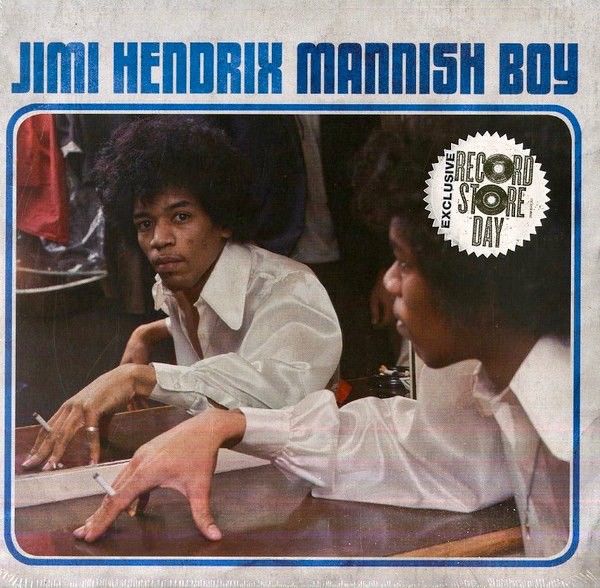
SONY LEGACY 7": JIMI HENDRIX - Mannish Boy, Trash Man - 45rpm RSD 2018 LTD #d SS
C$
25
$
18


C$ 25
Sold For
Jul 2, 2018
Sold Date
Jun 11, 2018
Start Date
C$ 30
Start price
1
Number Of Bids
Canada
Country Of Seller
eBay
Sold at
Favourite Auctions
To save auctions to your favourites, please login
If you don't have an account, please register
Description
****Welcome to our listing, thanks very much for looking!
****See our own website! We have lots of out of print LPs and CDs! You can find us on the world wide web at -
hearthedifference.net
****Shipping cost is only an estimate - it depends on the actual weight and size of the package as well as the service required. We do not profit from shipping costs, so if we overcharge, we will refund the difference back to you. It's always best to wait for our invoice before paying for your item. We will combine shipping for multiple items purchased.
****Please see our other listings for more great LPs and CDs - new items added daily!****To access our eBay store click on the little red door at the top right section of any of our eBay listings or, click on -
http://stores.ebay.com/Hear-The-Difference
Background -
In his brief four-year reign as a superstar, Jimi Hendrix expanded the vocabulary of the electric rock guitar more than anyone before or since. Hendrix was a master at coaxing all manner of unforeseen sonics from his instrument, often with innovative amplification experiments that produced astral-quality feedback and roaring distortion. His frequent hurricane blasts of noise and dazzling showmanship -- he could and would play behind his back and with his teeth and set his guitar on fire -- has sometimes obscured his considerable gifts as a songwriter, singer, and master of a gamut of blues, R&B, and rock styles.When Hendrix became an international superstar in 1967, it seemed as if he'd dropped out of a Martian spaceship, but in fact he'd served his apprenticeship the long, mundane way in numerous R&B acts on the chitlin circuit. During the early and mid-'60s, he worked with such R&B/soul greats as Little Richard, the Isley Brothers, and King Curtis as a backup guitarist. Occasionally, he recorded as a sessionman (the Isley Brothers' 1964 single "Testify" is the only one of these early tracks that offers even a glimpse of his future genius). But the stars didn't appreciate his show-stealing showmanship, and Hendrix was straitjacketed by sideman roles that didn't allow him to develop as a soloist. The logical step was for Hendrix to go out on his own, which he did in New York in the mid-'60s, playing with various musicians in local clubs, and joining white blues-rock singer John Hammond, Jr.'s band for a while.
It was in a New York club that Hendrix was spotted by Animals bassist Chas Chandler. The first lineup of the Animals was about to split, and Chandler, looking to move into management, convinced Hendrix to move to London and record as a solo act in England. There a group was built around Jimi, also featuring Mitch Mitchell on drums and Noel Redding on bass, that was dubbed the Jimi Hendrix Experience. The trio became stars with astonishing speed in the U.K., where "Hey Joe," "Purple Haze," and "The Wind Cries Mary" all made the Top Ten in the first half of 1967. These tracks were also featured on their debut album, Are You Experienced, a psychedelic masterwork that became a huge hit in the U.S. after Hendrix created a sensation at the Monterey Pop Festival in June of 1967.
Are You Experienced was an astonishing debut, particularly from a young R&B veteran who had rarely sung, and apparently never written his own material before the Experience formed. What caught most people's attention at first was his virtuosic guitar playing, which employed an arsenal of devices, including wah-wah pedals, buzzing feedback solos, crunching, distorted riffs, and lightning, liquid runs up and down the scales. But Hendrix was also a first-rate songwriter, melding cosmic imagery with some surprisingly pop-savvy hooks and tender sentiments. He was also an excellent blues interpreter and a passionate, engaging singer (although his gruff, throaty vocal pipes were not nearly as great an asset as his instrumental skills). Are You Experienced was psychedelia at its most eclectic, synthesizing mod pop, soul, R&B, Dylan, and the electric guitar innovations of British pioneers like Jeff Beck, Pete Townshend, and Eric Clapton.
Amazingly, Hendrix would only record three fully conceived studio albums in his lifetime. Axis: Bold as Love and the double-LP Electric Ladyland were more diffuse and experimental than Are You Experienced. On Electric Ladyland in particular, Hendrix pioneered the use of the studio itself as a recording instrument, manipulating electronics and devising overdub techniques (with the help of engineer Eddie Kramer in particular) to plot uncharted sonic territory. Not that these albums were perfect, as impressive as they were; the instrumental breaks could meander, and Hendrix's songwriting was occasionally half-baked, never matching the consistency of Are You Experienced (although he exercised greater creative control over the later albums).
The final two years of Hendrix's life were turbulent ones musically, financially, and personally. He was embroiled in enough complicated management and record company disputes (some dating from ill-advised contracts he'd signed before the Experience formed) to keep the lawyers busy for years. He disbanded the Experience in 1969, forming Band of Gypsies with drummer Buddy Miles and bassist Billy Cox to pursue funkier directions. He closed Woodstock with a sprawling, shaky set, redeemed by his famous machine-gun interpretation of "The Star Spangled Banner." The rhythm section of Mitchell and Redding were underrated keys to Jimi's best work, and Band of Gypsies ultimately couldn't measure up to the same standard, although Hendrix did record an erratic live album with them. In early 1970, the Experience re-formed and disbanded again shortly afterward. At the same time, Hendrix felt torn in many directions by various fellow musicians, record company expectations, and management, all of whom had their own ideas of what Hendrix should be doing. Almost two years since Electric Ladyland, a new studio album had yet to appear, although Hendrix was recording constantly during the period.
While outside parties did contribute to bogging down Hendrix's studio work, it also seems likely that Hendrix himself was partly responsible for the stalemate, unable to form a permanent lineup of musicians, unable to decide what musical direction to pursue, unable to bring himself to complete another album despite endless jamming. A few months into 1970, Mitchell -- Hendrix's most valuable musical collaborator -- came back into the fold, replacing Miles in the drum chair, although Cox stayed in place. It was this trio that toured the world during Hendrix's final months.
It's extremely difficult to separate the facts of Hendrix's life from rumors and speculation. Everyone who knew him well, or claimed to know him well, has different versions of his state of mind in 1970. Critics have variously mused that he was going to go into jazz, that he was going to get deeper into the blues, that he was going to continue doing what he was doing, or that he was too confused to know what he was doing at all. The same confusion holds true for his death: Contradictory versions of his final days have been given by his closest acquaintances of the time. He'd been working intermittently on a new album, tentatively titled First Ray of the New Rising Sun, when he died in London on September 18, 1970, from a drug-related overdose.
Hendrix recorded a massive amount of unreleased studio material during his lifetime. Much of this (as well as entire live concerts) was issued posthumously; several of the live concerts were excellent, but the studio tapes have been the focus of enormous controversy for over 20 years. These initially came out in haphazard drabs and drubs (the first, The Cry of Love, was easily the most outstanding of the lot). In the mid-'70s, producer Alan Douglas took control of these projects, overdubbing many of Hendrix's tapes with additional parts by studio musicians. In the eyes of many Hendrix fans, this was sacrilege, destroying the integrity of the work of a musician known to exercise meticulous care over the final production of his studio recordings. Even as late as 1995, Douglas was having ex-Knack drummer Bruce Gary record new parts for the typically misbegotten compilation Voodoo Soup. After a lengthy legal dispute, the rights to Hendrix's estate, including all of his recordings, returned to Al Hendrix, the guitarist's father, in July of 1995.
With the help of Jimi's step-sister Janie, Al set up Experience Hendrix to begin to get Jimi's legacy in order. They began by hiring John McDermott and Jimi's original engineer, Eddie Kramer, to oversee the remastering process. They were able to find all the original master tapes, which had never been used for previous CD releases, and in April of 1997, Hendrix's first three albums were reissued with drastically improved sound. Accompanying those reissues was a posthumous compilation album (based on Jimi's handwritten track listings) called First Rays of the New Rising Sun, made up of tracks from the Cry of Love, Rainbow Bridge and War Heroes.
Later in 1997, another compilation called South Saturn Delta showed up, collecting more tracks from posthumous LPs like Crash Landing, War Heroes, and Rainbow Bridge (without the terrible '70s overdubs), along with a handful of never-before-heard material that Chas Chandler had withheld from Alan Douglas for all those years.
More archival material followed. Radio One was basically expanded to the two-disc BBC Sessions (released in 1998), and 1999 saw the release of the full show from Woodstock as well as additional concert recordings from Band of Gypsies shows entitled Live at the Fillmore East. 2000 saw the release of the Jimi Hendrix Experience four-disc box set, which compiled remaining tracks from In the West, Crash Landing, and Rainbow Bridge, along with more rarities and alternates from the Chandler cache.
The family also launched Dagger Records, essentially an authorized bootleg label to supply hardcore Hendrix fans with material that would be of limited commercial appeal. Dagger released several live concerts (of shows in Oakland, Ottawa, Clark University in Massachusetts, Paris, San Francisco, Woburn in Bedfordshire, and Cologne) and a collection of studio jams and demos called Morning Symphony Ideas.
Mainstream Hendrix reissue activity continued during the 2000s and 2010s, spotlighted by major live albums originally recorded at the Isle of Wight (2002), Berkeley (2003), Monterey (2007), Winterland (2011), and the Miami Pop Festival (2013). In 2010, Sony issued a four-disc set titled West Coast Seattle Boy: The Jimi Hendrix Anthology, which offered a full disc of recordings from Hendrix's time as a backing guitarist.
That same year, Legacy, an imprint of Sony, released Valleys of Neptune. The compilation contained 12 previously unreleased tracks, and was the first of further such releases. In 2013, a second compilation appeared. People, Hell and Angels again contained 12 never-before-released songs, which in this case were recorded while Hendrix was working on the follow-up to Electric Ladyland. The final release in this series was put out in 2018, and its ten unreleased tracks also featured guest appearance from Stephen Stills and Johnny Winter. - Richie Unterberger
Legacy Recordings, the catalog division of Sony Music Entertainment, today announces its most ambitious line-up of collectible releases for Record Store Day, to be released Saturday, April 21, 2018.
Record Store Day was conceived in 2007 at a gathering of independent record store owners and employees as a way to celebrate and spread the word about the unique culture surrounding nearly 1400 independently owned record stores in the U.S. and thousands of similar stores internationally.
Legacy Recordings’ Record Store Day 2018 releases include:
Jimi Hendrix, Mannish Boy b/w Trash Man (7” Single)
Recorded at New York City’s Record Plant on April 22, 1969, this uptempo reworking of Muddy Waters’ “Mannish Boy” marks Jimi Hendrix’s first recording session with bassist Billy Cox and drummer Buddy Miles—the trio who became known as Band of Gypsys, whose work with Hendrix had a significant impact on his remarkable legacy. First released on Both Sides Of The Sky, a new studio album of rare and unissued Hendrix recordings, “Mannish Boy” is issued here as a 45 RPM single backed with “Trash Man,” an April 3, 1969 studio recording made by the original Jimi Hendrix Experience. “Trash Man” is drawn from Hear My Music, a Dagger Records “official bootleg” album not sold in stores and otherwise only available to fans via jimihendrix.com. - jimihendrix.com
Jimi Hendrix's previously unreleased cover of Muddy Waters' "Mannish Boy" was released via BBC Radio 6. The late guitarist recorded the famous blues cut at the Record Plant in New York on April 22, 1969. He was accompanied by bassist Billy Cox and drummer Buddy Miles, who soon adopted the name the Band of Gypsys.
Around the 1:20 mark in "Mannish Boy," Hendrix lightens the mood by mimicking his own guitar line with high-pitched, wordless singing. This playful approach was common during Hendrix's recording sessions during this period, according to engineer Eddie Kramer. "He'd do something really silly and stupid and everybody would be cracking up," Kramer told Rolling Stone. "He wanted to keep it light. He'd also do it to change it up a bit and inevitably those lines would work themselves into songs, and that's Jimi's sly humor."
Hendrix's "Mannish Boy" appears on the album Both Sides of the Sky. The album collects previously unreleased or unavailable recordings Hendrix laid down between January 1968 and February 1970, including collaborations with Stephen Stills, Johnny Winter and Lonnie Youngblood. It's the third compilation in a series that started with Valleys of Neptune in 2010 and continued with 2013's People, Hell and Angels.
John McDermott, who co-produced Both Sides of the Sky, suggested that this album might be the final dispatch from the Hendrix vaults. But, he added, "With Jimi, there is always hope that there is a cache of tapes somewhere out there that would really be great.” - Elias Leight, Rolling Stone
-
SONY / LEGACY / Experience Hendrix LLC RECORDS 7" Single item - FACTORY SEALED
-
Record Made in the USA
-
Pressing is in STEREO
-
Limited Edition - Numbered copies, this one is #3455 - RSD 2018 Exclusive Release
-
Record Speed: 45 rpm
-
Record Made issued in: 2018
-
Record Catalog Number / UPC: 1-9075-83603-79
Featured on this item:
Jimi Hendrix
Title of this Collectible RSD item -
Mannish Boy / Trash Man
Track Listings -
A1. Mannish BoyBass – Billy Cox Drums – Buddy Miles Vocals, Guitar – Jimi Hendrix Written-By – Ellas McDaniel, Mel London, Muddy Waters - 5:02
B1. Trash Man
Bass [Eight String] – Noel Redding Drums – Mitch Mitchell Written-By, Guitar – Jimi Hendrix - 7:23
Performed By / Credits on the item include -
• Design – Phil Yarnall
• Lacquer Cut By – WG
• Photography [Back Cover] – Authentic Hendrix LLC, Steve Braker
• Photography [Cover] – Authentic Hendrix LLC
• Producer – Eddie Kramer, Janie Hendrix, John McDermott
Other Information -
Sticker on cover: Record Store Day 2018 Exclusive
From the release Both Sides Of The Sky
Side A - Previously Unreleased Recording
Side B - Taken from the official Dagger Records 'bootleg' Hear My Music
• Published By – Watertoons Music
• Published By – Arc Music Corp.
• Published By – Lonmel Publishing Inc.
• Published By – Experience Hendrix, L.L.C.
• Phonographic Copyright (p) – Experience Hendrix, L.L.C.
• Copyright (c) – Experience Hendrix, L.L.C.
• Licensed To – Sony Music Entertainment
• Distributed By – Sony Music Entertainment
• Produced For – Experience Hendrix, L.L.C.
• Recorded At – Record Plant, N.Y.C.
• Recorded At – Olmstead Studios
• Lacquer Cut At – Nashville Record Productions
• Pressed By – United Record Pressing
CONDITION Details:
Jacket:-
The jacket/sleeve is in MINT condition - no seam splits or corner dings - FACTORY SEALED!
-
The jacket has NO splits of any kind - it is completely solid and intact, and shows only some very minimal shelf wear.
-
It has NO drill holes or saw marks of any kind.
-
There is NO writing on the front or back of the jacket.
-
The cover has clean and sharp colors - see picture with this listing for more detail.
-
The Vinyl is assumed to be in MINT condition - FACTORY SEALED!
-
This is the mint copy you want for your collection - any super picky audiophile would be happy with this one!
-
As for any record, even brand new, sealed ones, we always recommend a proper record cleaning before playing!
A Short Note About LP GRADING -
- Mint = Only used for sealed items.
- Near Mint = Virtually flawless in every way.
- Near Mint Minus = Item has some minor imperfections, some audible.
- Excellent = Item obviously played and enjoyed with some noise.
- Very Good Plus = Many more imperfections which are noticeable and obtrusive.
price rating