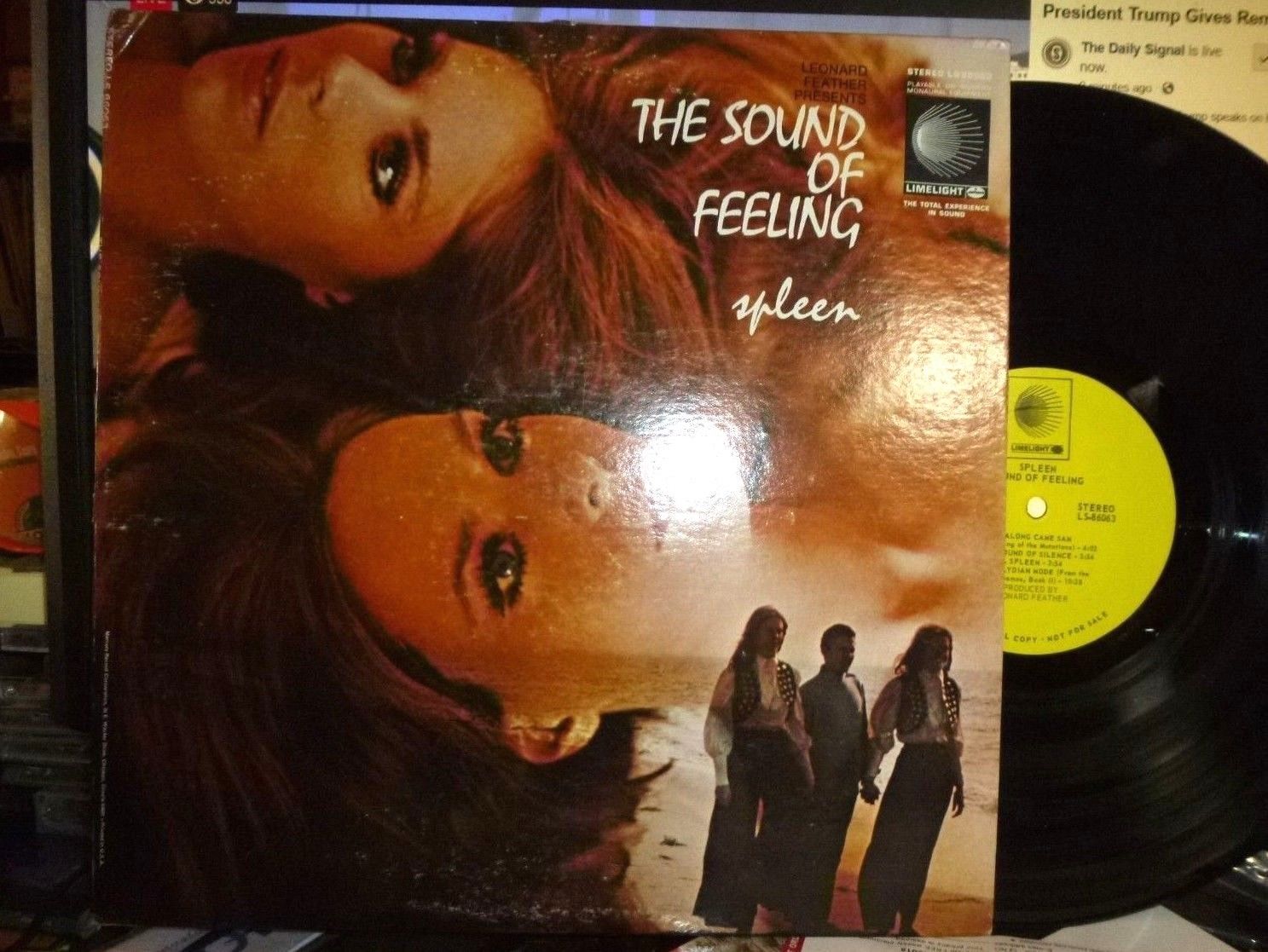
SPLEEN "The Sound Of Feeling" LP PROMO, NM/NM 1968, POP ROCK JAZZ Electronic
$
41


Favourite Auctions
To save auctions to your favourites, please login
If you don't have an account, please register
Description
he Sound Of Feeling was a group initially consisting of
multi-instrumentalist/arranger/singer Gary David and
twin sister vocalists (Alyce Bielfeldt and Rhae Bielfeldt (later Alyce and Rhae Andrece),
who met in Los Angeles in the mid-1960's.
The sisters had been trying to break as a singing duo, and had
even done a stint in Las Vegas as showgirls, whilst David had been
playing jazz in the area around San Francisco,
following his discharge from the army in 1959.
In addition to being proficient on bass, piano, and drums, he also sang and arranged.
He and the Andreces, choosing the name The Sound Of Feeling,
moved into realms of avant-garde jazz that managed to incorporate elements of pop music,
classical, and even folk sources, built around the sisters' unique, soaring vocal sound.
By 1967, amid the burgeoning psychedelic boom, The Sound Of Feeling were in
exactly the right position in relation to pop and jazz they were
heard by jazz critic/scholar Leonard Feather, who took to their innovative
approach to jazz vocalizing and put them together with Oliver Nelson.
The result was their debut album for Verve Records, with Feather producing,
supported by Nelson on soprano sax, with Ray Neapolitan (bass), Chuck Domanico (bass) and Dick Fisher (drums).
They were signed to Mercury Records following an appearance with
Duke Ellington at the Newport Jazz Festival, which
yielded their second album, "Spleen", which like its
predecessor got a Grammy Award nomination.
The sound is very groovy, with a female vocal duet, and mod swingin' jazzy lyrics.
The group continued working together until 1972 when David and the Andreces went their separate ways.
The Sound Of Feeling ?– Spleen
Label:
Limelight ?– LS 86063
Format:
Vinyl, LP, Album, Promo
Country:
US
Released:
1968
Genre:
Electronic, Jazz, Rock, Pop
Style:
Psychedelic Rock, Avantgarde
Tracklist Hide Credits
A1 Hurdy Gurdy Man
Written-By – D. Leitch*
5:27
A2 Hex
Written-By – A. Andrece*, G. David*, R. Andrece*
6:08
A3 Up Into Silence
Written-By – E.E. Cummings*, G. David*
2:02
A4 The Time Has Come For Silence
Written-By – G. David*
7:40
B1 Along Came Sam
Written-By – A. Andrece*, G. David*, R. Neapolitan*, R. Andrece*
4:02
B2 The Sound Of Silence
Written-By – P. Simon*
3:34
B3 Spleen
Written-By – G. David*, P. Verlaine*
2:54
B4 Mixolydian Mode (From The Microcosmos, Book II)
Written-By – B. Bartok*
10:28
Companies, etc.
Record Company – Mercury Record Corporation
Credits
Bass – Dave Parlato, Ray Neapolitan
Cello – Fred Katz
Drums – Maurice Miller
Harp – Gayle Levant
Liner Notes – Gary David, Leonard Feather
Producer – Leonard Feather
Soprano Saxophone, Alto Saxophone, Flute, Percussion – Joe Roccisano
Synthesizer [Moog] – Paul Beaver
Vibraphone [Microtonal], Percussion – Emil Richards
Vocals, Arranged By – Alyce Andrece, Rhae Andrece
Vocals, Piano, Arranged By – Gary David
GOLDMINE GRADING
MINT ---- It should appear to be perfect. No scuffs or scratches, blotches or stains, labels or writing, tears or splits. Mint means perfect.
NEAR MINT ---- Otherwise mint but has one or two tiny inconsequential flaws that do not affect play. Covers should be close to perfect with minor signs of wear or age just becoming evident: slight ring-wear, minor denting to a corner, or writing on the cover should all be noted properly.
VERY GOOD PLUS ---- The record has been handled and played infrequently or very carefully. Not too far from perfect. On a disc, there may be light paper scuffs from sliding in and out of a sleeve or the vinyl or some of the original luster may be lost. A slight scratch that did not affect play would be acceptably VG+ for most collectors.
VERY GOOD ---- Record displays visible signs of handling and playing, such as loss of vinyl luster, light surface scratches, groove wear and spindle trails. Some audible surface noise, but should not overwhelm the musical experience. Usually a cover is VG when one or two of these problems are evident: ring wear, seam splits, bent corners, loss of gloss, stains, etc.
GOOD ---- Well played with little luster and significant surface noise. Despite defects, record should still play all the way through without skipping. Several cover flaws will be apparent, but should not obliterate the artwork.
POOR ---- Any record or cover that does not qualify for the above "Good" grading should be seen as Poor. Several cover flaws.
price rating