Santana Abraxas Rare 1970 Columbia Records Original Press Vinyl LP w/Poster
$
50




Favourite Auctions
To save auctions to your favourites, please login
If you don't have an account, please register
Description
Welcome to Classic Cadillac Records! I visually grade all my records as accurately as possible and will never grade anything above Near Mint unless it's still sealed. Please note that a visual grade can differ from a play grade, and am happy to spot check a record upon request. All orders are shipped within 1 business day (usually sooner) and packed with extra care to ensure fast, safe arrival. Please look closely at all pictures, read all relevant details and ask any questions you may have before buying. I offer a full 30-day return policy on everything I sell, so buy with confidence! And most importantly, thanks for looking!
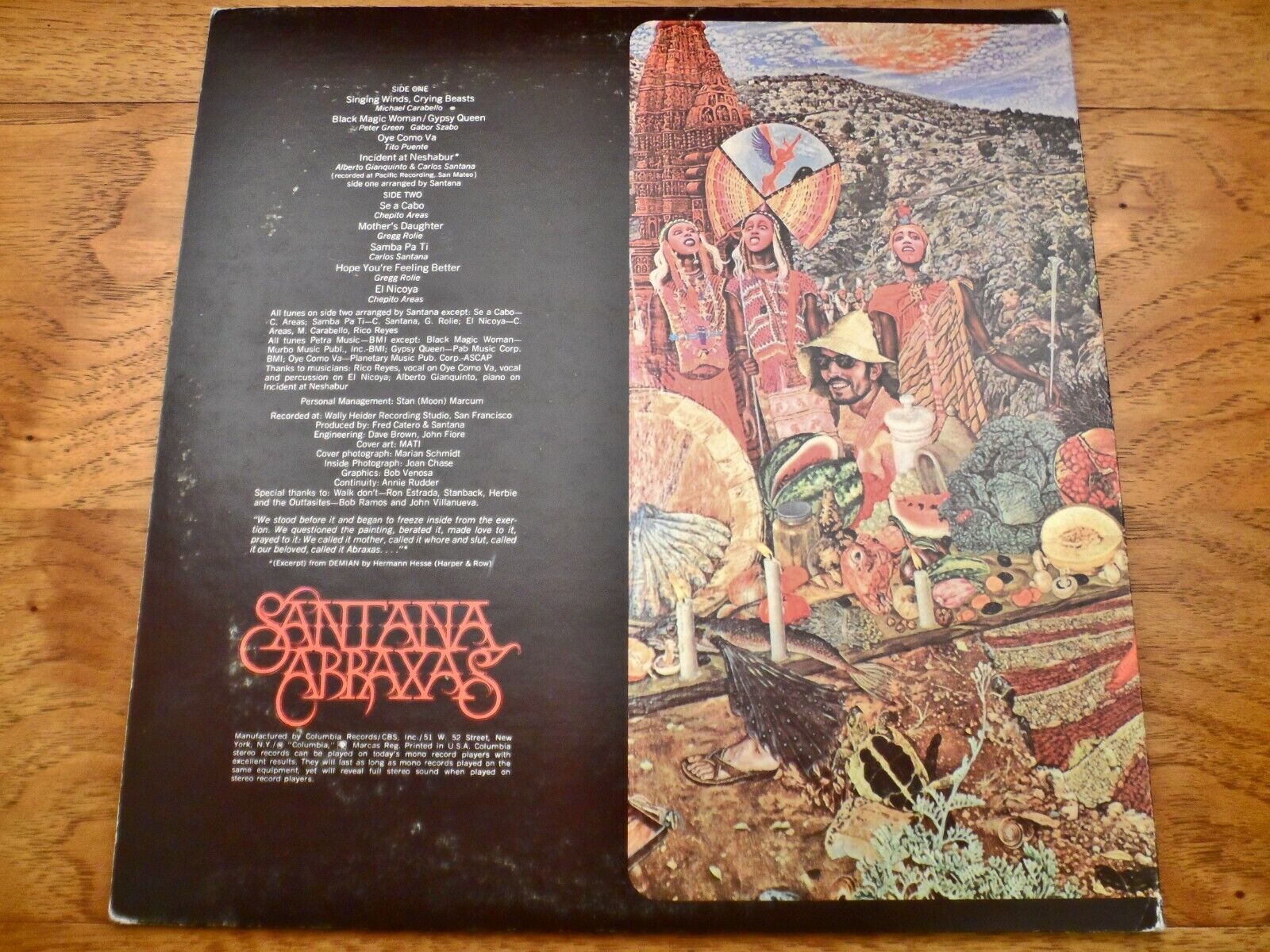
Abraxas Album cover from a painting by Mati Klarwein Studio album by Santana Released September 23, 1970 Recorded April 17–May 2, 1970 Studio Wally Heider Studios
(San Francisco, California)
Pacific Recording Studios
(San Mateo, California) Genre
- Latin rock
- Chicano rock
- jazz fusion
- psychedelic rock
- blues rock
(1969) Abraxas
(1970) Santana III
(1971) Singles from Abraxas
- "Black Magic Woman"
Released: 1970 - "Oye Como Va"
Released: 1971 - "Hope You're Feeling Better"
Released: 1971 - "Samba Pa Ti"
Released: 1973
Abraxas is the second studio album by Latin rock band Santana. It was released on September 23, 1970 by Columbia Records and became the band's first album to reach number one in the United States.
Title
The title of the album originates from a line in Hermann Hesse's book Demian, quoted on the album's back cover: "We stood before it and began to freeze inside from the exertion. We questioned the painting, berated it, made love to it, prayed to it: We called it mother, called it whore and slut, called it our beloved, called it Abraxas...."
Songs
Carlos Santana had been interested in Fleetwood Mac's leader and songwriter Peter Green, having seen him perform at the Fillmore West in San Francisco, and decided to cover the band's song "Black Magic Woman". Both were influenced as guitarists by B.B. King. The band added a cover of Gabor Szabo's instrumental "Gypsy Queen" to the end. "Oye Como Va" was a hit by Tito Puente in the early 1960s and the group played it live regularly, as they realized it was good for audiences to dance to.
"Incident at Neshabur" was co-written by Santana and his friend Alberto Gianquinto, who played piano on the track. Gregg Rolie played the other keyboards, contrasting with Gianquinto's jazz-influenced style. It ran through various time and key signatures.
The instrumental, "Samba Pa Ti" ("Samba for You"), was written by Santana after he saw a jazz saxophonist performing in the street outside his apartment. It was later covered by José Feliciano, who added lyrics, and also by Angélique Kidjo, who put lyrics in Yoruba, on her album Oyo. It is also one of the tracks featured in Nick Hornby's book 31 Songs.
Cover art
The album cover features the 1961 painting Annunciation by German-French painter Mati Klarwein. According to the artist, it was one of the first paintings he did after relocating to New York City. Carlos Santana reportedly noticed it in a magazine and asked that it be on the cover of the band's upcoming album. On the back of the record sleeve the cover art is just credited to 'MATI'. It is now considered a classic of rock album covers. Klarwein went on to design album artwork for many notable artists, including Miles Davis, Herbie Hancock, Earth, Wind & Fire, and Gregg Allman.
Critical reception
Professional ratings Review scores Source Rating AllMusic Christgau's Record Guide C+ Rolling Stone (favorable) The Rolling Stone Album Guide Encyclopedia of Popular MusicIn both 2003 and 2012, the album was ranked number 207 on Rolling Stone magazine's list of the 500 greatest albums of all time, and then at number 334 in a 2020 edition of the list. In 2000 it was voted number 202 in Colin Larkin's All Time Top 1000 Albums. The album was also included in the book 1001 Albums You Must Hear Before You Die. In 2015, the album was listed among Billboard's 50 Essential Latin Albums of the 50 Past Years.
Rock critic Robert Christgau, in one of his capsule reviews in The Village Voice, at the time of the album's release, gave it a rating of only C+, which denotes "a not disreputable performance, most likely a failed experiment or a pleasant piece of hackwork."
Legac
Abraxas was deemed "culturally, historically, or artistically significant" by the Library of Congress and was selected for preservation in their National Recording Registry in 2016.
The album is briefly mentioned in the 2009 film A Serious Man, though the film is set three years before the album was released.
Track listing
Original release
Side one No. Title Writer(s) Length 1. "Singing Winds, Crying Beasts" (Instrumental) Michael Carabello 4:51 2. "Black Magic Woman/Gypsy Queen" Peter Green/Gábor Szabó 5:24 3. "Oye Cómo Va" Tito Puente 4:17 4. "Incident at Neshabur" (Instrumental) Alberto Gianquinto, Carlos Santana 4:58 Side two No. Title Writer(s) Length 1. "Se a Cabó" José Areas 2:50 2. "Mother's Daughter" Gregg Rolie 4:25 3. "Samba Pa Ti" (Instrumental) Santana 4:45 4. "Hope You're Feeling Better" Rolie 4:10 5. "El Nicoya" Areas 1:30price rating


![Sonic Youth - Daydream Nation [ 2XLP, Goofin, NEW ] Nirvana - Radiohead](https://www.popsike.mobi/php/thumbnail.php?url=https://www.popsike.pics/pix/20141220/131383754569.jpg)