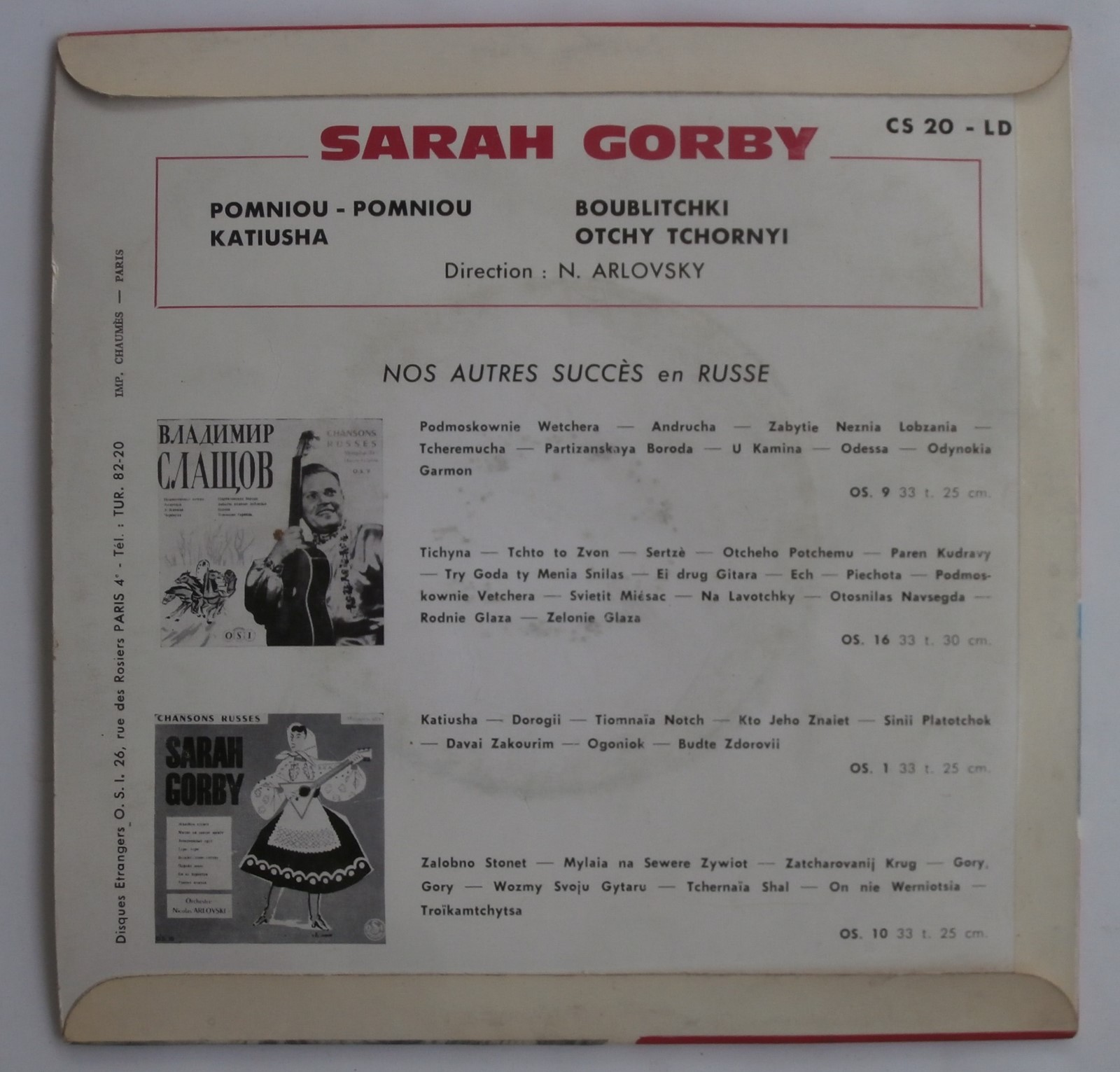
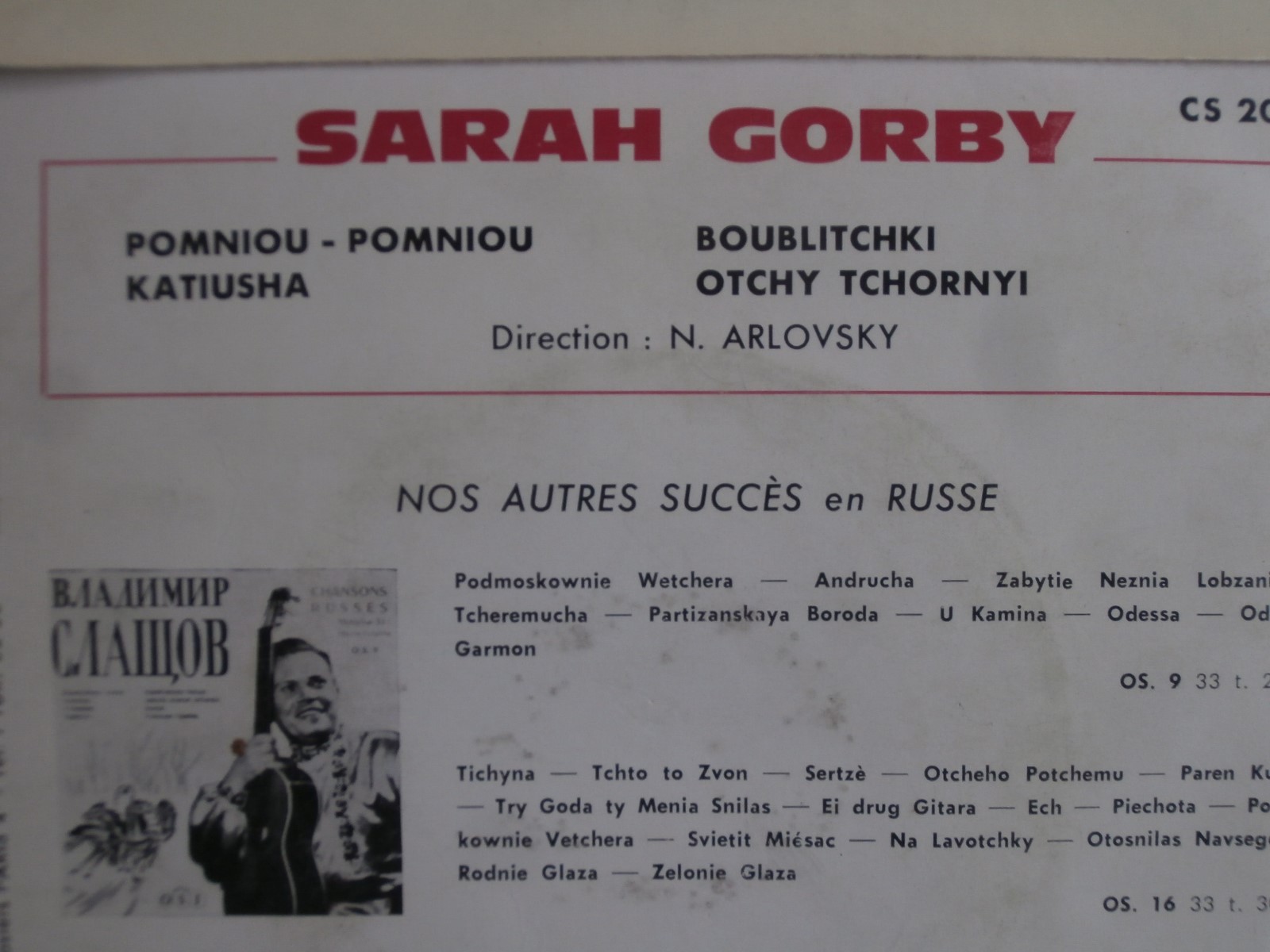
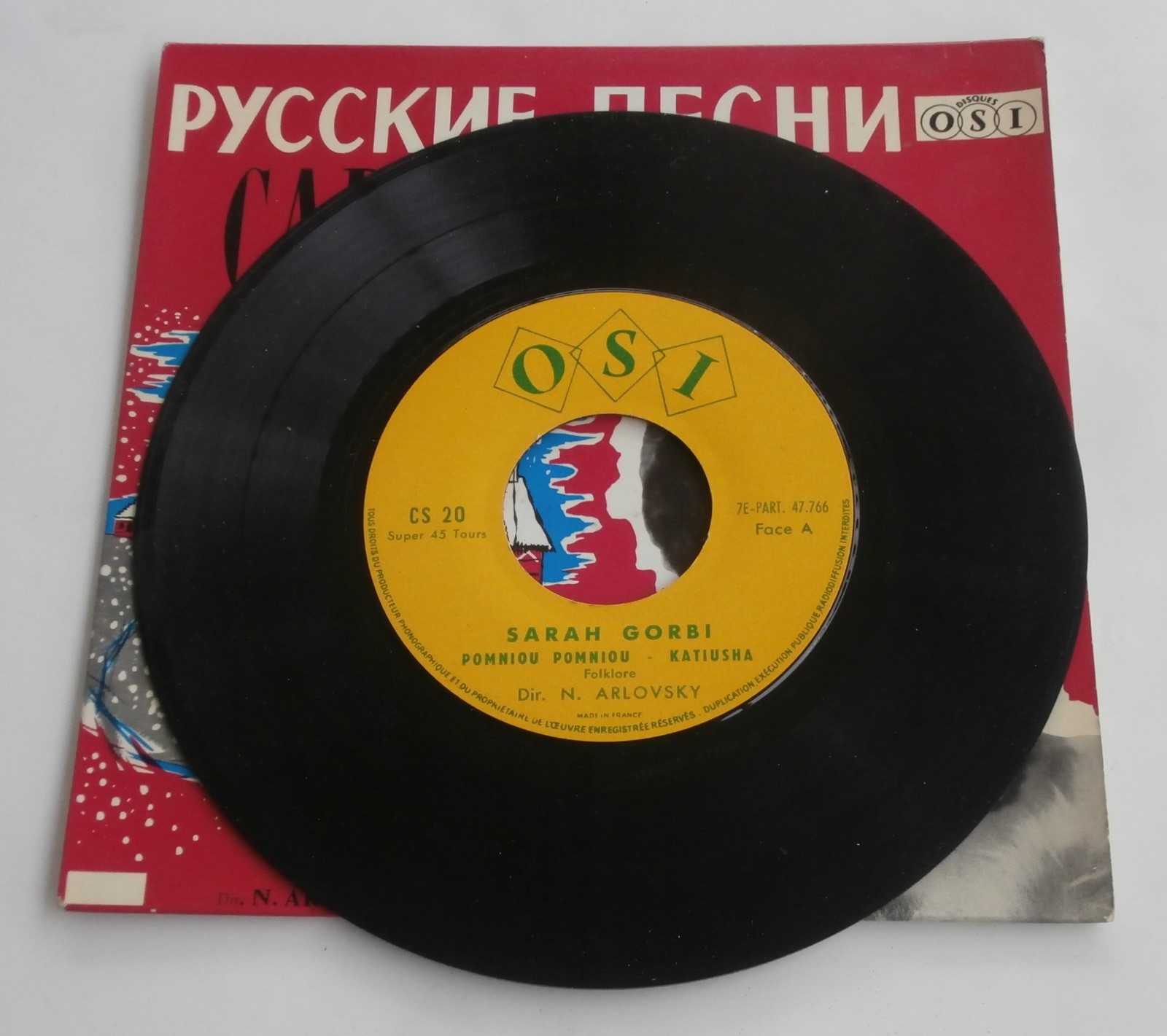
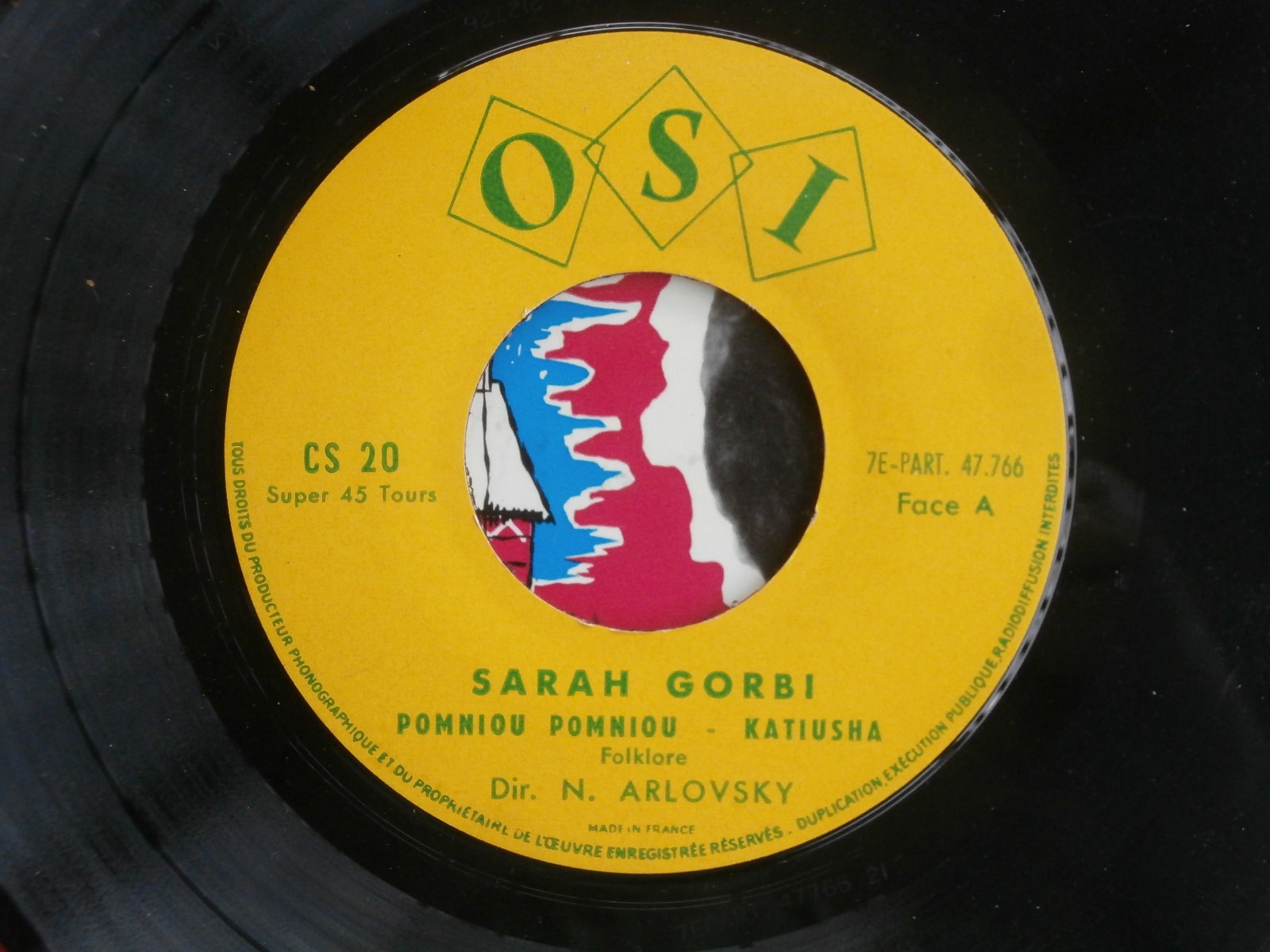
Secondhand Record For Sale Item: 7" inch record, 45 RPM EP by Sarah Gorby. I believe the title is Popular Russian and Gypsy Romances (?). “Romance songs” are also called “Gypsy songs”. From the net: “Sarah Gorby (real name Gorbach , Yiddish שׂרה ָאָרבי , Franz Sarah Gorby , 1900 , Chisinau of the Bessarabian province - 1980 , Paris ) - French pop singer ( contralto ), chansonnier . She is a popular singer of Jewish songs, Russian and Roma romances, pop pieces by Romanian , French and Soviet composers. Sarah Gorby was born in Chisinau in 1900 , in the family of Zeylik Khaimovich Gorbach ( originally from Starous Osh ) and his wife Beyla Kipelman [1] . At the age of 17, she left to study vocal skills in Iasi . After graduating from the Iasi Conservatory, she married a newspaper publisher, Joseph Goldstein, a lot older than she. According to the legend, one of the conditions that planned the singing career of Sarah Gorby was not to have children, so as not to lose her voice, as in her time she happened to the mother of Sarah, who had 7 children. After the wedding, the couple moved to Rome , and then to Paris , where they settled. Up to the beginning of the Second World War, they visited Iasi every year (where the mother of the singer lived), sometimes with a concert program. Sarah, already speaking under the stage name Gorby, became popular first of all in Latin America (at that time her main concert stage), and then in the United States (where she first arrived in December 1935 , and again in the spring of 1936 , after which Her tours in the US became regular) as an "international singer", that is, a singer singing in foreign languages (in the repertoire of the singer there were songs in 9 languages). So, on December 14, 1935, the singer performed at a ball that organized the Ladies' Society for Musicians and Artists at the Sherman Square Hotel in New York . April 5, 1936 at the hotel "Inter-Stuyvesant Hotel" The Lady's Society for Musicians and Artists organized an "intimate evening" of Sarah Gorby. In 1940, Sarah Gorby and her husband left Paris and fled to Haiti , a few years later in the United States . Here the singer continued her performances with the programs of the Jewish song and the Russian romance. So, according to the time-based Russian-language press of New York , on November 21, 1944, she performed at the Brooklyn Academy of Music in a concert of folk music and songs of Eastern Europe. May 14, 1945 took place "farewell", as it was announced, a concert of Nastya Polyakova. He went to the Club House and assembled a whole constellation of artists: Luda Bokal, Sarah Gorby, Marusya Sava , Y. Vasilevsky, F. Zarkevich, A. Kuznetsov, L. Kalbous, S. Karavaev (compere), M Mishon, V. Fomin, N. Mattei, G. Elin (grand piano). In the summer of 1945, Sarah Gorby sang in the restaurant "Casino Russe" (Casino Russe). November 19, 1945 there was an "intimate concert" by Nastya Polyakova "with the participation of friends-artists"; Vasya Fomin, the former participant of the Parisian ensemble Polyakova Luda Bokal, Senya Karavaev, Adya Kuznetsov, Lenya Kalbus, Sarah Gorby (who was regularly speaking at the restaurant "Korchma"), Misha Tsyganov and Marousia Sava took part in the concert. On December 8, the Nadezhda Mutual Society organized a concert by Sarah Gorby, M. Dalmatov and S. Korona. On December 19, Sarah Gorby, accompanied by Yugoslav guitarist Mirko Markovic, performed at the 21st annual concert-ball of the Caucasian Society. On March 9, 1946, "an artistic evening organized by the Society of people from Europe, with a big and interesting program, with the participation of the famous singer Sarah Gorby, in her international repertoire, took place in the big hall" Club House "(150 West 85th Street in Manhattan ); Lenny Kalbus - a well-known accordionist, Misha Markov - a famous guitarist. Speech by Sarah Gorby - the last this season, the artist leaves for California. " In the fall of 1947, Sarah Gorby again returned to New York after performing in Chicago and on October 31 at the Barbizon Plaza Hotel gave her first concert. In 1948, Sarah Gorby spent a touring season in Europe , giving concerts of a song in Yiddish in camps for displaced persons . In "letters from afar" the singer wrote about her impressions of what she saw: "Greetings to you from the ruined Kassel! Every human imagination pales before reality ... Terrible! She gave 23 concerts in 23 camps at 23pm! I travel in an American jeep, which shakes me to numbness " [2] . In 1949, the singer herself returned to Paris (her husband died in 1950 in Haiti). Recorded on shellac Sarah Gorby beginning no later than the beginning of the 1940s. Initially and primarily its repertoire consisted of songs by modern composers on poems by Jewish poets from different countries (including Soviet ones) writing in Yiddish , including Itzik Manger , Isroel Goichberg , Zailik Bardichever , Mordhe Gebirtig , Avrum Goldfaden , Itzik Fefer , Mani Leiba , Moyshe Kulbaka , Landau Zysze, Shmerke Kaczerginski and many others. Throughout the 1940s, these songs were published by a number of gramophone plates on 78 revolutions, mainly in the USA , accompanied by orchestras under the direction of the composer Jacques Météhen (1903-1986) and the future director of the conservatory in San Francisco Robin Laufer (Robin Laufer) . Less often performed and folk Jewish songs. Music for the poems of some poets Sarah Gorby composed herself, for example "Ovnt-lid" ( Evening Song ) on the poems of Itzik Manger. Arrangement of songs for Sarah Gorby in 1939-1943 was conducted by composer Stefan Volpe . Among the earliest recordings of Sarah Gorby, a series of 78-rpm singles in Romanian, accompanied by Doina, Nusha & Gypsy Trail Orchestra (Conductor Korneliu Kudolban). In 1946, the first records of Sarah Gorby in Russian , made in the USA-traditional songs, Russian folk songs, and later songs of Soviet composers - Matvei Blanter ( Katyusha ), Isaak Dunaevsky , Nikita Bogoslovsky (" Dark Night "), Tikhon Khrennikov (" There is a good town in the north "), front-line songs from the repertoire of Claudia Shulzhenko (" The Blue Handkerchief "," Let's light "), urban romances from the repertoire of her countryman Petr Leshchenko (" Gipsy Life " good boy "," Miracle miracles "), tsyg nskie romances ( "Burn, burn, love gypsy") and others. She also performed the songs of contemporary emigre authors, for example, Vasily Fomin ("All embarrassed"), and also wrote her own songs, but mostly in Yiddish (for example, "Bessarabia" and "Freilekhs"). Many of these records are made accompanied by an ensemble under the supervision of guitarist N. S. Orlovsky (Nicholas Arlofsky Ensemble), accompanied by which recorded and most of the Jewish songs. After the formation of the state of Israel, Gorby began to perform Israeli songs in Hebrew , accompanied by the orchestra Didier Boland et son orchestre, left numerous recordings of medieval Sephardic folk songs in ladino, accompanied by the Spanish guitarist Jose Luis (Jose Luis) and the French jazz guitarist Jean Bonalya (Jean Bonal), compositions of contemporary Romanian and French pop. In the 1950s, the long-playing records of Sarah Gorby began to appear on the labels Philips, Arion, OSI Disques, Barclay Disques, Galton and others, the old recordings on 78 revolutions of Melotone were transferred to a new long-playing record format. At the same time, for the first time, tape recordings of Sara Gorby's songs in the USSR appeared. In 1953 she was awarded le grand prix du disque. In 1960, she undertook a two-year tour in South America , during which three long-playing records of Jewish songs, Russian and Gypsy romances were also recorded in Buenos Aires (Recitative of Jewish Folk Songs, Russian Tavern and Sarah Gorby in unforgettable creations "). In these records, the orchestras were led by the Canadian - Argentine conductor Jascha Galperin and S. de Palma, and arrangements were made by the composer Jorge Andreani. In 1966 the Philips record company produced a gramophone record of the songs of the tragic period of the Holocaust in Yiddish (including the partisan hymn of Hirsch Glick), later reissued on a CD. Then there are two more LPs in Russian with such songs as "And who knows", "Valenki" , " Bublychki ", "Mishka", "Roads", "Seryozhka with Malaya Bronnaya" ("Muscovites"), "Hands "," Do not tell me about him "," Asters autumn "," The bell rings under the arc "," The lights are distant ", accompanied by the orchestra Georges Streha (Georges Streha). The last records of Sarah Gorby were made in 1979 . In the 1990s, a number of old Yiddish songs, Russian and Roma songs, Sephardic songs were digitized and republished on two compact discs by Arion companies in France and Philips in the US. The songs performed by Sarah Gorby were used in the soundtrack of the film "Onegin" directed by Martha Fiennes with Rafe Fiennes and Liv Tyler in the lead roles (1999). The Sarah Gorby Prize is awarded to artists whose works are related to the Yiddish language (among the awardees are the Israeli composer Daniel Galai and the poet Lev Berinsky ). In 1987, Ellen Prins , professor of linguistics at the University of Pennsylvania, Ellen Prins, published a frequently cited sociolinguistic quantitative analysis of the chronological changes in phonology of spoken Yiddish in the Sarah Gorby phonographic repertoire (see Prince, EF 1987. Sarah Gorby, Yiddish Folksinger: A Case Study of Dialect Shift. Sociology of Language 67: 83-116), demonstrating the consistent, gradual replacement of specifically Bessarabian language features from the singer's language, which basically did not affect, however, the class of closed words (prepositions, conjunctions and pronouns). [3] It should be noted that Sarah Gorby was probably the only performer of the Jewish song, which used a Bessarabian dialect of the Hebrew language , rather than the generally accepted theater standard.” Record will be carefully/responsibly packed. Please see my listings for other desirable titles! Returns: If an item is deemed “not as described” due to such circumstances as shipping damage or seller’s incorrect description of the item’s condition, it falls under the realm of the eBay Money Back Guarantee. The reason why I don’t have a return policy in addition to the eBay Money Back Guarantee is that return policies cover all other reasons for return (such as the buyer simply changing their mind) but they also require the seller to pay for shipping, which is an expense that I cannot afford, especially in the case of an international transaction. International Shipping: I sympathize with int’l buyers regarding shipping charges and their country’s Customs fees, but because the value must be declared in order to insure the item for that amount, I’m unable to satisfy the expectations of most buyers in certain countries. If you’re an exception, all you need to do is let me know and hopefully we can work together! Condition: Records may not function as intended per surface noise, defective playback due to manufacturing defect or scratches, etc. and any extant sleeves/covers often have damage such as flawed edges and odors which may require repair or treatment, so I’m selling the item as being in “For parts or not working” condition. Most records are in scratched condition. See Goldmine Record Album Price Guide, 5th Edition, page 17: “It’s estimated that no more than 2 to 4 percent of all records remaining from the 1950’s and 1960s are truly Near Mint” (and the next grade down from Near Mint is VG+, where light scratches are present). It amazes me that the world of record collecting doesn’t have an official grading company such as in the comic book field (they have CGC), the coin collecting realm (they have PCGS), etc. Until an official 3rd party industry expert comes along, record grading remains subjective and opinions vary due to parties’ differences in audio equipment, etc. CUSTOMER SERVICE Most of the items I offer here on eBay are from estates in the Philadelphia / NYC area, and are fresh to the market. If you have any questions, need more info, or want to set up a Preview appointment, please feel welcome to message me and I'll respond in a timely manner. Thanks for your interest, ~Chris



![Prince & the Revolution - Chaos And Disorder [New Vinyl LP] Explicit](https://www.popsike.mobi/php/thumbnail.php?url=https://www.popsike.pics/pix/20190918/153647027653.jpg)