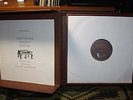
Schnabel - Beethoven Society Edition - 32 Sonatas - NM
$
300


Favourite Auctions
To save auctions to your favourites, please login
If you don't have an account, please register
Description
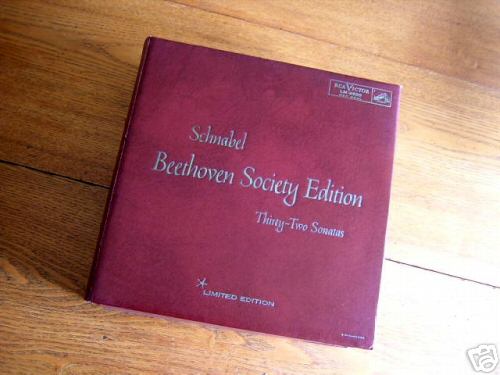
Beethoven's 32 Sonatas - Limited Edition 13 LP Leather Bound Box Set - RCA Victor Red Seal LM-9500 - Arthur Schnabel, 1956.
Comes with: Beethoven, Ludwig Van. 32 Sonatas For The Pianoforte. Memorial Edition Edited By Arthur Schnabel. In 2 Volumes.
Simon Schuster, 1935. 4to, original stiff printed wrappers. 862pp. 12th Printing of Vol. 1 and 11th Printing of Vol. 2. Fine copies in chipped tissue jackets.
Condition:
Box Set Packaging: VG+
LPs: NM
Music Volumes: NM/M
Critical reviews:
Beethoven: The 32 Sonatas Artur Schnabel (EMI: London, 1932-35)
Evening Standard (London), Jun 1, 2005 by NORMAN LEBRECHT
OF ALL the great pianists of the early 20th century, Artur Schnabel was the last to embrace recording, arguing that it was unmusical to perform without having eyecontact with listeners. And it ran against the ephemeral nature of music to set in shellac an interpretation that might change according to his mood, the weather, or an article he had read in the newspaper.
Schnabel acquiesced in 1932, agreeing to record the 32 Beethoven sonatas, in his own edition, stipulating that they were to be sold only on subscription. He entered Abbey Road with pronounced reluctance, demanding all kinds of diversions to make him imagine there was an audience involved with his work.
The result was a cycle so fresh that it continues to astonish. Small of hand as he was broad of mind, Schnabel was the antipode of the brilliant virtuoso who tosses off cascades of notes with unerring accuracy. In the mountainous spans of the Hammerklavier Sonata, opus 106, he can be heard struggling to reach tops and bottoms. He scatters wrong notes like confetti - and, in so doing, he reflects the superhuman scope of Beethoven's ambition more cogently than any other pianist. This is a road map to the composer's mind. NL
(c)2005. Associated Newspapers Ltd.. Provided by ProQuest Information and Learning Company. All rights Reserved.
BEETHOVEN'S SONATAS REMAIN A PIANISTIC EVEREST
By TIM PAGE Published: November 17, 1985Speak to a keyboard player of ''the 48'' and it will immediately be understood that you refer to the 48 preludes and fugues that make up Bach's ''Well Tempered Clavier.'' Only one other body of work in the piano repertory commands a similar distinction - ''the 32'' - Beethoven's canon of piano sonatas.
Composed between 1794 and 1821, Beethoven's sonatas set not just one single standard but several - from the brilliant early fulfillments of formulas established by Haydn and Mozart, through the heaven-storming popular favorites of the composer's middle period, on through the spare, magnificently self-confident questings of his final years.
Yet to divide Beethoven into tidy categories is not only to diminish him, but also misleading. For there are mysteries aplenty in early Beethoven. What drama we find in a work like the Sonata No. 7 in D minor (Op. 10, No. 3) and how it must have startled audiences in 1798 when it was first performed! And the late works are not pure, monolithic enigma -the second movement of Opus 90, for instance, is as serene and songful as anything in Beethoven's early quartets.
It is now 50 years since Artur Schnabel completed his historic Beethoven Society recording of the complete sonatas, the standard by which all subsequent performances have been judged. These performances are prized for their intelligence and inner repose rather than for technical command (there was no tape splicing in those days, and the master hit his share of clinkers). Schnabel's disks have been in and out of the American catalogue many times - on RCA Victor, on Angel and, most recently, on Seraphim; they remain available on import.
It was considered a small miracle when Schnabel completed his survey; since then, the miracle has become commonplace, with distinguished sets from Backhaus, Kempff, Arrau, Brendel and Claude Frank, among others. Now two more editions have entered the market - one brand new, the other a reissue of a classic recording made about 30 years ago.
Daniel Barenboim, only 45 years old, has now completed his second traversal of the Sonatas (Sonatas No. 1-15, Deutsche Grammophon DG 413 759-1, six disks; Sonatas No. 16-32, Deutsche Grammophon 413 766-1, six disks; 413-759-2 and 413-766-2 compact disks). Mr. Barenboim approaches Beethoven with such solemn reverence that his readings seem uniformly heavy and ponderous. This is the stern, forbidding Beethoven of the scowling countenance. The music is never allowed to sing, unfettered; Beethoven's melodies are broken up all along the line with hundreds of little italicizations, luftpausen and unnecessary inner voices - it is as if Mr. Barenboim were pointing out earthshaking revelations all along the way, even in the most modest little scherzos. Seriousness should never be equated with profundity; the bawdy humor of, say, the ''Canterbury Tales'' is at least as meaningful as the musings of a gloomy existentialist philosopher. These performances, while technically assured and well recorded, can only be recommended to those who put their art on a pedestal, and refuse to laugh with Shakespeare and Joyce.
What a relief to turn to Yves Nat's 30-year-old set on EMI, now available here for the first time (EMI References 1109 213, 11 disks, available from International Book and Record, 40-11 24th St., Long Island City, New York 11101). Here is God's plenty -Beethoven in all his craggy, vital glory. Nat, who lived from 1890 to 1956, was, after Cortot, the most celebrated French pianist of his time; Proust once wrote that Nat's playing ''was that of so great a pianist that one no longer knows if he is a pianist at all; for it becomes so transparent, so filled with what he performs, that he disappears from view and is no more than a window giving on to the masterpiece.'' Nat's playing is quirky, sometimes jangling and not always entirely technically adept. But one never doubts that these are the interpretations of a great musician; Nat's playing goes right to the essence of each measure and movement, yoking them together with consummate mastery.
Not all of the nicknames that have been affixed to the most popular sonatas were actually fashioned by the composer; Beethoven would be mystified by references to the ''Moonlight Sonata.'' Richard Goode has now recorded seven sonatas on a three-record set (Book of the Month Club Records 71-7506; cassettes 81-7507; compact disks 31-7510) and all but two of them have nicknames. (For the record, they are Opus 13 - the ''Pathetique''; Opus 27, No. 2 - the ''Moonlight''; Opus 28 - the ''Pastoral''; Opus 31, No. 2 - the ''Tempest''; Opus 81a - ''Les Adieux''; Opus 79 and Opus 90). This is straightforward music-making, sweet and energetic, with few eccentricities or flashes of blazing temperament. Call it first-class generic Beethoven playing - and I mean that as a compliment.
It is rather unfortunate that Peter Serkin, whom I consider one of the finest homegrown American pianists since William Kapell, should be recording the Beethoven sonatas on the fortepiano. Questions of musical authenticity aside, the fortepiano seems more limited than a modern piano - in its action, in its tone, in its ultimate esthetic appeal. Still, it is true that the sound of the instrument more closely approximates what Beethoven actually heard than would a modern grand.
Despite the closeted sound of his instrument, Mr. Serkin's latest recording - of Beethoven's Sonata No. 29 ''Hammerklavier'' (Pro Arte PAD 181; PCD 181 compact disk) - can be recommended. Mr. Serkin plays with enormous skill and sensitivity. He has a distinct way with Beethoven, as earlier recordings (on both period and modern instruments) have proved, playing directly and without sentiment, but with a searching intelligence and passion that helps one hear the music anew.
On Mar-27-07 at 08:27:48 PDT, seller added the following information:
My rating system:
M = Mint. Unopened,still factory sealed.
NM = Opened, but with no visible imperfections. Handled with great care and played rarely if at all.
VG++ = May have superficial signs of use that don't affect play. Only well cared for records will grade out to VG++.
VG+ = Vinyl may show slight signs of wear and may have slight scuffs or light scratches that don't affect the sound. The cover may have slight signs of wear.
VG = Surface noise will be noticeable,but will not overpower the music.The cover may have writing,tape or stickers,but not all three.
G = This album can play through without skipping,but there will be significant surface noise and scratches.The cover may have splits,writing,tape,or stickers on it.
Please check my other auctions - Dozens of classical records now for sale!