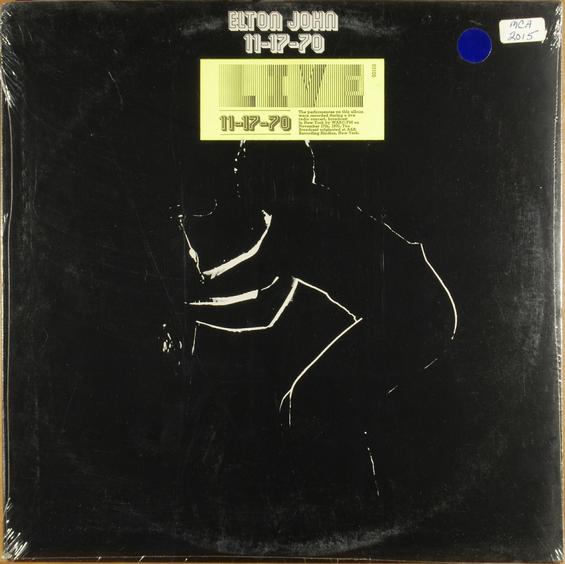
Sealed LP: Elton John: 11/17/197
$
27


$ 27
Sold For
Feb 27, 2010
Sold Date
Feb 20, 2010
Start Date
$ 25
Start price
2
Number Of Bids
USA
Country Of Seller
eBay
Auctioned at
Favourite Auctions
To save auctions to your favourites, please login
If you don't have an account, please register
Description
Elton John: 11/17/197
FACTORY SEALED LP
Format: Sealed LPRecord Company/Release Number: Uni: 9315
Bar Code: NONE
Original release date: 1971 (The original release date is not intended to reflect the year this record was actually pressed.)
Country: U.S.A.
Condition of the cover: Mint
Condition of the record: Sealed - Assumed Mint
Shipping Weight: 1 pounds, 0 ounces
Opening bid: 24.99
Inventory number: 206073
Notes: Sticker on the shrink wrap as shown in the photo below. Please contact me if you have any difficulty viewing the photos.
Songs:
- Bad Side of the Moon
- Amoreena
- Take Me to the Pilot
- Sixty Years On
- Honky Tonk Women
- Can I Put You On
- Burn Down the Mission/My Baby Left Me/Get Back
- Steve Brown: Coordination
- Brian Dee: Keyboards
- Joe Disabato: Coordination
- Gus Dudgeon: Producer, Liner Notes
- David Hentschel: Engineer
- Elton John: Keyboards, Vocals
- David Larkham: Design, Photography
- Dee Murray
- Nigel Olsson
- Phil Ramone: Engineer
- John Tobler: Liner Notes
- The great thing about this early live record is its obscurity — not just that this isn't one of his better-known records, but that the set list is a fanboy's dream, heavy on album tracks, covers, and the kinds of song that make Elton John's early work so individual. It's not just that there are no hits here, but it's that these six (seven, on the CD reissue) songs emphasize the spare, hard-rocking bluesy singer/songwriter that may not have written his own words, but always sang them with conviction and melodies that made them seem like his own. This may be a minor effort in his catalog, but that's part of its pleasure — it's certainly a record from the time before Elton the superstar, as he tears through Tumbleweed Connection tracks prior to the record's release, does a phenomenal reworking of "Honky Tonk Women," hauls out B-sides like "Bad Side of the Moon," and gives a fierce, infectious performance. It's not essential for anyone but obsessives, but if you want any indication of what Elton sounded like prior to his big break, this is an excellent, even intoxicating, summary.
- In terms of sales and lasting popularity, Elton John was the biggest pop superstar of the early '70s. Initially marketed as a singer/songwriter, John soon revealed he could craft Beatlesque pop and pound out rockers with equal aplomb. He could dip into soul, disco, and country, as well as classic pop balladry and even progressive rock. His versatility, combined with his effortless melodic skills, dynamic charisma, and flamboyant stage shows, made him the most popular recording artist of the '70s. Unlike many pop stars, John was able to sustain his popularity, charting a Top 40 single every single year from 1970 to 1996. During that time, he had temporary slumps in creativity and sales, as he fell out of favor with critics, had fights with his lyricist, Bernie Taupin, and battled various addictions and public scandals. But through it all, John remained a remarkably popular artist, and many of his songs -- including "Your Song," "Rocket Man," "Goodbye Yellow Brick Road," and "Don't Let the Sun Go Down on Me" -- became contemporary pop standards.
- The son of a former Royal Air Force trumpeter, John was born Reginald Kenneth Dwight in 1947. Dwight began playing piano at the age of four, and when he was 11, he won a scholarship to the Royal Academy of Music. After studying for six years, he left school with the intention of breaking into the music business. In 1961, he joined his first band, Bluesology, and divided his time between playing with the group, giving solo concerts at a local hotel, and running errands for a London publishing house. By 1965, Bluesology was backing touring American soul and R&B musicians like Major Lance, Doris Troy, and the Bluebells. In 1966, Bluesology became Long John Baldry's supporting band and began touring cabarets throughout England. Dwight became frustrated with Baldry's control of the band and began searching for other groups to join. He failed his lead vocalist auditions for both King Crimson and Gentle Giant before responding to an advertisement by Liberty Records. Though he failed his Liberty audition, he was given a stack of lyrics left with the label courtesy of Bernie Taupin, who had also replied to the ad. Dwight wrote music for Taupin's lyrics and began corresponding with him through mail. By the time the two met six months later, Dwight had changed his name to Elton John, taking his first name from Bluesology saxophonist Elton Dean and his last from John Baldry.
- John and Taupin were hired by Dick James to become staff songwriters at his fledgling DJM in 1968. The pair collaborated at a rapid rate, with Taupin submitting batches of lyrics -- he often wrote a song an hour -- every few weeks. John would then write music without changing the words, sometimes completing the songs in under a half-hour. Over the next two years, the duo wrote songs for pop singers like Roger Cook and Lulu. In the meantime, John recorded cover versions of current hits for budget labels to be sold in supermarkets. By the summer of 1968, he had begun recording singles for release under his own name. Usually, these songs were more rock- and radio-oriented than the tunes he and Taupin were giving to other vocalists, yet neither of his early singles for Phillips, "I've Been Loving You Too Long" and "Lady Samantha," sold well. In June of 1969, he released his debut album for DJM, Empty Sky, which received fair reviews, but no sales.
- For his second album, John and Taupin hired producer Gus Dudgeon and arranger Paul Buckmaster, who contributed grandiose string charts to Elton John. Released in the summer of 1970, Elton John began to make inroads in America, where it appeared on MCA's Uni subsidiary. In August, he gave his first American concert at the Troubadour in Los Angeles, which received enthusiastic reviews, as well as praise from Quincy Jones and Leon Russell. Throughout the fall, Elton John continued to climb the charts on the strength of the Top Ten single "Your Song." John followed it quickly in February 1971 with the concept album Tumbleweed Connection, which received heavy airplay on album-oriented radio in the U.S., helping it climb into the Top Ten. The rapid release of Tumbleweed Connection established a pattern of frequent releases that John maintained throughout his career. In 1971, he released the live 11-17-70 and the Friends soundtrack, before releasing Madman Across the Water late in the year. Madman Across the Water was successful, but John achieved stardom with the follow-up, 1972's Honky Chateau. Recorded with his touring band -- bassist Dee Murray, drummer Nigel Olsson, and guitarist Davey Johnstone -- and featuring the hit singles "Rocket Man" and "Honky Cat," Honky Chateau became his first American number one album, spending five weeks at the top of the charts.
- Between 1972 and 1976, John and Taupin's hit-making machine was virtually unstoppable. "Rocket Man" began a four-year streak of 16 Top 20 hits in a row; out of those 16 -- including "Crocodile Rock," "Daniel," "Bennie and the Jets," "The Bitch Is Back," and "Philadelphia Freedom" -- only one, the FM hit "Saturday Night's Alright for Fighting," failed to reach the Top Ten. Honky Chateau began a streak of seven consecutive number one albums -- Don't Shoot Me I'm Only the Piano Player (1973), Goodbye Yellow Brick Road (1973), Caribou (1974), Greatest Hits (1974), Captain Fantastic and the Brown Dirt Cowboy (1975), Rock of the Westies (1975) -- that all went platinum. John founded Rocket, a record label distributed by MCA, in 1973 in order to sign and produce acts like Neil Sedaka and Kiki Dee. John didn't become a Rocket recording artist himself, choosing to stay with MCA for a record-breaking eight-million-dollar contract in 1974. Later in 1974, he played and sang on John Lennon's number one comeback single "Whatever Gets You Through the Night," and he persuaded Lennon to join him on-stage at Madison Square Garden on Thanksgiving Day 1974; it would prove to be Lennon's last live performance. The following year, Captain Fantastic became his first album to enter the American charts at number one. After its release, he revamped his band, which now featured Johnstone, Quaye, Roger Pope, Ray Cooper, and bassist Kenny Passarelli; Rock of the Westies was the first album to feature this lineup.
- Throughout the mid-'70s, John's concerts were enormously popular, as were his singles and albums, and he continued to record and perform at a rapid pace until 1976. That year, he revealed in an interview in Rolling Stone that he was bisexual; he would later admit that the confession was a compromise, since he was afraid to reveal that he was homosexual. Many fans reacted negatively to John's bisexuality, and his audience began to shrink somewhat in the late '70s. The decline in his record sales was also due to his exhaustion. After 1976, John cut his performance schedule drastically, announcing that he was retiring from live performances in 1977 and started recording only one album a year. His relationship with Taupin became strained following the release of 1976's double album Blue Moves, and the lyricist began working with other musicians. John returned in 1978 with A Single Man, which was written with Gary Osborne; the record produced no Top 20 singles. That year, he returned to live performances, first by jamming at the Live Stiffs package tour, then by launching a comeback tour in 1979 accompanied only by percussionist Ray Cooper. "Mama Can't Buy You Love," a song he recorded with Philly soul producer Thom Bell in 1977, returned him to the Top Ten in 1979, but that year's Victim of Love was a commercial disappointment.
- John reunited with Taupin for 1980's 21 at 33, which featured the Top Ten single "Little Jeannie." Over the next three years, John remained a popular concert artist, but his singles failed to break the Top Ten, even if they reached the Top 40. In 1981, he signed with Geffen Records and his second album, Jump Up!, became a gold album on the strength of "Blue Eyes" and "Empty Garden (Hey Hey Johnny)," his tribute to John Lennon. But it was 1983's Too Low for Zero that began his last great streak of hit singles, with the MTV hit "I'm Still Standing" and the Top Ten single "I Guess That's Why They Call It the Blues." Throughout the rest of the '80s, John's albums would consistently go gold, and they always generated at least one Top 40 single; frequently, they featured Top Ten singles like "Sad Songs (Say So Much)" (1984), "Nikita" (1986), "Candle in the Wind" (1987), and "I Don't Want to Go on with You Like That" (1988). While his career continued to be successful, his personal life was in turmoil. Since the mid-'70s, he had been addicted to cocaine and alcohol, and the situation only worsened during the '80s. In a surprise move, he married engineer Renate Blauel in 1984; the couple stayed married for four years, although John later admitted he realized he was homosexual before his marriage. In 1986, he underwent throat surgery while on tour, but even after he successfully recovered, he continued to abuse cocaine and alcohol.
- Following a record-breaking five-date stint at Madison Square Garden in 1988, John auctioned off all of his theatrical costumes, thousands of pieces of memorabilia, and his extensive record collection through Sotheby's. The auction was a symbolic turning point. Over the next two years, John battled both his drug addiction and bulimia, undergoing hair replacement surgery at the same time. By 1991, he was sober, and the following year, he established the Elton John AIDS Foundation; he also announced that he would donate all royalties from his single sales to AIDS research.
- In 1992, John returned to active recording with The One. Peaking at number eight on the U.S. charts and going double platinum, the album became his most successful record since Blue Moves and sparked a career renaissance for John. He and Taupin signed a record-breaking publishing deal with Warner/Chappell Music in 1992 for an estimated 39 million dollars. In 1994, John collaborated with lyricist Tim Rice on songs for Disney's animated feature The Lion King. One of their collaborations, "Can You Feel the Love Tonight," won the Academy Award for Best Original Song, as well as the Grammy for Best Male Pop Vocal Performance. John's 1995 album Made in England continued his comeback, peaking at number three on the U.K. charts and number 13 in the U.S.; in America, the album went platinum. The 1997 follow-up, The Big Picture, delivered more of the same well-crafted pop, made the Top Ten, and produced a hit in "Something About the Way You Look Tonight." However, its success was overshadowed by John's response to the tragic death of Princess Diana -- he re-recorded "Candle in the Wind" (originally a eulogy for Marilyn Monroe) as a tribute to his slain friend, with Taupin adapting the lyrics for what was planned as the B-side of "Something About the Way You Look Tonight."
- With the profits earmarked for Diana's favorite charities, and with a debut performance at Diana's funeral, "Candle in the Wind 1997" became the fastest-selling hit of all time in both Britain and the U.S. upon the single's release, easily debuting at number one on both sides of the Atlantic; with first-week sales of over three million copies in the U.S. alone and 14 weeks in the top spot, it was John's biggest hit ever. For his next project, John reunited with Lion King collaborator Tim Rice to write songs for Disney's Broadway musical adaptation of the story of -Aida; an album of their efforts featuring a who's who of contemporary pop musicians was released in early 1999, going gold by the end of the year. In late 2000, John landed a TV special with CBS, performing a selection of his greatest hits at Madison Square Garden; a companion album drawn from those performances, One Night Only, was issued shortly before the special aired. 2001's Songs from the West Coast was a return to form for John, who found critical success for the first time since the '80s. However, it wasn't until 2004's popular Peachtree Road album that he managed to match that success commercially. In 2006, John and Taupin released The Captain & the Kid, a sequel to 1975's Captain Fantastic and the Brown Dirt Cowboy.
FINE PRINT
- All pictures are of the exact item being sold.
- This record was from a record store called "Phantasmagoria" that was located in Allentown, Pennsylvania. Phantasmagoria went out of business in 1978. I purchased their leftover inventory some years later when I owned a new & used record store in Catasauqua called "Music Madness". Music Madness is still listed in the phone book if you want to try to contact me.
- Phantasmagoria used round colored stickers to indicate the price of the albums. They had a sign on the wall with the color sticker combinations for the customers to use so they knew the price of the albums. Most of the albums still have these stickers on them, and in some rare cases, the stickers are written on.
- Your item(s) will be shipped the next business day after I receive your payment.
- I always leave feedback before your item ships. Please consider leaving feedback for me after you have had a chance to inspect and enjoy this item.
- Please avoid questions on the last day of the auction. I might not have enough time to give you an answer before the auction ends.
- Payment by PayPal only (except for items when local pick-up has been arranged).
- All album reviews, credits and artist biographies are from All Music Guide. If you haven't been to their web site, you have to check it out. It's one of the most comprehensive music references on the internet. In some cases, credits may include reissue (CD) information. Obviously any credits referenced to CDs do not apply to these album releases.
- All sealed albums are being sold as collector's items and cannot be returned due to manufacturer's defects. It may be almost impossible to replace many of the sealed albums that I am selling.
- IT IS NOT MY INTENTION TO MAKE A PROFIT ON THE POSTAGE. ANY ACCIDENTAL OVERCHARGE GREATER THAN $1 WILL BE REFUNDED TO YOU.
Shipping
Domestic (U.S.A.) buyers:- Pick-up is fine with me. Just be prepared to pay by cash. No shipping fees apply. E-mail me to setup a time that is convenient for the both of us.
- All uninsured and underinsured shipments are the responsibility of the buyer.
- I have started to add a $1.00 "handling fee" which is to help defray the cost of a new mailing box. This is approximately what I pay for them from BagsUnlimited. If you opt to have your record(s) shipped by Priority Mail, I will refund the dollar since the box from the Post Office is free. If don't chose Priority Mail and you feel that the dollar is unfair, let me know so I can refund it. Upon refunding your dollar, I will package your album(s) in an "almost new" mailer which was used to send a record to me.
- Foreign buyers must pay with US dollars through PayPal only. Please do not send cash - it's too risky.
- SHIPPING: I will send an invoice with options for the cost of shipping after the auction ends. You will have the choice of the following two options:
- USPS First Class International: Estimated delivery time to most countries is about 10-30 days. (Customs may delay delivery)
- USPS Priority Mail International: Estimated delivery time to most countries is about 6-10 days. (Customs may delay delivery)
- All uninsured and underinsured shipments are the responsibility of the buyer.
- I have started to add a $1.00 "handling fee" which is to help defray the cost of a new mailing box. This is approximately what I pay for them from BagsUnlimited. If you opt to have your record(s) shipped by Priority Mail, I will refund the dollar since the box from the Post Office is free. If don't chose Priority Mail and you feel that the dollar is unfair, let me know so I can refund it. Upon refunding your dollar, I will package your album(s) in an "almost new" mailer which was used to send a record to me.
- The buyer is responsible for all customs regulations and fees in their own country.
- You can go to the USPS International Postage Calculator to approximate the cost of your postage. The shipping weight for this record is listed near the beginning of this listing. If you are purchasing multiple records and need to manually calculate the postage, subtract 8 ounces for each additional record.
If you also collect Grand Funk, let me know if you have anything that you might want to sell or trade. I am always looking to add something new to my collection.
Counter by AuctionTamer
price rating