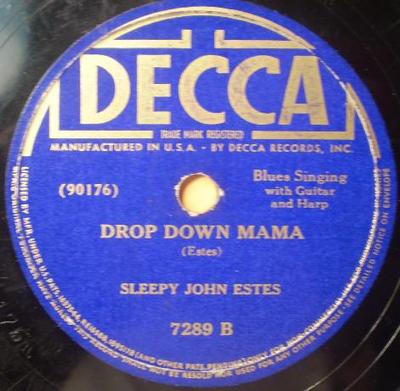
Sleepy John Estes on Decca 7289 - Drop Down Mama, Married Woman Blues w/ Harp
$
153


Favourite Auctions
To save auctions to your favourites, please login
If you don't have an account, please register
Description
for your consideration...
Sleepy John Estes on Decca 7289
Drop Down Mama, Married Woman Blues
Unbelievable Vocal and Guitar w/ Unbelievable Harp
V+ Nice playing Copy with thin background noise, a great old timey country blues performance on great 78rpm.
Good not great gloss, some scuffs and scrapes, its been played, but nothing too deep.
Please note: I try to grade conservatively. I can provide a Sound Sample upon request.
Payment Required within 48 hours of Auction No Exceptions unless you contact me before bidding.
SHIPPING: PLEASE NOTE $4 SHIPPING AND CONSIDERATE HANDLING within U.S.. I pack the 78 firmly (but not too firmly) in a sleeve between two slats of cardboard, surrounded by bubble wrap and/or peanuts. I don't tape the edges of records. Will be shipped via Media Mail, with tracking #, and with insurance for any record over $25. INTERNATIONAL SHIPPING TO COUNTRIES INDICATED FOR BIDDERS WITH FLAWLESS FEEDBACK ONLY THANK YOU
Returns: Returns are accepted within 7 days, refunds minus postage upon receipt of item back.
Ask any questions I’ll do my best to answer as quickly as possible. Note my feedback and bid with confidence.
I like the VJM grading system for 78 RPM records:
- N. As new and unplayed (there are virtually no 78s that can categorically be claimed to be unplayed).
- N-. Nearly Mint, but has been played. No visible signs of wear or damage.
- E+. Plays like new, with very, very few signs of handling, such as tiny scuffs from being slipped in and out of jackets.
- E . Still very shiny, near new looking, with no visible signs of wear, but a few inaudible scuffs and scratches.
- E-. Still shiny but without the lustre of a new record, few light scratches.
- V+. An average condition 78 in which scuffs and general use has dulled the finish somewhat. Wear is moderate but playing is generally free from distortion. Surface noise not overly pronounced
- V. Moderate, even wear throughout, but still very playable. Surface noise and scratches audible but not intrusive.
- V-. Quite playable still, but distortion and heavy greying in loud passages. Music remains loud in most passages. Surface noise and scratches well below music level.
- G+. Grey throughout but still serviceable. Music begins to sound muffled. Heavy scratches.
- G. Quite seriously worn and scratched, but music level is still higher than surface noise.
- G-. Music still prominent, but wear and scratch damage extensive.
- F. Most of music remains audible over surface noise, but listening now uncomfortable.
- P. Unplayable
Sleepy John Estes
From Wikipedia, the free encyclopedia Jump to: navigation, search Sleepy John EstesI Ain't Gonna Be Worried No More 1929-1941 Background information Birth name John Adam Estes Born January 25, 1899
Nutbush, Tennessee, United States Died June 5, 1977 (aged 78)
Brownsville, Tennessee, United States Genres Country blues, blues Instruments Vocals, guitar Years active 1929–1977 Associated acts Yank Rachell
Hammie Nixon
John Adam Estes[1] (January 25, 1899[2] or 1904[3] – June 5, 1977[4]), best known as Sleepy John Estes or Sleepy John, was a American blues guitarist, songwriter and vocalist, born in Ripley, Lauderdale County, Tennessee.[1]
Career
In 1915, Estes' father, a sharecropper who also played some guitar, moved the family to Brownsville, Tennessee. Not long after, Estes lost the sight of his right eye when a friend threw a rock at him during a baseball game.[4] At the age of 19, while working as a field hand, he began to perform professionally. The venues were mostly local parties and picnics, with the accompaniment of Hammie Nixon, a harmonica player, and James "Yank" Rachell, a guitarist and mandolin player. He would continue to work on and off with both musicians for more than fifty years.[1]
Estes made his debut as a recording artist in Memphis, Tennessee in 1929, at a session organized by Ralph Peer for Victor Records.[4] His partnership with Nixon was first documented on songs such as "Drop Down Mama" and "Someday Baby Blues" in 1935; later sides replaced the harmonica player with the guitarists Son Bonds or Charlie Pickett.[5] He later recorded for the Decca and Bluebird labels, with his last pre-war recording session taking place in 1941.[4] He made a brief return to recording at Sun Studio in Memphis in 1952, recording "Runnin' Around" and "Rats in My Kitchen", but otherwise was largely out of the public eye for two decades.
Estes was a fine singer, with a distinctive "crying" vocal style. He frequently teamed with more capable musicians, like "Yank" Rachell, Hammie Nixon, and the piano player Jab Jones. Estes sounded so much like an old man, even on his early records, that blues revivalists reportedly delayed looking for him because they assumed he would have to be long dead, and because fellow musician Big Bill Broonzy had written that Estes had died. By the time he was tracked down, by Bob Koester and Samuel Charters in 1962, he had become completely blind and was living in poverty. He resumed touring and recording, reunited with Nixon and toured Europe several times and Japan, with a clutch of albums released on the Delmark Records label.[5] His later records are generally considered less interesting than his pre-war output. Nevertheless, Estes, Nixon and Rachell also made a successful appearance at the 1964 Newport Folk Festival.[6]
Bob Dylan mentions Estes in the sleevenotes to Bringing It All Back Home (1965).[7]
Many of Estes' original songs were based on events in his own life or on people he knew from his home town of Brownsville, Tennessee, such as the local lawyer ("Lawyer Clark Blues"), local auto mechanic ("Vassie Williams' Blues"), or an amorously inclined teenage girl ("Little Laura Blues").[5] "Lawyer Clark Blues" referenced the lawyer, and later judge and senator, Hugh L. Clarke. Clarke and his family lived in Brownsville, and according to the song let Estes 'off the hook' for an offense.
He also dispensed advice on agricultural matters ("Working Man Blues") and chronicled his own attempt to reach a recording studio for a session by hopping a freight train ("Special Agent (Railroad Police Blues)"). His lyrics combined keen observation with an ability to turn an effective phrase.[8][9]
Some accounts attribute his nickname "Sleepy" to a blood pressure disorder and/or narcolepsy. Others, such as blues historian Bob Koester, claim he simply had a "tendency to withdraw from his surroundings into drowsiness whenever life was too cruel or too boring to warrant full attention".[8][10]
price rating


