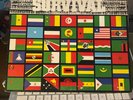
Survival - Bob Marley & The Wailers LP 80s Island blue label w barcode
$
30


Favourite Auctions
To save auctions to your favourites, please login
If you don't have an account, please register
Description
LP NM
Jacket NM-
Artist Biography by William Ruhlmann
For marketing purposes, Bob Marley, the Wailers, and Bob Marley & the Wailers have become interchangeable names, used indiscriminately to refer to recordings actually made by separate entities. So, it is worth recalling the distinctions that existed at the times these entities performed and recorded. The Wailers, formed in Kingston, Jamaica, in 1963, was a vocal group consisting of Junior Braithwaite, Beverley Kelso, Bunny Livingston, Bob Marley, Peter McIntosh, and Cherry Smith; they were called variously the Teenagers, the Wailing Rudeboys, the Wailing Wailers, and finally the Wailers. Braithwaite, Kelso, and Smith had departed by 1966, leaving the trio of Livingston, Marley, and McIntosh. By the early '70s, they had begun playing musical instruments and added a rhythm section consisting of brothers Aston "Family Man" Barrett (bass) and Carlton (Carlie) Barrett (drums). After recording extensively in Jamaica, this unit was signed to Great Britain's Island Records, which issued its label debut, Catch a Fire, in April 1973, followed by Burnin' in November. These albums attracted critical attention but did not chart at first.
By the time of Natty Dread (1974), the original group had split, with McIntosh (later billed as Peter Tosh) and Livingston (later billed as Bunny Wailer) leaving. The album was credited to Bob Marley & the Wailers, the group consisting of Marley, the Barretts, keyboard player Bernard "Touter" Harvey, and lead guitarist Al Anderson, with backing vocals by the I-Threes (Marcia Griffiths, Rita Marley, and Judy Mowatt). The breakthrough for this group was their appearance at the Lyceum in London on July 18, 1975. The show was recorded and quickly released on LP as Live!, and Marley and his reggae music became an international sensation. The success of Eric Clapton's cover of "I Shot the Sheriff," a Marley song from Burnin', in the summer of 1974, had done much to popularize reggae (the original version made the U.S. R&B charts that fall), but Marley himself now achieved stardom as a performer. "No Woman, No Cry," a song originally heard on Natty Dread, reached the U.K. charts in its live rendition in September 1975, becoming a Top 40 hit. With that, both Natty Dread and Live! reached the British charts. In the U.S., Natty Dread had charted in May; it was followed by Burnin' and Catch a Fire in the fall. (Live! was held back from U.S. release for a year; when it appeared, it charted in the Top 100.)
Bob Marley & the Wailers reached their commercial apex in the U.S. with the April 1976 release of their next studio album, Rastaman Vibration, which hit the Top Ten as "Roots, Rock, Reggae" became a minor pop chart entry and a Top 40 R&B hit. At this point, the group consisted of Marley, the Barretts, the I-Threes, keyboard player Tyrone Downie, percussionist Alvin "Seeco" Patterson, rhythm guitarist Earl "Chinna" Smith, and lead guitarist Donald Kinsey. Exodus, released in May 1977, found Marley & the Wailers taking a slightly more uptempo (and disco-influenced) direction; it produced three Top 40 chart hits in the U.K. ("Exodus," "Waiting in Vain," and the Top Ten "Jamming," backed by the non-LP "Punky Reggae Party") and became their first Top Ten album in Great Britain. In the U.S., it sold about as well as Rastaman Vibration, but the band began meeting resistance from category conscious radio programmers who couldn't figure out whether to slot it as rock or R&B. "Exodus" became a Top 20 R&B hit and "Waiting in Vain" made the R&B Top 40, but neither single charted pop. Once again, Marley had tinkered with the band's personnel, which for Exodus consisted of himself, the Barretts, the I-Threes, Downie, Patterson, and lead guitarist Julian (Junior) Marvin.
Kaya, the fourth studio album by Bob Marley & the Wailers, appeared in March 1978. In the U.K., it was the band's biggest success yet, reaching the Top Five, powered by the advance single "Is This Love," which was a Top Ten hit, and by the follow-up single "Satisfy My Soul," which reached the Top 40. But the story was far different in the U.S., where the album struggled. Black radio seemed to have decided that the band did not fit formats dominated by disco, while pop radio was increasingly attracted to new wave sounds and treated reggae as a fad that had passed. The double live album Babylon by Bus, released in November, which marked the return of Al Anderson and the addition of keyboard player Earl "Wire" or "Wya" Lindo, was a modest seller, again doing better in England than in America.
The fifth Bob Marley & the Wailers studio album, Survival, was released in October 1979. It reached the Top 20 in the U.K., with the single "So Much Trouble in the World" reaching the charts, but in the U.S. it sold only moderately well, though "Wake Up and Live" became a minor R&B chart entry. Uprising, released in June 1980 and prefaced by the propulsive single "Could You Be Loved," gave Marley a commercial rebound. Single and album were Top Ten hits in the U.K. The U.S. was more resistant, but "Could You Be Loved" reached the R&B charts and the album charted higher than any of the band's albums since Exodus. Uprising might have done better domestically if Marley had not become ill shortly after its release and been forced to cancel his tour promoting it after only a few dates. His death in May 1981 of course brought an end to the band known as Bob Marley & the Wailers, but it did not end his and the band's success. Even before his death, the back catalog began to sell, with a British single release of "Three Little Birds" from Exodus reaching the Top 20 in the fall of 1980. Shortly after Marley's death, "No Woman, No Cry" was reissued and reached the U.K. Top Ten, with Live! (retitled Live at the Lyceum) returning to the album chart. The posthumous album Confrontation was issued two years after Marley's death, in May 1983. Both its single, "Buffalo Soldier," and the LP made their way up the U.K. Top Five. In the U.S., the single made the R&B charts, and the album was another moderate seller.
But the album that really established the defunct band as an across-the-board sales success was the hits collection Legend -- The Best of Bob Marley & the Wailers, released in the U.K. three years after Marley's death, in May 1984, and in August in the U.S. The album topped the British charts with "One Love/People Get Ready," originally released on Exodus, becoming a Top Five single, "Waiting in Vain" returning to the Top 40, and "Could You Be Loved" returning to the charts. American chart statistics were not as spectacular, but the album became a perennial seller; before the end of the century, it had been certified for sales of ten million copies. Its success, in turn, stimulated sales of the Marley catalog in the U.S., and in the '90s Burnin', Live!, Rastaman Vibration, Exodus, Kaya, Uprising, and Confrontation all went gold, while Island continued to scale the charts with compilations such as Rebel Music (1986), Talkin' Blues (1991), and Natural Mystic (1995). Often, the focus was on Marley alone. For example, the 1992 four-CD box set Songs of Freedom, which included recordings dating back to the early '60s, was billed to Marley, not Marley & the Wailers, as was the 1999 chart album of newly created duets Chant Down Babylon. On the other hand, the many repackagers of '60s Wailers' recordings have long tended to credit their wares to Bob Marley & the Wailers even though the material was cut by the Livingston/McIntosh/Marley group, and Island has long credited reissues of Catch a Fire to Bob Marley & the Wailers (indeed, the initial U.S. release carried that credit). Thus, in practice, recordings by Bob Marley & the Wailers can refer to any music featuring Marley and made in the '60s, '70s, and '80s, though careful listeners will insist that the credit should apply only to the recordings and performances of Marley and his regular backup group from the breakup of the original Wailers trio in 1974 to Marley's death in 1981.
All Lps are sight graded
Note: I Do Not Grade inner sleeves, If these are Important to you then you may e-mail me)
RECORD GRADING Based On Goldmine Grading Standards:
Near Mint (NM): A nearly perfect record. There may be one or two small inaudible defects. The record should show no obvious signs of wear. A 45 RPM or EP sleeve should have no more than the most minor defects, such as almost invisible ring wear or other sights of slight handling. An LP jacket should have no creases, folds, seam splits or any other noticeable similar defect. No cut-out holes, either.
Near Mint Minus (NM-): A record that should play mint but has a few slight visible marks. The album will have as much luster as an NM, there just may be some superficial scuffs from the sleeve or very light hairlines that shouldn't be audible. An NM- album cover subjectively fits somewhere in between VG+ and NM.
Very Good Plus (VG+): A Very Good Plus record will show some signs that it was played and otherwise handled by a previous owner who took good care of it. Record surfaces may show some slight signs of wear and may have slight scuffs or very light scratches that don t significantly affect play. Slight warps that do not affect the sound are OK. The label may have some ring wear or discoloration, but it should be barely noticeable. The center hole will not have been misshapen by repeated play. 45 Picture sleeves will have some slight wear, lightly turned-up corners, or a slight seam-split. An LP jacket may have slight signs of wear also and may be marred by a cut-out hole, indentation or corner indicating it was taken out of print and sold at a discount.
Very Good (VG): Many of the defects found in a VG+ record will be more pronounced in a VG disc. Surface noise will be evident upon playing, especially in soft passages and during a song s intro and fade, but will not overpower the music otherwise. Groove wear will start to be noticeable, as will light scratches (deep enough to feel with a fingernail) that will affect the sound. Labels may be marred by writing, or have tape or stickers (or their residue) attached. The same will be true of picture sleeves or LP covers. However, it will not have all of these problems at the same time, just two or three of them.
Good (G), Good Plus (G+): Good does not mean Bad! A record in Good or Good Plus condition can be put onto a turntable and will play though without skipping. But it will have significant surface noise and scratches and visible groove wear. A jacket or sleeve will have seam splits, especially at the bottom or on the spine. Tape, writing, ring wear or other defects will start to overwhelm the subject.
Poor (P), Fair (F): Below good. imperfections will be described.
Please check out my other items for sale. (I offer shipping discounts) I'll Be adding More Daily except for Friday and Saturday.
ALLSHIPPING PRICES ARE FINAL
additional items are 1.50 per item up to 6 within USA (if you are bidding on multiple items lots I have in one listing. you pay each shipping total added together)
Priorty shipping is available e-mail for total
Please Do A One Time payment for combined shipping on all all items won. Request a Final invoice if I have not already combined them for you
NOTE: Gatefold Lps Count as 2 Lps when shipping out of the country
SHIPPING TO CANADA Multiple LP Shipping Rates In USD
1 LP 11.50
2. Lps 13.00
3 Lps 15.00
4 Lps 17.00
5 Lps 26.00
6 Lps 29.00
Multiple Shipping Rates SHIPPING TO Rest Of The World Outside USA in USD
Note: Gatefold Lps Count as 2 Lps
1 LP 17.25
2 LP 20.00
3. Lps 26.50
4 Lps 30.00
5 Lps 48.00 (price jump becuse weight usually takes it to priority mail rate)
6 Lps 51.00
7 Lps 54.00
8 LPs 58.00
9 Lps 61.00
10 Lps 64.00
11 Lps 67.00
12 Lps 70.00
The MAN has to get his cut so Texas residents must add 8.25 % Sales Tax
If you are unsure about shipping costs please do not hesitate to e-mail me.
QUESTIONS:? Please ask. That is what I am here for. (I may not get to them if you wait close to an item's ending.)
MORE PICTURES? Just ask and I'll send them to you
MEDIA MAIL: is not recommended for rare items. Priority mail is faster and safer.
I leave feedback after item arrives and it is left for me. (It's easier to keep up with that way) Please limit your feedback comments to things within the realm of my responsibility.
Thank you for reading all of this :-)
price rating