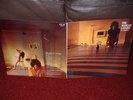
Syd Barrett Barrett Harvest SHSP 4007 UK 1st press A1/B1 + inner 1970 (No EMI)
£
330
$
437


Favourite Auctions
To save auctions to your favourites, please login
If you don't have an account, please register
Description
Syd Barrett Barrett Harvest SHSP 4007 UK 1st press Vinyl, LP, in a laminated cover on a yellow/green Harvest label without an EMI boxed logo on it.
The vinyl appears to have been lightly played and is in great shape. It played through beautifully on my turntable with no hop, stick or jump. It is housed in its original Harvest inner sleeve, which is also in good condition, with no obvious flaws. The sleeve has some ring-wear, but is otherwise in good shape - with no rips or writing. Matrix / Runout (Side A var. 1): SHSP 4007 A-1G G 1 Matrix / Runout (Side B var. 1): SHSP 4007 B-1G T 1
Barrett is the second and final studio album of new material released by former Pink Floyd frontman Syd Barrett. Recording began at Abbey Road Studios on 26 February 1970, and lasted for 15 sessions until 21 July. The album was produced by Pink Floyd's David Gilmour and Richard Wright, who also contributed on bass and keyboards respectively, along with previous Madcap contributor Jerry Shirley on drums.
Barrett was released in November 1970 on Harvest in the United Kingdom, but unlike his debut LP The Madcap Laughs it failed to chart.
The initial sales and the critical and public reaction to Barrett's first solo album, The Madcap Laughs, were deemed sufficient and enthusiastic enough by EMI to sanction a second solo album by Barrett. On 24 February 1970, a month after releasing The Madcap Laughs, Barrett appeared on John Peel's Top Gear radio show, where he performed only one song from the newly released album ("Terrapin"), three that would later be recorded for Barrett ("Gigolo Aunt", "Baby Lemonade" and "Effervescing Elephant"), and a one-off ("Two of a Kind", which was written by Richard Wright). The session producers had no verbal contact with Barrett, having communication with him only via Gilmour. For the radio session, Gilmour and Humble Pie drummer Jerry Shirley accompanied Barrett on bass and bongos, respectively. The version of "Gigolo Aunt" recorded for the radio session (and later released on 1988's The Peel Session) was unfinished, as Barrett had sung the opening verse three times. Barrett played slide guitar on the radio version of "Baby Lemonade", with Gilmour on organ.
Two days later, he began working on his second album in Abbey Road Studios, with Gilmour as producer, and a trio of musicians: Richard Wright, Shirley and Gilmour. The main aim for the Barrett sessions was to give Barrett the structure and focus many felt was missing during the long and unwieldy sessions for The Madcap Laughs. Thus, the sessions were more efficiently run and the album was finished in considerably less time than The Madcap Laughs (six months, compared to Madcap's one year). On 6 June 1970, Barrett gave his one and only official solo performance, at the Olympia in Kensington, backed once more by Gilmour and Shirley. At the end of "Octopus", the fourth number of the set, Barrett baffled the audience and his backing musicians by abruptly taking off his guitar and walking off stage.
The cover of the album was designed by Barrett; it was originally one of many drawings Barrett had done in Cambridge, years earlier. Barrett was released in November 1970 to less interest than had greeted The Madcap Laughs earlier in the year, and as a result, failed to reach the chart. Talks of more singles and a third album were rumoured over the following months. Barrett dismissed the album and Madcap, saying: "They've got to reach a certain standard and that's probably reached in Madcap once or twice and on the other one only a little – just an echo of that. Neither of them are much more than that." Allmusic reviewer Ritchie Unterberger called the album "a bit fuller and smoother than the first album", referring to "Baby Lemonade", "Gigolo Aunt", and "Effervescing Elephant" as "among his peppiest and best-loved tunes"; however, "the tone is darker and more meandering" in the rest of the album. In an overview of Barrett's career, Rolling Stone referred to both Barrett's solo albums as "entrancing".
On 16 February 1971, Barrett recorded a short set for BBC Radio 1's Sound of the Seventies radio show; in contrast to 1970's radio appearance where Barrett performed new material, this time he played songs from Barrett: "Baby Lemonade", "Dominoes" and "Love Song". Bored and directionless, Barrett headed back to his hometown of Cambridge and – but for a brief dalliance with a band called Stars in 1972, and some abortive recording sessions in 1974 – left his music career behind for good.
"Doing Syd's record was interesting, but extremely difficult. Dave [Gilmour] and Roger [Waters] did the first one (The Madcap Laughs) and Dave and myself did the second one. But by then it was just trying to help Syd any way we
price rating