(TALKING HEADS-Speaking in Tongues)-most popular album yet-D7-LP
A$
37
$
25


Favourite Auctions
To save auctions to your favourites, please login
If you don't have an account, please register
Description
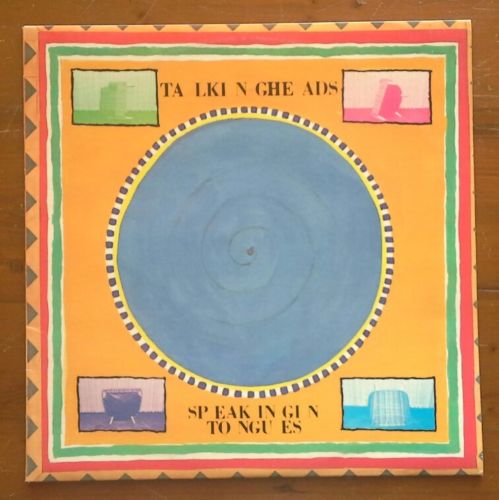
ITEM: VINYL 12” LP 33 1/3rpm
ARTIST: TALKING HEADS
TITLE: Speaking in Tongues
COUNTRY PRINTED: OZ
CAT No: SIRE, 23883-1
COVER: (Grade at NEAR MINT+)
INNER COVER: (Grade at NEAR MINT+)
LABELS: (Grade at MINT)
VINYL: (Grade at NEAR MINT+)
TRACKS:
All lyrics written by David Byrne; all music composed by Talking Heads.
Side one
1."Burning Down the House" – 4:00
2."Making Flippy Floppy" – 4:36
3."Girlfriend Is Better" – 4:25
4."Slippery People" – 3:30
5."I Get Wild/Wild Gravity" – 4:06
Side two
1."Swamp" – 5:09
2."Moon Rocks" – 5:04
3."Pull Up the Roots" – 5:08
4."This Must Be the Place (Naive Melody)" – 4:56
Review: by William Ruhlmann
Talking Heads found a way to open up the dense textures of the music they had developed with Brian Eno on their two previous studio albums for Speaking in Tongues, and were rewarded with their most popular album yet. Ten backup singers and musicians accompanied the original quartet, but somehow the sound was more spacious, and the music admitted aspects of gospel, notably in the call-and-response of "Slippery People," and John Lee Hooker-style blues, on "Swamp." As usual, David Byrne determinedly sang and chanted impressionistic, nonlinear lyrics, sometimes by mix-and-matching clichés ("No visible means of support and you have not seen nothin' yet," he declared on "Burning Down the House," the Heads' first Top Ten hit), and the songs' very lack of clear meaning was itself a lyrical subject. "Still don't make no sense," Byrne admitted in "Making Flippy Floppy," but by the next song, "Girlfriend Is Better," that had become an order -- "Stop making sense," he chanted over and over. Some of his charming goofiness had returned since the overly serious Remain in Light and Fear of Music, however, and the accompanying music, filled with odd percussive and synthesizer sounds, could be unusually light and bouncy. The album closer, "This Must Be the Place (Naive Melody)," even sounded hopeful. Well, sort of. Despite their formal power, Talking Heads' preceding two albums seemed to have painted them into a corner, which may be why it took them three years to craft a follow-up, but on Speaking in Tongues, they found an open window and flew out of it.
Biography: by Stephen Thomas Erlewine
At the start of their career, Talking Heads were all nervous energy, detached emotion, and subdued minimalism. When they released their last album about 12 years later, the band had recorded everything from art-funk to polyrhythmic worldbeat explorations and simple, melodic guitar pop. Between their first album in 1977 and their last in 1988, Talking Heads became one of the most critically acclaimed bands of the '80s, while managing to earn several pop hits. While some of their music can seem too self-consciously experimental, clever, and intellectual for its own good, at their best Talking Heads represent everything good about art-school punks.
And they were literally art-school punks. Guitarist/vocalist David Byrne, drummer Chris Frantz, and bassist Tina Weymouth met at the Rhode Island School of Design in the early '70s; they decided to move to New York in 1974 to concentrate on making music. The next year, the band won a spot opening for the Ramones at the seminal New York punk club CBGB. In 1976, keyboardist Jerry Harrison, a former member of Jonathan Richman's Modern Lovers, was added to the lineup. By 1977, the band had signed to Sire Records and released its first album, Talking Heads: 77. It received a considerable amount of acclaim for its stripped-down rock & roll, particularly Byrne's geeky, overly intellectual lyrics and uncomfortable, jerky vocals.
For their next album, 1978's More Songs About Buildings and Food, the band worked with producer Brian Eno, recording a set of carefully constructed, arty pop songs, distinguished by extensive experimenting with combined acoustic and electronic instruments, as well as touches of surprisingly credible funk. On their next album, the Eno-produced Fear of Music, Talking Heads began to rely heavily on their rhythm section, adding flourishes of African-styled polyrhythms. This approach came to a full fruition with 1980's Remain in Light, which was again produced by Eno. Talking Heads added several sidemen, including a horn section, leaving them free to explore their dense amalgam of African percussion, funk bass and keyboards, pop songs, and electronics.
After a long tour, the band concentrated on solo projects for a couple of years. By the time of 1983's Speaking in Tongues, the band had severed its ties with Eno; the result was an album that still relied on the rhythmic innovations of Remain in Light, except within a more rigid pop-song structure. After its release, Talking Heads embarked on another extensive tour, which would turn out to be their last; it's captured on the Jonathan Demme-directed concert film Stop Making Sense. After releasing the straightforward pop album Little Creatures in 1985, Byrne directed his first movie, True Stories, the following year; the band's next album featured songs from the film. Two years later, Talking Heads released Naked, which marked a return to their worldbeat explorations, although it sometimes suffered from Byrne's lyrical pretensions.
After its release, Talking Heads were put on "hiatus"; Byrne pursued some solo projects, as did Harrison, and Frantz and Weymouth continued with their side project, Tom Tom Club. In 1991, the band issued an announcement that they had broken up. Five years later, the original lineup minus Byrne reunited as the Heads for the album No Talking Just Head. Then in 1999, all four worked together to promote a 15th-anniversary edition of Stop Making Sense.
VINYL GRADING SYSTEM
MINT:
RECORD: New condition with no surface marks or loss of sound quality.
COVER: New condition with no surface marks, creases or wear.
NEAR MINT:
RECORD: Barely noticeable surface mark with no loss of sound quality.
COVER: Barely noticeable surface mark/ wear.
EXCELLENT:
RECORD: Some signs of being played with extremely little if no loss of sound quality.
COVER: Slight wear or creasing.
VERY GOOD:
RECORD: Obviously been played with noticeable surface marks & the occasional light scratches but exhibits no major loss of sound quality.
COVER: Noticeable wear on cover, seam or spine.
+(PLUS)/-(MINUS):
Slightly up or down in condition as appears in the comments above.
NOTE:
Gradings are done visually unless there appears to be a questionable surface mark on the vinyl, it is then put on the turntable to check. A comment describing the outcome will appear if this is the case.
COMBINED/BULK POSTAGE SAVINGS
WITHIN AUSTRALIA
1 LP:
Use the Post Calculator or see above to find the POST COST of this item within OZ.
WANT TO ADD MORE ITEMS?
ALL AUSTRALIAN STATES=$18.95 for 2-17 LPs (or up to 5kg).
NOTE:
Double albums count as 2 LPs; triple albums count as 3 LPs etc
PAYMENT METHOD
WITHIN AUSTRALIA
Option…
Internet Bank Deposit /Money Order/Personal Cheque (waiting period 5 days till cleared) /Paypal in $AUD
GUARANTEE
We strive to provide an accurate grading to ensure a quality product.
But sometimes an error is made.
If you consider this is the case, then please contact us for the refund of your purchase.
FEEDBACK
When you get your item, please examine or test it.
If you are satisfied, then leave some positive feedback for us.
We will have already left feedback for you.
price rating