TENJO SAJIKI - TERAYAMA SHUJI - J.A. SEAZER -- SHINTOKOMARU - LP Japan PLP-7620
$
80


Favourite Auctions
To save auctions to your favourites, please login
If you don't have an account, please register
Description
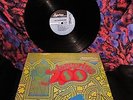
This is a very rare copy of the Victor Records (2002) LP edition of SHINTOKUMARU (Poison Circle) composed by J.A. Seazer for the legendary Tenjo Sajiki (Tenjosajiki), the avant-garde Tokyo theater group led by Terayama Shuji. Recording is of the original 1978 live theater production with fantastic sound quality. How to describe the music? A holy combination of hard progressive / acid psych / and traditional Japanese music... a mind-blowing, phantasmagoric production that could only be created by the genius of Terayama and J.A. Seazer.
Includes lyric sheet insert. Sleeve and vinyl are both at least NM. Sleeve is incredibly clean with original paper obi belt. Vinyl is super clean.
Victor Records PLP-7620
I will be listing more rare Terayama Shuji / Tenjo Sajiki items in the near future.
_____________________________________________________
From Wikipedia:
Sh?ji Terayama
From Wikipedia, the free encyclopedia Sh?ji Terayama Born December 10, 1935 Died May 4, 1983 (aged 47) Nationality Japanese Occupation Poet, dramatist, writer, film director, photographerSh?ji Terayama (?? ?? Terayama Sh?ji?, December 10, 1935 – May 4, 1983) was an avant-garde Japanese poet, dramatist, writer, film director, and photographer. According to many critics and supporters,[1] he was one of the most productive and provocative creative artists to come out of Japan. He was born December 10, 1935, the only son of Hachiro and Hatsu Terayama in Hirosaki city in the northern Japanese prefecture of Aomori. His father died at the end of Pacific War in Indonesia in September 1945. When Terayama was nine, his mother moved to Ky?sh? to work at an American military base, while he himself went to live with relatives in the city of Misawa, also in Aomori. At this same time, Terayama lived through the Aomori air raids that killed more than 30,000 people.
Terayama entered Aomori Prefectural Aomori High School in 1951, and in 1954 went to prestigious Waseda University's Faculty of Education to study Japanese language and literature. However, he soon dropped out because he fell ill with nephrotic syndrome. He received his education through working in bars in Shinjuku. His oeuvre includes a number of essays claiming that more can be learned about life through boxing and horse racing than by attending school and studying hard. Accordingly, he was one of the central figures of the "runaway" movement in Japan in the late 1960s, as depicted in his book, play, and film "Throw Away Your Books, Run into the Streets! (???????????)".
In 1967, Terayama formed the Tenj? Sajiki (????) theater troupe, whose name comes from the Japanese translation of the 1945 Marcel Carné film "Les Enfants du Paradis", so can be translated as "children of heaven", however its correct translation is "Ceiling Gallery" and has a meaning similar to the English expression "Peanut Gallery". The troupe was dedicated to the avant-garde and staged a number of controversial plays tackling social issues from an iconoclastic perspective. Some major plays include "Bluebeard" (???), "Yes" (???), and "The Crime of Fatso Oyama" (????????), among others. Also involved with the theater were artists Aquirax Uno (?????) and Tadanori Yokoo (????), who designed many of the advertisement posters for the group. Musically, he worked closely with experimental composer J.A. Seazer and folk musician Kan Mikami.
He was also involved in poetry and at 18 was the second winner of the Tanka Studies Award.
Terayama experimented with ‘city plays’, a fantastical satire of civic life.
Shuji Terayama's grave (Takao Cemetery zone A front row, ????A?) Google maps viewAlso in 1967, Terayama started an experimental cinema and gallery called 'Universal Gravitation,' which is in fact still in existence at Misawa as a resource center. The Terayama Sh?ji Memorial Hall, which has a large collection of his plays, novels, poetry, photography and a great number of his personal effects and relics from his theatre productions, can also be found in Misawa. In 1976, he was a member of the jury at the 26th Berlin International Film Festival.[2]
Terayama published almost 200 literary works, and over 20 short and full-length films.
He was married to Tenj? Sajiki co-founder Ky?ko Kuj? (?????), but they later divorced, although they continued to work together until Terayama's death on May 4, 1983 from cirrhosis of the liver.
Contents
- 1 Works
- 1.1 Short Films
- 1.2 Feature-Length
- 2 Notes
- 3 References
- 4 External links
- 5 Books On Shuji Terayama
Works
His film oeuvre is well known for its experimentalism and includes:
Short Films
- Catology (1960) (lost[3])
- The Cage / Ori (1964)
- Emperor Tomato Ketchup / Tomato Kechappu K?tei (1971, short version)
- The War of Jan-Ken Pon / Janken Sens? (1971)
- Rolla (1974)
- Ch?fuku-ki (1974)
- Cinema Guide for Young People / Seish?nen no Tame no Eiga Ny?mon (1974)
- The Labyrinth Tale / Meiky?-tan (1975)
- H?s?-tan (1975)
- Der Prozess (1975)
- Les Chants de Maldoror / Marudororu no Uta (1977)
- The Eraser / Keshigomu (1977)
- Shadow Film - A Woman with Two Heads / Nit?-onna - Kage no Eiga (1977)
- The Reading Machine / Shokenki (1977)
- An Attempt to Describe the Measure of A Man / Issunb?shi o Kijutsusuru Kokoromi (1977)
Feature-Length
- Emperor Tomato Ketchup / Tomato Kechappu K?tei (1971, long version)
- Throw Away Your Books, Rally in the Streets / Sho o Suteyo, Machi e Dey? (1971)[4][5]
- Death in the Country / Den'en ni Shisu (aka: "Pastoral Hide and Seek")(1974)
- Boxer / Bokus? (1977)
- Fruits of Passion ?????? / Shanhai Ijin Sh?kan (1981)
- Grass Labyrinth / Kusa-meiky? (1983)
- Video Letter (1983, with Shuntar? Tanikawa)
- Farewell to the Ark / Saraba hakobune (1984)
Takaaki Terahara (?? ?? Terahara Takaaki?), known professionally as Julius Arnest "J.A." Caesar (born 6 October 1948), is a Japanese film and theater music composer.[1] Seazer enjoyed popularity among students in Japan during the 1960s, and worked closely with director Shuji Terayama and his theater Tenjo Sajiki until Terayama's death (besides incidental music, he wrote a few full-fledged rock operas for Tenjo Sajiki, including Shintokumaru). He is a member of the theatrical company Experimental Laboratory of Theatre ? Universal Gravitation (?????????? Engeki-Jikkenshitsu Ban'y? Inryoku?), better known as just Ban'y? Inryoku. He gained notoriety closer to the mainstream by writing songs for the anime Revolutionary Girl Utena, and has also composed the score to the animated film adaptation of Suehiro Maruo's manga Mr. Arashi's Amazing Freak Show (also known as Midori or Shojo-tsubaki).
price rating