THE BALLAD OF CHOL SOO LEE 1978 PSYCH VINYL RECORD ASIAN AMERICAN CIVIL RIGHTS
$
130


Favourite Auctions
To save auctions to your favourites, please login
If you don't have an account, please register
Description
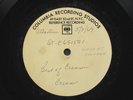
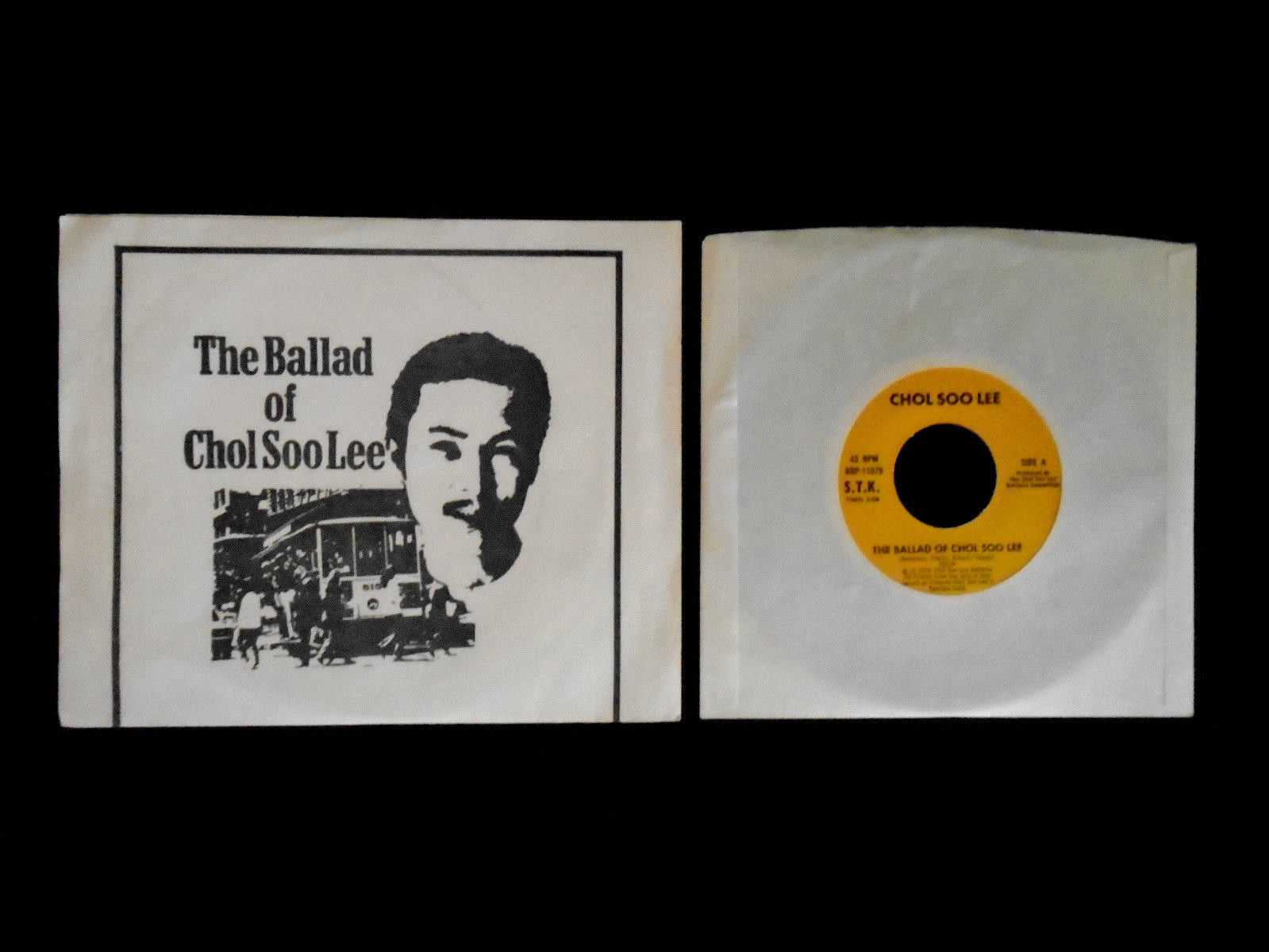
Up for sale is this original extremely rare 45 vinyl record The Ballad of Chol Soo Lee produced by the Chol Soo Lee Defense Committee in 1978.
"The Ballad of Chol Soo Lee" was a 1978 single intended to raise funds for Chol Soo Lee's defense. Lee was a Korean immigrant who was falsely convicted of murdering a Chinatown gang figure in San Francisco in 1973. His case became a major cause for Asian American activists, including current Public Defender of San Francisco Jeff Adachi, and he was eventually granted a new trial and acquitted.
A young Adachi, San Francisco's public defender, can be heard plucking away a smooth bassline as the vocalist sings, "He's not the only one / Nor does he stand alone / Joined by us all / His spirit will carry on."
Chol Soo Lee was a Korean American immigrant who was wrongfully convicted for the 1973 murder of Yip Yee Tak, a San Francisco Chinatown gang leader, and sentenced to life in prison. While in prison, he was sentenced to death for the killing of another prisoner, Morrison Needham, though Chol Soo claimed self-defense. Chol Soo served ten years of his sentence for the killing of Yip Yee Tak of which he was later acquitted, eight of those on death row. Investigative reporting by K. W. Lee sparked the formation of the Free Chol Soo Lee Defense Committee, which spurred a national pan-Asian movement. Chol Soo finally won his freedom in 1983 through the help of the Free Chol Soo Lee Defense Committee.
Lee was born in Seoul, Korea, in 1952 and immigrated to America in 1964. Not speaking English or having parents to guide him, he had a difficult life. He was arrested on June 7, 1973, and convicted of first-degree murder for killing Yip Yee Tak, who was gunned down in broad daylight on June 3, 1973. Lee was sentenced to life imprisonment.
Alerted by young Asian American supporters of Chol Soo Lee from San Francisco about his innocence, investigative reporter K. W. Lee from The Sacramento Union, embarked on a six-month investigation in June 1977, into what became known as the "Alice in Chinatown Murder Case". On October 8, 1977, Lee killed Morrison Needham in a prison yard altercation. Lee, who claimed self-defense, was charged with murder with special circumstances, which calls for the death penalty.
The first of two articles by K. W. Lee appeared in The Sacramento Union on January 29, 1978. It questioned the verdict in the first case.
The continuing investigative series prompted a local drive to form the first Chol Soo Lee Defense Committee, organized by then law school graduate Jay Yoo and Davis school teacher Grace Kim in Sacramento, third generation Japanese American college student Ranko Yamada, and third-generation Korean Americans Gail Whang and Brenda Paik Sunoo in the Bay area. This led to a national coalition of Asian American activists, and Korean community groups and churches in February 1978.
On August 11, 1982, the retrial of the first case began, and on September 3, 1982, the San Francisco County Superior Court jury acquitted Lee of the murder of Yip Yee Tak, and its foreman joined the Chol Soo Lee Defense Committee. On January 14, 1983, California's 3rd District Court of Appeal nullified Chol Soo Lee's death sentence for the Needham stabbing, citing the Stockton trial judge's incorrect jury instructions, and for allowing hearsay testimony in the death penalty phase of the trial.
San Joaquin County Superior Court Judge Peter Seires ordered Chol Soo Lee to be released on March 28, 1983, after Lee's supporters pledged property worth twice the amount of the $250,000 bail. However, the prosecution moved to retry Lee on the prison killing charge. Lee's co-counsels were able to plea bargain on the Needham case. Lee, who had served nearly ten years in prison, was given credit for time served and freed from prison.
Lee did not receive an apology or compensation from the state. Lee lived the rest of his life in San Francisco.
In the midst of numerous speaking engagements, Lee shared his story with Bay Area youth, stressing the importance of engaging with the Asian American community. He also drafted an autobiography which was completed after his death by University of California at Davis professor Richard S. Kim, Freedom without Justice.
Chol Soo Lee died on December 3, 2014 in San Francisco, CA. He was 62 years old.
All items are shipped out quickly. Feel free to email if you have any questions. You can also pick up this item in Sacramento, CA to avoid the shipping costs. Thank you.MINT (M)
These are absolutely perfect in every way. Often rumored but rarely seen, Mint should never be used as a grade unless more than one person agrees that the record or sleeve truly is in this condition. There is no set percentage of the Near Mint value these can bring; it is best negotiated between buyer and seller.
NEAR MINT (NM OR M-)
A good description of a NM record is “it looks like it just came from a retail store and it was opened for the first time.” In other words, it’s nearly perfect. Many dealers won’t use a grade higher than this, implying (perhaps correctly) that no record or sleeve is ever truly perfect.
NM records are shiny, with no visible defects. Writing, stickers or other markings cannot appear on the label, nor can any “spindle marks” from someone trying to blindly put the record on the turntable. Major factory defects also must be absent; a record and label obviously pressed off center is not Near Mint. If played, it will do so with no surface noise. (NM records don’t have to be “never played”; a record used on an excellent turntable can remain NM after many plays if the disc is properly cared for.)
NM covers are free of creases, ring wear and seam splits of any kind.
NOTE: These are high standards, and they are not on a sliding scale. A record or sleeve from the 1950s must meet the same standards as one from the 1990s or 2000s to be Near Mint! It’s estimated that no more than 2 to 4 percent of all records remaining from the 1950s and 1960s are truly Near Mint. This is why they fetch such high prices, even for more common items.
Don’t assume your records are Near Mint. They must meet these standards to qualify!
VERY GOOD PLUS (VG+)
or EXCELLENT (E)
A good description of a VG+ record is “except for a couple minor things, this would be Near Mint.” Most collectors, especially those who want to play their records, will be happy with a VG+ record, especially if it toward the high end of the grade (sometimes called VG++ or E+).
VG+ records may show some slight signs of wear, including light scuffs or very light scratches that do not affect the listening experience. Slight warps that do not affect the sound are OK. Minor signs of handling are OK, too, such as telltale marks around the center hole, but repeated playing has not misshapen the hole. There may be some very light ring wear or discoloration, but it should be barely noticeable.
VG+ covers should have only minor wear. A VG+ cover might have some very minor seam wear or a split (less than one inch long) at the bottom, the most vulnerable location. Also, a VG+ cover may have some defacing, such as a cut-out marking. Covers with cut-out markings can never be considered Near Mint.
Very Good (VG)
Many of the imperfections found on a VG+ record are more obvious on a VG record. That said, VG records — which usually sell for no more than 25 percent of a NM record — are among the biggest bargains in record collecting, because most of the “big money” goes for more perfect copies. For many listeners, a VG record or sleeve will be worth the money.
VG records have more obvious flaws than their counterparts in better shape. They lack most of the original gloss found on factory-fresh records. Groove wear is evident on sight, as are light scratches deep enough to feel with a fingernail. When played, a VG record has surface noise, and some scratches may be audible, especially in soft passages and during a song’s intro and ending. But the noise will not overpower the music otherwise.
Minor writing, tape or a sticker can detract from the label. Many collectors who have jukeboxes will use VG records in them and not think twice. They remain a fine listening experience, just not the same as if it were in better shape.
VG covers will have many signs of human handling. Ring wear in the middle or along the edges of the cover where the edge of a record would reside, is obvious, though not overwhelming. Some more creases might be visible. Seam splitting will be more obvious; it may appear on all three sides, though it won’t be obvious upon looking. Someone might have written or it or stamped a price tag on it, too.
Good (G),
Good Plus (G+)
or Very Good Minus (VG–)
These records go for 10 to 15 percent of the Near Mint value, if you are lucky.
Good does not mean bad! The record still plays through without skipping, so it can serve as filler until something better comes along. But it has significant surface noise and groove wear, and the label is worn, with significant ring wear, heavy writing, or obvious damage caused by someone trying to remove tape or stickers and failing miserably. A Good to VG– cover has ring wear to the point of distraction, has seam splits obvious on sight and may have even heavier writing, such as, for example, huge radio station letters written across the front to deter theft.
price rating