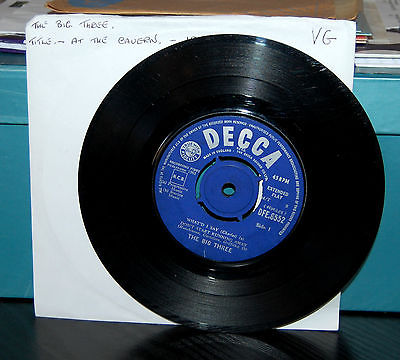
THE BIG THREE. " AT THE CAVERN (EP) " DECCA UK 1963. NO COVER. ORIG.
£
15
$
20


Favourite Auctions
To save auctions to your favourites, please login
If you don't have an account, please register
Description
Big Three, The ?– At The Cavern
Label: Decca ?– DFE 8552 Format: Vinyl, 7", EP, 45 RPM, MonoCountry: UK Released: 1963 Genre: Rock Style: Beat
TracklistHide Credits
A1 What'd I Say Written-By – Charles* A2 Don't Start Running Away Written-By – Griffiths*, Gustafson*, Hutchinson* B1 Zip-A-Dee-Doo-Dah Written-By – Wrubel*, Gilbert* B2 Reelin' And Rockin' Written-By – Berry*Companies etc
- Recorded At – Cavern Club
Credits
- Bass – Johnny Gustafson*
- Drums – Brian Griffiths
- Engineer – Terry Johnson (2)
- Lead Guitar – Johnny Hutchinson
- Liner Notes – Bob Wooler
- Producer – Noel Walker
‘Cass & The Cassanovas’ (later The Big Three) were formed in May 1959 by Newcastle Upon Tyne born Brian Casser along with Adrian Barber on guitar and Johnny Hutchinson on drums and vocals.
By July 1959 the band played the first gig with Johnny Hutch at the Corinthean club in Liverpool’s Slater Street but they needed a bass player to complete the line-up.
Enter John Frederick Gustafson born in Liverpool on the 8th August 1942.
Johnny Gustafson as he was known didn’t even have a bass at this time but Barber reconstructed an acoustic which he used on a New Years Eve gig at the Tower Ballroom in New Brighton.
The band continued as a four piece for the next year playing gigs at the Liverpool Stadium, St George’s Hall and The Cavern Club. Casser, the founder member, moved to London causing his exit from the band.
The band, now a trio, sorts a new name and decided on ‘The Big Three’.
This was an awesome (LOUD) three piece, not only because of Adrian Barber’s electronic wizardry but because Johnny Hutch had his drum kit tuned for ultimate volume.
Some people said he used sticks carved from brush handles and that his bass drum skin had a wooden centre which was struck by a bass drum pedal with a steel hammer attached.
One musician I spoke to about the bands sound said “Johnny Hutch’s bass drum would take your head off!” But this was not to be the bands final or most successful line up.
Brian Epstein
The band signed up with the monopolistic Brian Epstein Co. for management and were sent to Hamburg. Adrian Barber left the band and was replaced by Brian Griffith in august 1962.
Their reputation grew and they were without doubt the most formidable and influential band on the Merseyside scene. They recorded what was basically a demo of ‘Some Other Guy’ for Decca, which Decca released against the bands wishes, causing a split with Epstein in July 1963.
This was ultimately the end of ‘The Big Three’ and in the latter part of 1963 Gustafson and Griffiths left and went to Hamburg with another band ‘The Seniors’.
Hutchinson replaced them with Paddy Chambers and Faron Ruffley but this group would not live up to the bands former reputation.
Strictly Graded - RECORD COLLECTOR Grading System.
Grading System: In order to assist everyone who buys and sells rare discs, Record Collector magazine has originated a set of standards for the condition of second-hand records, I have added a (+) or (-) to my gradings where applicable.
MINT: The record itself is in brand new condition with no surface marks or deterioration in sound quality. The cover and any extra items such as the lyric sheet, booklet or poster are in perfect condition. Records advertised as Sealed or Unplayed should be Mint.
EXCELLENT: The record shows some signs of having been played, but there is very little lessening in sound quality. The cover and packaging might have slight wear and/or creasing.
VERY GOOD: The record has obviously been played many times, but displays no major deterioration in sound quality, despite noticeable surface marks and the occasional light scratch. Normal wear and tear on the cover or extra items, without any major defects, is acceptable.
GOOD: The record has been played so much that the sound quality has noticeably deteriorated, perhaps with some distortion and mild scratches. The cover and contents suffer from folding, scuffing of edges, spine splits, discoloration, etc.
FAIR: The record is still just playable but has not been cared for properly and displays considerable surface noise; it may even jump.
The cover and contents will be torn, stained and/or defaced.
POOR: The record will not play properly due to scratches, bad surface noise, etc. The cover and contents will be badly damaged or partly missing.
BAD: The record is unplayable or might even be broken, and is only of use as a collection-filler.
POSTAGE DISCOUNTS FOR MULTIPLE PURCHASES.REQUEST INVOICE PRIOR TO PAYMENT SO YOU BENEFIT.
price rating