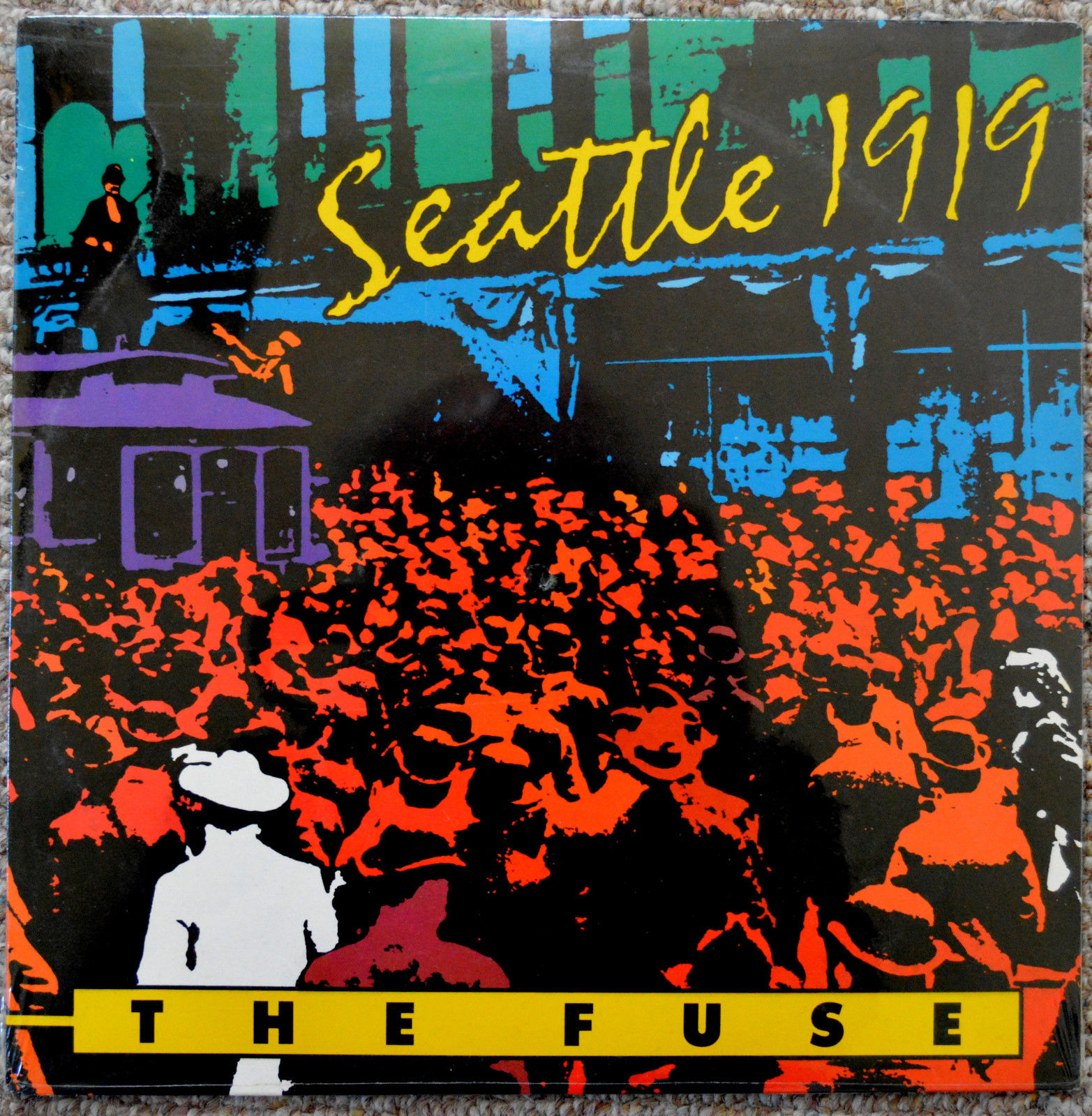
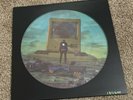
THE FUSE "SEATTLE 1919" - Rock Opera-Musical Documentary - SEALED & NEW 2 LP set
$
20


$ 20
Sold For
Jul 5, 2018
Sold Date
Jun 7, 2018
Start Date
$ 25
Start price
1
Number Of Bids
USA
Country Of Seller
eBay
Sold at
Favourite Auctions
To save auctions to your favourites, please login
If you don't have an account, please register
Description
PLEASE READ COMPLETE AUCTION DESCRIPTION
BEFORE BIDDING
_______________
PAYMENT DUE WITHIN
5 DAYS
OF AUCTION CLOSING
_______________
UP FOR AUCTION IS:
SEALED
&
NEW
THE FUSE
SEATTLE 1919
Seattle 1919 - Musical Documentary
The story of the Seattle General Strike has been told in many ways, but none more unique than the rock opera, Seattle 1919, recorded by The Fuse in 1985.
Two LP Record Set
FUSE MUSIC SIS-003
1985
Tracklist
- Running down the road
- Winter in Seattle
- Roll in with the union
- Push
- Now the other way turn
- Street speech
- Anna Louise
- Mister Charles Piez
- The time is now
- Get some more
- Words
- Shut it down
- One step further
- Nothing moves but the tide
- The road forks here
- It's gotta stop
- Let the woman go free
- On the line
- Caught in the middle
- The Promised Land
- Til the high tide comes again
STILL SEALED & NEW
Seattle 1919 - Musical Documentary
The story of the Seattle General Strike has been told in many ways, but none more unique than the rock opera, Seattle 1919, recorded by The Fuse in 1985. Composed by Rob Rosenthal and produced by Mike Rawson and Rob Rosenthal, the album tells the story in 21 songs of a young Midwesterner, Peter Rinearson, who rides the rails to Seattle looking for work in the World War I shipyards. As the songs narrate his fictional but historically plausible tale, Peter explores working-class Seattle, meeting gamblers, sailors, and Wobblies and developing a friendship with Anna Louise Strong. He becomes involved first in the life of Seattle's Skid Road, then in the labor movement, joining in the great strike that shuts down the shipyards and the city. When the strike fails, Anna Louise Strong leaves Seattle while Peter stays on. He bids her goodbye and contemplates the future in the final song ('Til the High Tide Comes Again) :
Seattle 1919 - Musical Documentary
I began thinking about the Strike as a topic for songs almost from the moment I first read about it while in college. I was academically and politically interested in working-class struggles, and general strikes in particular, and so completely taken by the SGS as the most successful general strike in US history. It seemed to embody the (best) qualities I found in rock 'n' roll: defiance, excitement, rebellion, etc. At the time I was very much influenced by people like Stanley Aronowitz and the idea that cultural approaches were important to re-invigorating the labor movement (and musically much influenced by The Beatles and others who seemed to be stretching rock with serious content and album-length conceptions). My friends and I, including Mike Rawson, had many conversations about writing music that would appeal to working-class kids who had never been taught this history.
In 1978, I went to Seattle to conduct interviews with Strike survivors for a masters thesis I was writing on the strike and its political effects. I think I had already started "Shut it Down" and maybe a few other songs, but my experiences in Seattle led to many new songs. Some, like "Nothing Moved But the Tide" literally came from something someone said to me in an interview. When I returned to Santa Barbara, I spent the next year or so working on my masters thesis on the strike. I would work late into the evening or night almost every day, and then bike home, a 15 mile ride. The combination of the material in my head and the rhythm of the biking led to many new songs; often I would arrive home with an idea to scribble down.
In 79, I think, I got a letter from Mike Rawson, who was in law school. He said, "You know, you've been talking about this idea of a rock opera about the Strike for a long time. How about when you finish your masters and I finish law school, we go up to Seattle for some time and you/we finish it." Fortunately, shortly thereafter my then girlfriend, now wife, Sunny was accepted to library grad school at UWashington, so the whole thing fell together. She and I went up there in September of 1980; Mike joined us six months later, and we stayed until sometime in 1982. While there I worked a series of jobs--janitor, appliance installer, document coder--and these too led to some more songs. I can remember clearly waiting for an elevator in a high rise I was bringing refrigerators into and jotting down "Push" on a scrap of dry wall I picked up. By the time Mike joined me, I had 40 songs. He helped me edit them down, join some together to make a single song, and co-wrote a few that I'd been working on.
I came back to Santa Barbara in 1982, there to do my PhD, but also to get the album done. Sunny and I were living in a tiny house on Garden Street that had a full garage, probably as big as the house. I went dumpster diving for a week or so finding carpet and egg cartons, and tacked them up to muffle the sound (not that successfully according to some neighbors), turning the garage into a rehearsal and informal recording studio. I recruited a band by placing ads in the local papers and at music stores. There were some good things I had to offer: practice only once a week (so people could keep their other band connections), a very high royalty rate on any albums we sold, and most of all, the guarantee that we would make an album. Today, anyone can make an album (actually a CD) for almost nothing, but then you needed to go into a recording studio and get the vinyl pressed, all of which cost some money so actually making an album was a strong incentive. But I was honest from the beginning that actually selling a lot of them (though of course we hoped to do that) was a long shot, and everyone understood it was a gamble. I auditioned perhaps thirty singers and musicians and ended up with the six who formed The Fuse with me.
For two years we practiced once a week, spending six months on five or six songs, and then going into a studio and recording those, then beginning with a new six. Over time we graduated from 8-track studios to 16-track, and finally to Santa Barbara Studios, then the state-of-the-art 24 track studio in Santa Barbara where the big boys like Joe Walsh and Ringo sometimes recorded. Our total budget, from Mike's and my savings, was $5000 (for recording time and the actual manufacturing of 2000 copies), and this last move wouldn't have been possible except people there had heard about the project and got interested in it, squeezing us in at odd hours, often very late at night. In May of 1985 we finished the album; a little while later a friend and I spent a month up in Seattle trying to promo it and finding out how hard it is for an independent label to get heard on the radio. But that's another story...
As for the performance: After I had taken the job at Wesleyan I was contacted by Helen Lee of the Labor Center at Evergreen. We didn't know each other, but she had heard the album and wanted The Fuse to play a concert out there. I explained we had never played it live, that we hadn't played together in three years, and that we were scattered all over the country now. But she was persistent. She said they'd fundraise to bring us all to Seattle for four days, three days of practicing and then a concert at the Broadway Performance Hall. All of the band agreed to come (though some with great trepidation--could we really pull this off??) except Billy Bowne, the drummer, who was replaced by a friend of mine, Jack Whalen, who I had played some of the early Seattle songs with in a garage band called Jacks or Better in the late 70s. For a few months we each practiced with the record wherever we were. In late April of 1989 we went to Olympia, practiced almost nonstop for three days, and then on Mayday, May 1, gave the concert at the Broadway Performance Hall, one of the really great experiences of my life
STILL SEALED
and
NEW
Grading Records
Grading Records
The following is the grading system first developed by Goldmine Records. Virtually all methods currently in use for the grading of records, is based in some way, shape, or form, on this system. Rather than offer some variation of the original system first developed by Goldmine, the Record Collector's Guild will display the Goldmine record grading method in it's entirety.
Visual or Play Grading?
In an ideal world, every record would be played before it is graded. But the time involved makes it impractical for most dealers, and anyway, it's rare that you get a chance to hear a record before you buy through the mail. Some advertisers play-grade everything and say so. But unless otherwise noted, records are visually graded.
How to Grade
Look at everything about a record. It's playing surface, it's label, it's edges...under a strong light. Then based on your overall impression give it a grade based on the following criteria:
- Mint (M) Absolutely perfect in every way. Certainly never been played, possibly even still sealed.(More on still sealed under "Other Considerations"). Should be used sparingly as a grade, If at all.
- Near Mint (NM or M-) A nearly perfect record. Many dealers won't give a grade higher than this implying (perhaps correctly)that no record is ever truly perfect.
The record should show no obvious signs of wear. A 45 RPM or EP sleeve should have no more than the most minor defects, such as almost invisible ring wear or other signs of slight handling.
An LP cover should have no creases, folds, seam splits or other noticeable similar defects. No cut-out holes, either. And of course, the same should be true of any other inserts, such as posters, lyric sleeves and the like.
Basically, an LP in near mint condition looks as if you just got it home from a new record store and removed the shrink wrap.
Near Mint is the highest price listed in all Goldmine price guides. Anything that exceeds this grade, in the opinion of both buyer and seller, is worth significantly more than the highest Goldmine book value. - Very Good Plus (VG+) Generally worth 50 percent of the Near Mint value.
A Very Good Plus record will show some signs that it was played and otherwise handled by a previous owner who took good care of it.
Record surfaces may show some signs of wear and may have slight scuffs or very light scratches that don't affect one's listening experiences. Slight warps that do not affect the sound are "OK".
The label may have some ring wear or discoloration, but it should be barely noticeable. The center hole will not have been misshapen by repeated play.
Picture sleeves and LP inner sleeves will have some slight wear, lightly turned up corners, or a slight seam split. An LP cover may have slight signs of wear also and may be marred by a cut-out hole, indentation or corner indicating it was taken out of print and sold at a discount.
In general, if not for a couple things wrong with it, this would be Near Mint. All but the most mint-crazy collectors will find a Very Good Plus record highly acceptable. - Very Good (VG) Generally worth 25 percent of Near Mint value. Many of the defects found in a VG+ record will be more pronounced in a VG disc. Surface noise will be evident upon playing, especially in soft passages and during a song's intro and fade, but will not overpower the music otherwise. Groove wear will start to be noticeable, as with light scratches (deep enough to feel with a fingernail) that will affect the sound.
Labels may be marred by writing, or have tape or stickers (or their residue) attached. The same will be true of picture sleeves or LP covers. However, it will not have all of these problems at the same time, only two or three of them.
Goldmine price guides with more than one price will list Very Good as the lowest price. This, not the Near Mint price, should be your guide when determining how much a record is worth, as that is the price a dealer will normally pay you for a Near Mint record. - Good (G), Good Plus (G+) Generally worth 10-15 percent of the Near Mint value. Good does not mean Bad! A record in Good or Good Plus condition can be put onto a turntable and will play through without skipping. But it will have significant surface noise and scratches and visible groove wear (on a styrene record, the groove will be starting to turn white).
A cover or sleeve will have seam splits, especially at the bottom or on the spine. Tape, writing, ring wear or other defects will start to overwhelm the object.
It is a common item, you'll probably find another copy in better shape eventually. Pass it up. But, if it's something you have been seeking for years, and the price is right, get it...but keep looking to upgrade. - Poor (P), Fair (F) Generally worth 0-5 percent of the Near Mint price. The record is cracked, badly warped, and won't play through without skipping or repeating. The picture sleeve is water damaged, split on all three seams and heavily marred by wear and writing. The LP cover barely keeps the LP inside it. Inner sleeves are fully seam split, crinkled, and written upon.
Except for impossibly rare records otherwise unattainable, records in this condition should be bought or sold for no more than a few cents each.
Other Considerations
Most dealers give a separate grade to the record and it's sleeve or cover. In an ad, a record's grade is listed first, followed by that of the sleeve or the cover.
- With Still Sealed (SS) records, let the buyer beware! Unless it'a a U.S. pressing from the last 10-15 years or so. It's too easy to reseal one. Yes, some legitimately never-opened LP's from the 1960's still exist. But if you're looking for a specific pressing, the only way you can know for sure is to open the record.
© 1997
PAYMENT DUE WITHIN
5 DAYS
OF AUCTION CLOSING
price rating









![Violator [2014] [LP] by Depeche Mode (Vinyl, Mar-2014, Rhino (Label))](https://www.popsike.mobi/php/thumbnail.php?url=https://www.popsike.pics/pix/20161114/132002634593.jpg)