The Beatles "Abbey Road". Apple PCS 7088 UK 1st press 2/1 1969 drain/her majesty
£
26
$
34


Favourite Auctions
To save auctions to your favourites, please login
If you don't have an account, please register
Description
The Beatles ? "Abbey Road" Apple Records ?PCS 7088 UK 1st press. Vinyl, LP, released in 1969.
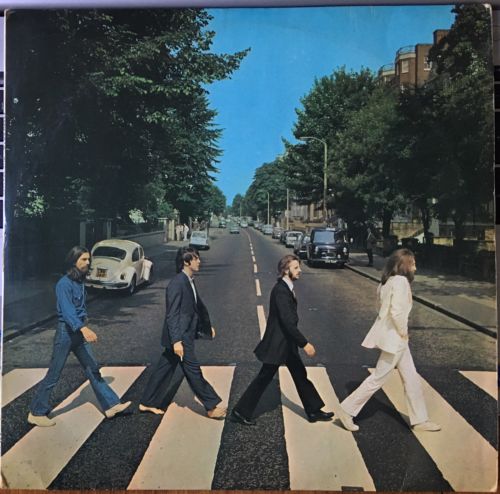
The vinyl does have several surface marks which can produce a bit of crackle between tracks. It played through fine on my elderly stereo - no hop, stick or jump. The vinyl is housed in a white inner sleeve, which is, in turn housed in a full laminated cover without flaps on the back. The front cover has the drain showing, the rear cover has the Apple logo aligned with the text. There is a small ? on the labels and on the front cover the drain is visible in the crossing. There is no 'Her Majesty' credit on Side 2 label. The spine is intact and legible. Matrix / Runout Side 1 : YEX 749-2 Matrix / Runout Side 2 : YEX 750-1
"Abbey Road" is the Beatles' eleventh studio album, released on 26 September 1969 by Apple Records. The recording sessions for the album were the last in which all four Beatles participated. Although "Let It Be" was the final album that the Beatles completed before the band's dissolution in April 1970, most of the album had been recorded before the "Abbey Road" sessions began. A two-sided hit single from the album, "Something" backed with "Come Together", released in October, topped the Billboard Hot 100 chart in the US.
"Abbey Road" is a rock album that incorporates genres such as blues, pop, and progressive rock, and it makes prominent use of the Moog synthesizer and the Leslie speaker. Side two contains a medley of song fragments edited together to form a single piece. The album was recorded amid a more enjoyable atmosphere than the "Get Back/Let It Be" sessions earlier in the year, but there were still frequent disagreements within the band. John Lennon had privately left the group by the time the album was released and McCartney publicly quit the following year.
Although "Abbey Road" was an immediate commercial success and reached ?No.? 1 in the UK and US, it initially received mixed reviews, some critics describing its music as inauthentic and bemoaning the production's artificial effects. Many critics now view the album as the Beatles' best and rank it as one of the greatest albums of all time. In particular, George Harrison's contributions, "Something" and "Here Comes the Sun", are considered to be among the best songs he wrote for the group. The album's cover, which features the four band members walking across a zebra crossing outside Abbey Road Studios, has become one of the most famous and imitated images in the history of popular music.
After the unpleasant recording sessions for the proposed "Get Back" album (ultimately released in 1970 as "Let It Be"), Paul McCartney suggested to music producer George Martin that the group get together and make an album "the way we used to do it", free of the conflict that had begun during sessions for "The Beatles" (also known as the "White Album"). Martin agreed, but on the strict condition that all the group – particularly John Lennon – allow him to produce the record in the same manner as earlier albums and that discipline would be adhered to.
The first sessions for "Abbey Road" began on 22 February 1969, only three weeks after the "Get Back" sessions, in Trident Studios. There, the group recorded a backing track for "I Want You (She's So Heavy)" with Billy Preston accompanying them on Hammond organ. No further group recording occurred until April because of Ringo Starr's commitments on the film "The Magic Christian". After a small amount of work that month and a session for "You Never Give Me Your Money" on 6 May, the group took an eight-week break before recommencing on 2 July. Recording continued through July and August, with the last backing track, for "Because", being taped on 1 August. Overdubs continued through the month, with the final sequencing of the album coming together on 20 August – the last time all four Beatles were present in a studio together.
McCartney, Starr and Martin have reported positive recollections of the sessions, while George Harrison said, "we did actually perform like musicians again". Lennon and McCartney had enjoyed working together on the non-album single "The Ballad of John and Yoko" in April, contributing friendly banter between takes, and some of this camaraderie carried over to the "Abbey Road" sessions. Nevertheless, there was a significant amount of tension between the group members. According to author Ian MacDonald, McCartney had an acrimonious argument with Lennon during the sessions. Lennon's wife Yoko Ono had become a permanent presence at Beatles recordings and clashed with other members. Halfway through recording in June, Lennon and Ono were involved in a car accident. A doctor told Ono to rest in bed, so Lennon had one installed in the studio so she could observe the recording process from there.
The album's two halves represented a compromise; Lennon wanted a traditional release with distinct and unrelated songs while McCartney and Martin wanted to continue their thematic approach from "Sgt. Pepper's Lonely Hearts Club Band" by incorporating a medley. Lennon ultimately said that he disliked "Abbey Road" as a whole and felt that it lacked authenticity, calling McCartney's contributions "[music] for the grannies to dig" and not "real songs" and describing the medley as "junk ... just bits of songs thrown together". During the sessions, Lennon expressed a desire to have all of his songs on one side of the album, with McCartney's on the other.
Nobody was entirely sure that the work was going to be the group's last, though Harrison said "it felt as if we were reaching the end of the line". After the album was released, the "Get Back/Let It Be" project was re-examined, and work on it continued into 1970. Therefore, "Let It Be" became the last album to be finished by the Beatles, even though its recording had begun before "Abbey Road".
By September 1969, after the recording of "Abbey Road", Lennon had formed a new group, the Plastic Ono Band, in part because the Beatles had rejected his song "Cold Turkey". While Harrison worked with such artists as Leon Russell, Doris Troy, Preston and Delaney & Bonnie through to the end of the year, McCartney took a hiatus from the group after his daughter Mary was born on 28 August. On 20 September, Lennon formally announced his departure to the other Beatles. "Abbey Road" was released on 26 September 1969. The single "Something"/"Come Together" followed in October, while Lennon released the Plastic Ono Band's version of "Cold Turkey" the same month. The Beatles did little promotion of "Abbey Road" directly, and no public announcement was made of the band's split until McCartney announced he was leaving the group in April 1970, at which point they disbanded.
The cover was designed by Apple Records creative director Kosh. It is the only original UK Beatles album sleeve to show neither the artist name nor the album title on its front cover, which was Kosh's idea, despite EMI claiming the record would not sell without this information. He later explained that "we didn't need to write the band's name on the cover ... They were the most famous band in the world".
The front cover design, a photograph of the group on a zebra crossing, was based on ideas sketched by McCartney, and taken on 8 August 1969 outside EMI Studios in Abbey Road. At 11:35 that morning, photographer Iain Macmillan was given only ten minutes to take the photo whilst he stood on a step-ladder and a policeman held up traffic behind the camera. Macmillan took six photographs, which McCartney later examined with a magnifying glass before deciding which of the shots would be used upon the album sleeve.
In the image selected by McCartney, the group walk across the street in single file from left to right, with Lennon leading, followed by Starr, McCartney, and Harrison. McCartney is barefoot and out of step with the other members. Apart from Harrison, the group are wearing suits designed by Tommy Nutter. To the left of the picture, parked next to the zebra crossing, is a white Volkswagen Beetle which belonged to one of the people living in the block of flats across from the recording studio. After the album was released, the number plate (LMW 281F) was stolen repeatedly from the car. In 1986, the car was sold at auction for £2,530 and in 2001 was on display in a museum in Germany. The man standing on the pavement to the right of the picture is Paul Cole (7 July 1911 – 13 February 2008), an American tourist unaware he had been photographed until he saw the album cover months later. On the original cover, McCartney holds a cigarette; in 2003 several US poster companies airbrushed this cigarette out of the image, without permission from either Apple or McCartney.
Shortly after the album's release the cover became part of the "Paul is dead" rumour that was spreading across college campuses in the United States. According to followers of the rumour, the cover depicted the Beatles walking out of a cemetery in a funeral procession. The procession was led by Lennon, dressed in white, as a religious figure, Starr, dressed in black, as the undertaker, McCartney, out of step with the others, as a barefoot corpse and Harrison, dressed in denim, as the gravedigger. The left-handed McCartney is holding a cigarette in his right hand, said to indicate an imposter and the license plate on the Volkswagen parked on the street is 28IF, meaning McCartney would have been 28 if he had lived.
"Abbey Road" initially received mixed reviews from music critics, who criticised the production's artificial sounds and viewed its music as inauthentic. William Mann of the London Times said that the album will "be called gimmicky by people who want a record to sound exactly like a live performance", although he considered it to be "teem[ing] with musical invention" and added: "Nice as 'Come Together' and Harrison's 'Something' are – they are minor pleasures in the context of the whole disc … Side Two is marvellous …" Ed Ward of Rolling Stone called the album "complicated instead of complex" and felt that the Moog synthesizer "disembodies and artificializes" the band's sound, adding that they "create a sound that could not possibly exist outside the studio". While he found the medley on side two to be their "most impressive music" since "Rubber Soul", Nik Cohn of The New York Times said that, "individually", the album's songs are "nothing special". Albert Goldman of Life magazine wrote that "Abbey Road" "is not one of the Beatles' great albums" and, despite some "lovely" phrases and "stirring" segues, side two's suite "seems symbolic of the Beatles' latest phase, which might be described as the round-the-clock production of disposable music effects".
Conversely, Chris Welch wrote in Melody Maker: "the truth is, their latest LP is just a natural born gas, entirely free of pretension, deep meanings or symbolism … While production is simple compared to past intricacies, it is still extremely sophisticated and inventive." Derek Jewell of The Sunday Times found the album "refreshingly terse and unpretentious", and although he lamented the band's "cod-1920s jokes ('Maxwell's Silver Hammer') and … Ringo's obligatory nursery arias ('Octopus's Garden')", he considered that "Abbey Road" "touches higher peaks than did their last album". John Mendelsohn, writing for Rolling Stone, called it "breathtakingly recorded" and praised side two especially, equating it to "the whole of Sgt. Pepper" and stating, "That the Beatles can unify seemingly countless musical fragments and lyrical doodlings into a uniformly wonderful suite ... seems potent testimony that no, they've far from lost it, and no, they haven't stopped trying."
Many critics have since cited "Abbey Road" as the Beatles' greatest album. In a retrospective review, Nicole Pensiero of PopMatters called it "an amazingly cohesive piece of music, innovative and timeless". Mark Kemp of Paste viewed the album as being "among The Beatles' finest works, even if it foreshadows the cigarette-lighter-waving arena rock that technically skilled but critically maligned artists from Journey to Meatloaf would belabor throughout the '70s and '80s". Neil McCormack of The Daily Telegraph dubbed it the Beatles' "last love letter to the world" and praised its "big, modern sound", calling it "lush, rich, smooth, epic, emotional and utterly gorgeous". AllMusic's Richie Unterberger felt that the album shared Sgt. Pepper's "faux-conceptual forms", but had "stronger compositions", and wrote of its standing in the band's catalogue: "Whether "Abbey Road" is the Beatles' best work is debatable, but it's certainly the most immaculately produced (with the possible exception of Sgt. Pepper) and most tightly constructed." Ian MacDonald gave a mixed opinion of the album, noting that several tracks had been written at least a year previously, and would possibly have been unsuitable without being integrated into the medley on side two. He did, however, praise the production, particularly the sound of Starr's bass drum.
"Abbey Road" received high rankings in several "best albums in history" polls by critics and publications. Time included it in their 2006 list of the All-Time 100 Albums. In 2009, readers of Rolling Stone named "Abbey Road" the greatest Beatles album and in 2012, the magazine ranked it number 14 on its list of the 500 greatest albums of all time. The album was also included in the book 1001 Albums You Must Hear Before You Die.
Musicologist Walter Everett interprets that most of the lyrics on side two's medley deal with "selfishness and self-gratification – the financial complaints in 'You Never Give Me Your Money,' the miserliness of Mr. Mustard, the holding back of the pillow in 'Carry That Weight,' the desire that some second person will visit the singer's dreams – perhaps the 'one sweet dream' of 'You Never Give Me Your Money'? – in 'The End.'" Everett adds that the medley's "selfish moments" are played in the context of the tonal centre of A, while "generosity" is expressed in songs where C major is central. The medley concludes with a "great compromise in the 'negotiations'" in "The End", which serves as a structurally balanced coda. In response to the repeated A-major choruses of "love you", McCartney sings in realisation that there is as much self-gratifying love ("the love you take") as there is of the generous love ("the love you make"), in A major and C major, respectively.
"Abbey Road" sold four million copies in its first two months of release. In the UK, the album debuted at number 1, where it remained for 11 weeks before being displaced for one week by the Rolling Stones' "Let It Bleed". The following week (which was Christmas), "Abbey Road" returned to the top for another six weeks (completing a total of 17 weeks) before being replaced by "Led Zeppelin II". In all it spent 81 weeks on the UK albums chart.
Reaction overseas was similar. In the US, the album spent 12 weeks at number one on the Billboard Top LPs chart. It was the National Association of Recording Merchandisers (NARM) best-selling album of 1969 and was number four on Billboard magazine's top LPs of 1970 year-end chart. Abbey Road was certified 12× platinum by the RIAA in 2001. In Japan, it was one of the longest-charting albums to date, remaining in the top 100 for 298 weeks during the 1970s.
In June 1970, Allen Klein reported that "Abbey Road" was the Beatles' best-selling album in the US with sales of about five million. By 1992, "Abbey Road" had sold nine million copies. The album became the ninth-most downloaded on the iTunes Store a week after it was released there on 16 November 2010. A CNN report stated it was the best-selling vinyl album of 2011. It is the first album from the 1960s to sell over five million albums since 1991 when Nielsen SoundScan began tracking sales. In the US, the album had sold 7,177,797 copies by the end of the 1970s. As of 2011, the album had sold over 31 million copies worldwide and is one of the band's best-selling albums.
"Her Majesty" appears as a hidden track. Between "The End" and "Her Majesty" is 14 seconds of silence. Later releases of the album included the song on the track listing.
price rating