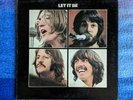
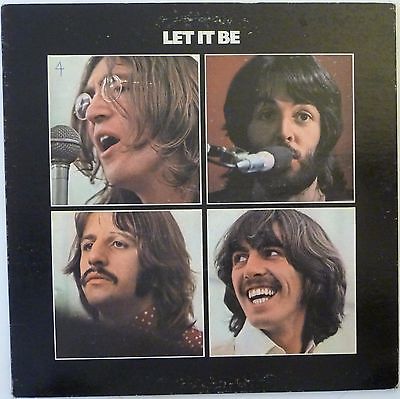
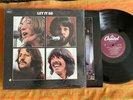
The Beatles, Let It Be Apple Records, AR 34001,Stereo,Gatefold, 1970, US
$
20


Favourite Auctions
To save auctions to your favourites, please login
If you don't have an account, please register
Description
Tracklist
A1 Two Of Us, Written by Lennon; McCartney, 3:33
A2 I Dig A Pony, Written by Lennon; McCartney, 3:55
A3 Across The Universe, Written by Lennon; McCartney, 3:51
A4 I Me Mine, Written by Harrison, 2:25
A5 Dig It, Written by Harrison, Lennon; McCartney, Starkey, 0:51
A6 Let It Be, Written by Lennon; McCartney, 4:01
A7 Maggie Mae, Arranged by Harrison, Lennon; McCartney, Starkey Written by P.D., 0:39
B1 I've Got A Feeling, Written by Lennon; McCartney, 3:38
B2 One After 909, Written by Lennon; McCartney, 2:52
B3 The Long And Winding Road, Written by Lennon; McCartney, 3:40
B4 For You Blue, Written by Harrison, 2:33
B5 Get Back, Written by Lennon; McCartney, 3:09
Companies, etc.
Manufactured By – Apple Records, Inc.
Mastered At – Bell Sound Studios
Pressed By – Capitol Records Pressing Plant, Los Angeles
Credits
Design – John Kosh
Keyboards [Uncredited] – Billy Preston (tracks: A2, A5, B1, B2, B5)
Lacquer Cut By – Sam Feldman
Photography By – Ethan Russell
Producer [Reproduced For Disc] – Phil Spector
Producer [Uncredited] [Original Recordings] – George Martin
From Wikipedia, the free encyclopedia:
Let It Be is the twelfth and final studio album by the English rock band the Beatles. It was released on 8 May 1970, almost a month after the group's break-up. Like most of the band's previous releases, it was a number one album in many countries, including both the US and the UK, and was released in tandem with the motion picture of the same name.
The album was conceived as Get Back, a return to the Beatles' earlier, less complicated approach to music. It was recorded and projected for release before their album Abbey Road (1969). For this reason, some critics and fans, such as Mark Lewisohn, argue that Abbey Road should be considered the group's final album and Let It Be the penultimate.
The recording sessions began at Twickenham Film Studios in January 1969 as part of a planned documentary showing the Beatles preparing to return to live performance. A project instigated by Paul McCartney, the filmed rehearsals were marked by ill-feeling within the band, leading to George Harrison's temporary departure from the group. As a condition of his return, the Beatles reconvened at their own Apple Studio, where they completed the recordings with the help of guest musician Billy Preston.
Following several rejected mixes by Glyn Johns, a new version of the album was created by Phil Spector. While three songs from the sessions were released as singles before the album's release, "Get Back" / "Don't Let Me Down" and "Let It Be", the songs were remixed by Spector for the album and "Don't Let Me Down" was not included.
Despite a mixed review from Rolling Stone at the time of its release, the album was ranked number 86 in the magazine's list of the 500 greatest albums of all time in 2003[3] but was adjusted to number 392 in the 2012 version.[4] Let It Be... Naked was released in 2003, an alternative version of the album, stripping much of Spector's production work and using some different versions of songs.
price rating





![Let It Be [LP] by Beatles (The) (Vinyl, Oct-1987, Capitol/EMI Records)](https://www.popsike.mobi/php/thumbnail.php?url=https://www.popsike.pics/pix/20240208/176229113420.jpg)