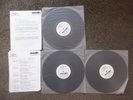
The Beatles ? Let it Be ? Rare 1970 Apple Records Original Press Vinyl LP ?
$
50


Favourite Auctions
To save auctions to your favourites, please login
If you don't have an account, please register
Description
Welcome to Classic Cadillac Records! I visually grade all my records as accurately as possible and will never grade anything above Near Mint unless it's still sealed. Please note that a visual grade can differ from a play grade, and am happy to spot check a record upon request. All orders are shipped within 1 business day (usually sooner) and packed with extra care to ensure fast, safe arrival. Please look closely at all pictures, read all relevant details and ask any questions you may have before buying. I offer a full 30-day return policy on everything I sell, so buy with confidence! And most importantly, thanks for looking!
Let It Be Studio album and partial live album by the Beatles Released 8 May 1970 Recorded February 1968 (Across the Universe),
January 1969,
January and April 1970 Venue Apple Corps rooftop, London Studio Apple, EMI and Twickenham Film Studios, London Genre Rock Length 35:10 Label Apple Producer Phil Spector the Beatles chronology Abbey Road
(1969) Let It Be
(1970) From Then to You
(1970) The Beatles North American chronology Hey Jude
(1970) Let It Be
(1970) The Beatles' Christmas Album
(1970) Singles from Let It Be
- "Get Back"
Released: 11 April 1969 - "Let It Be"
Released: 6 March 1970 - "The Long and Winding Road"
Released: 11 May 1970
Let It Be is the twelfth and final studio album by the English rock band the Beatles. It was released on 8 May 1970, almost a month after the group's break-up, in tandem with the motion picture of the same name. Like most of the band's previous releases, the album topped record charts in many countries, including both the US and the UK. However, the critical response was generally unfavourable, and Let It Be came to be regarded as one of the most controversial rock albums in history.
Rehearsals began at Twickenham Film Studios in January 1969 as part of a planned documentary showing the Beatles' return to live performance. Paul McCartney conceived the project as an attempt to reinvigorate the band by returning to simpler rock and roll configurations. The filmed rehearsals were marked by ill feeling, leading to George Harrison's temporary departure from the group. As a condition of his return, the members reconvened at their own Apple Studio with guest keyboardist Billy Preston. The project then yielded a single public concert held impromptu on the studio's rooftop on 30 January, from which three of the album's tracks were drawn.
In April 1969, the Beatles issued the single "Get Back", after which engineer Glyn Johns proposed rejected mixes of the album, then titled Get Back, that were widely bootlegged before release. From then, the project lay in limbo as they moved onto the recording of Abbey Road, released that September. By then, John Lennon had departed the group. In January 1970, the remaining Beatles finished the album with the completion of "Let It Be" and "I Me Mine". The former was issued as a single in March 1970, and like all the album's recording to this point, was produced by George Martin.
Get Back was ultimately assembled under the title of Let It Be by the American producer Phil Spector in early 1970. He omitted "Don't Let Me Down" (the B-side of the "Get Back" single) and instead included a 1968 take of "Across the Universe". Spector also included excerpts of studio chatter and applied orchestral and choir overdubs to four tracks. The additions offended McCartney, particularly in the case of "The Long and Winding Road". In 2003, McCartney spearheaded Let It Be... Naked, an alternative mix of Let It Be that removes Spector's embellishments.
Background
The Beatles completed the five-month sessions for their self-titled double album (also known as the "White Album") in mid October 1968. While the sessions had revealed deep divisions within the group for the first time, leading to Ringo Starr quitting for three weeks, the band enjoyed the opportunity to re-engage with ensemble playing, as a departure from the psychedelic experimentation that had characterised their recordings since the band's retirement from live performance in August 1966. Before the White Album's release, John Lennon enthused to music journalist Jonathan Cott that the Beatles were "coming out of our shell ... kind of saying: remember what it was like to play?" George Harrison welcomed the return to the band's roots, saying that they were aiming "to get as funky as we were in the Cavern".
Concerned about the friction over the previous year, Paul McCartney was eager for the Beatles to perform live again. With Lennon's agreement, he booked studio space at Twickenham Film Studios for all of January 1969, so that the band could be filmed rehearsing new songs for a live performance in a concert venue. The timeline was dictated by Harrison being away in the United States until Christmas and Starr's commitment to begin filming his role in The Magic Christian in February.
Final mixing
"Let It Be" MENU 0:00 The Beatles' "Let It Be" from Let It Be Problems playing this file? See media help.Several songs from the recording sessions have been released officially in versions different from those on the Let It Be album. "Get Back" and "Don't Let Me Down" were released on a single in April 1969 and "Let It Be" was the A-side of the band's March 1970 single. Seven tracks were live performances, in accordance with the original album concept: "I've Got a Feeling", "One After 909" and "Dig a Pony" from the rooftop performance, and "Two of Us", "Dig It", "Get Back" and "Maggie Mae" from studio sessions. Contrary to the original concept, the album versions of "For You Blue", "I Me Mine", "Let It Be" and "The Long and Winding Road" feature editing, splicing and/or overdubs. "Don't Let Me Down" was not included on the album. The third track on the album is an edited version of the original 1968 recording of "Across the Universe", played back at a slower speed (which lowered the key from D to D?), which had only been rehearsed at Twickenham and not professionally recorded on multi-track tape during the January 1969 sessions.
McCartney was dissatisfied with Spector's treatment of some songs, particularly "The Long and Winding Road". McCartney had conceived of the song as a simple piano ballad, but Spector dubbed in orchestral and choral accompaniment. McCartney unsuccessfully attempted to halt release of Spector's version or at least have it altered. Lennon defended Spector's work in his "Lennon Remembers" interview for Rolling Stone, saying, "he was given the shittiest load of badly recorded shit, with a lousy feeling toward it, ever. And he made something out of it. He did a great job." In 2003, McCartney spearheaded Let It Be... Naked, an alternative mix of Let It Be that removes Spector's embellishments.
Lennon chose not to credit Johns for his contribution as a producer. When EMI informed Martin that he would not get a production credit because Spector produced the final version, Martin commented: "I produced the original, and what you should do is have a credit saying 'Produced by George Martin, over-produced by Phil Spector'."
Packaging
In most countries except the United States, the Let It Be LP was originally presented in a box with a full colour book. The book contained photos from the January 1969 filming, by Ethan Russell; dialogue from the film, with all expletives removed at EMI's insistence; and essays by Rolling Stone writers Jonathan Cott and David Dalton. Despite the new album title, the book was still titled Get Back. Its inclusion was another step in the Beatles' efforts to provide increasingly elaborate packaging for their records since Sgt. Pepper's Lonely Hearts Club Band. The book's lavishness increased production costs by 33 per cent, however, driving the retail price higher than for any previous Beatles album.
The LP cover was designed by John Kosh and includes individual photos of the four band members, again taken by Russell. On the front cover, the photos are set in quadrants on a black surround. The album title appears in white text above the images but, as on Abbey Road and other Beatles LPs, the cover does not include the band's name.
Critical reception and legacy
Retrospective professional ratings Review scores Source Rating AllMusic The A.V. Club B? Billboard Chicago Sun-Times Christgau's Record Guide A? The Daily Telegraph Encyclopedia of Popular Music Pitchfork 9.1/10 The Rolling Stone Album Guide Sputnikmusic 4/5Let It Be topped album charts in both America and the UK, and the "Let It Be" single and "The Long and Winding Road" also reached number one in the US. Despite its commercial success, according to Beatles Diary author Keith Badman, "reviews [were] not good". NME critic Alan Smith wrote: "If the new Beatles' soundtrack is to be their last then it will stand as a cheapskate epitaph, a cardboard tombstone, a sad and tatty end to a musical fusion which wiped clean and drew again the face of pop." Smith added that the album showed "contempt for the intelligence of today's record-buyer" and that the Beatles had "sold out all the principles for which they ever stood". Reviewing for Rolling Stone, John Mendelsohn was also critical of the album, citing Spector's production embellishments as a weakness: "Musically, boys, you passed the audition. In terms of having the judgment to avoid either over-producing yourselves or casting the fate of your get-back statement to the most notorious of all over-producers, you didn't."
John Gabree of High Fidelity magazine found the album "not nearly as bad as the movie" and "positively wonderful" relative to the recent solo releases by McCartney and Starr. Gabree admired "Let It Be", "Get Back" and "Two of Us", but derided "The Long and Winding Road" and "Across the Universe", the last of which he described as "bloated and self-satisfied – the kind of song we've come to expect from these rich, privileged prototeenagers". While questioning whether the Beatles' split would remain permanent, William Mann of The Times described Let It Be as "Not a breakthrough record, unless for the predominance of informal, unedited live takes; but definitely a record to give lasting pleasure. They aren't having to scrape the barrel yet." In his review for The Sunday Times, Derek Jewell deemed the album to be "a last will and testament, from the blackly funereal packaging to the music itself, which sums up so much of what The Beatles as artists have been – unmatchably brilliant at their best, careless and self-indulgent at their least."
In a retrospective review, Richie Unterberger of AllMusic described Let It Be as the "only Beatles album to occasion negative, even hostile reviews", but felt that it was "on the whole underrated". He singles out "some good moments of straight hard rock in 'I've Got a Feeling' and 'Dig a Pony'", and praises "Let It Be", "Get Back", and "the folky 'Two of Us', with John and Paul harmonising together". Let It Be was ranked number 86 in Rolling Stone's list of the 500 Greatest Albums of All Time in 2003 and number 392 in the 2012 version. It was voted number 890 in the third edition of Colin Larkin's All Time Top 1000 Albums (2000).
In 1971, Let It Be won the Grammy Award for the Best Original Score Written for a Motion Picture or Television Special. Despite his objections to Spector's embellishments and the expensive packaging, including the "blatant hype" printed on the LP's back cover, McCartney personally accepted the band's award. The Beatles also won the Academy Award for the Best Original Song Score for the songs in the film. In 1988, the Slovenian band Laibach released a thrash metal version of the album, also titled Let It Be.
Track listing
Official release
All tracks are written by Lennon–McCartney, except where noted. Side one No. Title Writer(s) Lead vocals Length 1. "Two of Us" McCartney with Lennon 3:36 2. "Dig a Pony" Lennon 3:54 3. "Across the Universe" Lennon 3:48 4. "I Me Mine" George Harrison Harrison 2:26 5. "Dig It" Lennon, McCartney, Harrison, Richard Starkey Lennon 0:50 6. "Let It Be" McCartney 4:03 7. "Maggie Mae" Traditional(Arranged by: Lennon, McCartney, Harrison, Starkey) Lennon with McCartney 0:40 Total length: 19:17 Side two No. Title Writer(s) Lead vocals Length 1. "I've Got a Feeling" McCartney and Lennon 3:37 2. "One After 909" Lennon with McCartney 2:54 3. "The Long and Winding Road" McCartney 3:38 4. "For You Blue" Harrison Harrison 2:32 5. "Get Back" McCartney 3:09 Total length: 15:50
price rating