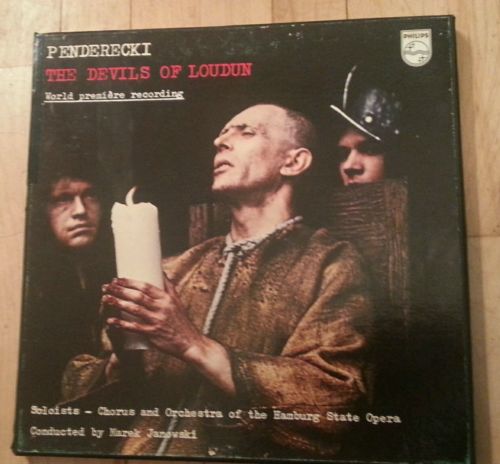
The Devils of Loudun 1969 Hamburg Opera 2 LPs 60 Pg Libretto PENDERECKI Box Set
$
26


Favourite Auctions
To save auctions to your favourites, please login
If you don't have an account, please register
Description
World Premiere Recording of The Devils of Loudun 1969 Hamburg State Opera by PENDERECKI.
Holland import of two Vinyl 33 1/3" LPs boxed set which includes 60 page illustrated 12"x12" Libretto.
The internal text is in English, German & Dutch.
Text on cover & spine in English.
The records themselves are in very good condition, no marks that I can see. The spine has been previously repaired, and also is in good condition. There are a few scuffs on the cover. I have attached photos of all four sides of the LP's.
I accept Paypal & Ship to the USA
Wiki info:
Die Teufel von Loudun (The Devils of Loudun) is an opera in three acts written in 1968 and 1969 by Polish composer Krzysztof Penderecki, and then revised in 1972 and 1975. It has a German libretto by the composer, based on John Whiting's dramatization of Aldous Huxley's novel.
The work was commissioned by the Hamburg State Opera, which consequently gave the premiere on June 20, 1969. Only 48 hours afterwards, the opera received its second performance in Stuttgart, followed two months later by its American debut mounted by the Santa Fe Opera.[1] The work was revised in 1972 following suggestions by Polish theatre director Kazimierz Dejmek.[2][3]This added two new scenes, excluded a scene from the opera's first act, regrouped other scenes, and modified the first act's instrumentation.[3] Finally, in 1975, Penderecki added two more scenes in the second act. Performances of The Devils of Loudun now generally follow this 1975 edition.
The Devils of Loudun, the first and most popular of Penderecki's operas, is emblematic of the composer's interest in historical events of traumatic nature.[4] As suggested by its title, the opera draws its story line from the 1632-38 mass demonic possession in the town of Loudun, France. However, rather than a narrative of these historical events, the opera underscores a more general dichotomy between central and local power,[5] and thus provides a political commentary, denouncing thereof the iniquities committed by the totalitarian states of the mid-20th century.[6] Accordingly, the opera thematic construct should be regarded as allegorical rather than merely historical.
price rating

![Mercyful Fate - Don't Break The Oath (Yellow, Black, LP) [PRE-ORDER]](https://www.popsike.mobi/php/thumbnail.php?url=https://www.popsike.pics/pix/20220515/334441426140.jpg)


