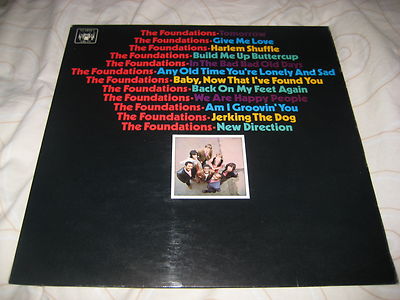
The Foundations Self Titled Eponymous UK Vinyl LP 1969 Marble Arch
£
19
$
25


Favourite Auctions
To save auctions to your favourites, please login
If you don't have an account, please register
Description
The Foundations Self Titled Eponymous UK Vinyl LP 1969 Marble Arch
The Foundations Self Titled Eponymous UK Vinyl LP 1969 Marble Arch
Marble Arch MAL 1157
A1 Any Old Time You're Lonely And Sad
A2 Give Me Love
A3 Back On My Feet Again
A4 Harlem Shuffle
A5 Build Me Up Buttercup
A6 Tomorrow
B1 Baby, Now That I've Found You
B2 New Direction
B3 Am I Groovin' Now
B4 In The Bad Bad Old Days
B5 Jerking The Dog
B6 We Are Happy People
Vinyl = EX
Sleeve= VG some storage wear.
The Foundations were a British soul band, active from 1967 to 1970. The group, made up of West Indians, White British, and a Sri Lankan, are best known for their two biggest hits, "Baby Now That I've Found You" (a Number One hit in the UK Singles Chart and Canada, and subsequently Top 10 in the US), written by Tony Macaulay and John MacLeod; and "Build Me Up Buttercup" (a number 3 on the Billboard Hot 100 and number 1 in Canada), co-written by Macaulay with Mike d'Abo, at the time the lead vocalist with Manfred Mann. The group was the first multi-racial group to have a number 1 hit in the UK in the 1960s.
The Foundations are notable for being one of the few label acts to successfully imitate what became known as the Motown Sound. In terms of line-up and musical style, they anticipated the sound of the more successful Hot Chocolate. They were in a similar musical vein as Love Affair, who also topped the UK charts in 1968 with their version of Robert Knight's "Everlasting Love". The Foundations signed to Pye, at the time one of only four big UK record companies (the others being EMI with its HMV, Columbia Records, and Parlophone labels; Decca; and Philips who also owned Fontana).
The Foundations drew much interest and intrigue due to the size and structure of the group. Not only was there a diverse ethnic mix in the group, but there was also diversity in ages and musical backgrounds. The oldest member of the group was Mike Elliott, who was 38 years old. The youngest was Tim Harris, who, at 18, was barely out of school. The West Indian horn section, which consisted of Jamaican-born Mike Elliott and Pat Burke, both saxophonists and Dominican-born Eric Allendale on trombone. They were all highly experienced musicians who came from professional jazz and rock-and-roll backgrounds. Mike Elliott had played in various jazz and rock and roll bands including Tubby Hayes and Ronnie Scott, the Cabin Boys (led by Tommy Steele's brother, Colin Hicks), and others. Pat Burke, a professional musician, was from the London Music Conservatorium. Eric Allendale had led his own band at one stage as well as having played with Edmundo Ros and being a former member of the Terry Lightfoot and Alex Walsh bands. Alan Warner, the guitarist, was also an experienced musician for his age, having played with numerous semi-pro groups from the age of 16. Bassist Peter Macbeth was a former teacher. Tony Gomez, the keyboard player, was a former clerk, while Clem Curtis had been an interior decorator and professional boxer.
The story of the origins of the Foundations can be somewhat surprising and a bit confusing as to who was responsible for choosing the band's name, and various sources give slightly different accounts of their beginnings. One version is that they were originally called The Ramong Sound or The Ramongs, and there were two lead singers, Clem Curtis and Psychedelic shock rocker Arthur Brown. Other variations on this are that after they dropped the "Ramong" from their name, they were then called The Foundation Squad or The Foundation Sound. Apparently, Arthur Brown was only a temporary member for about one month, and by the time the Foundations had signed to Pye, he had left the group.
The Foundations actually did come together in Bayswater, London in January 1967. They practiced and played in a basement club called the Butterfly Club, which they ran. While managing the club themselves, they played music nightly, and handled the cooking and cleaning. They would get to bed around 6 or 7 a.m., sleep until 4 p.m., get up and begin again to get ready to open at 8 p.m. Sometimes they barely made enough money to pay the rent, let alone feed themselves. At times, they lived off the leftovers and a couple of pounds of rice. They stayed there until they were eventually forced out by a protection racket gang and then had to move next door to a dingy unused mini-cab office.
While the biography on Allmusic states that Barry Class was the first to discover them, Alan Warner, the original founding member and lead guitarist of The Foundations and former Ramongs member states that it was actually Fairway who saw them in the dingy office and then introduced them to Class. Either way, both Fairway and Class teamed up to become their managers. Class took care of the business management, while Fairway went out promoting and trying to secure gigs for the group.
When they were at the top spot with "Baby, Now That I've Found You", Fairway commented to Melody Maker that most management would pull them out of the "bargain priced dates" that were booked for some time. He expressed gratitude to everyone for their support, and said that they would fulfill every engagement for which they had signed.
Not long after "Baby, Now That I've Found You" became a hit, rock historian Roger Dopson describes what followed as a "behind the scenes struggle", where Fairway was "pushed out" and his partner, Barry Class, remained as sole manager of the group. Fairway later attempted to sue the band, alleging that he was wrongfully dismissed, though the band said that he had resigned of his own accord. Dopson also noted that Fairway also leaked a story to the media saying that the Foundations had broken up which only served to keep the Foundations name in the news headlines. Fairway and Class eventually introduced them to Pye A&R man Tony Macaulay. The day Macaulay came to hear them play, he was suffering from what he described as the worst hangover of his life. The band was playing so loud he could not judge how good they were, but he decided to give them a chance. He would later comment in the book, 1000 UK #1 Hits by Jon Kutner and Spencer Leigh, that he woke up that morning with a stinking headache, and when he got to the studio and heard The Foundations, he thought they were pretty terrible. He decided his hangover was to blame, and so he gave them the benefit of the doubt.
They did a couple of tours backing The Toys and later Motown Records' Edwin Starr.Curtis doubted if this group called The Toys was the original Toys let alone American. They were noticed by Brian Epstein who added them to the roster of his NEMS Agency but the contract became void when he died.
When "Baby Now That I've Found You" was first released it went nowhere. Luckily the BBC's newly founded BBC Radio 1 were looking to avoid any records being played by the pirate radio stations and they looked back at some recent releases that the pirate stations had missed. "Baby, Now That I've Found You" was one of them. The single then took off and by November was number one in the UK Singles Chart. This was the ideal time because of the soul boom that was happening in England since 1965 and with American R&B stars visiting the UK, interest and intrigue in The Foundations was generated. Their second single released in January 1968, "Back On My Feet Again", did not do as well but made it to #18 in the UK,[2] and #29 in Canada. Also in January 1968 they were invited to put down some tracks for John Peel's radio show. One of the tracks that they laid down was a cover of ? and the Mysterians garage classic 96 Tears. On the same day PP Arnold was in the studio with Dusty Springfield and Madeline Bell as her backing vocalists.
price rating


![Impossible Kid [LP] by Aesop Rock (Vinyl, Apr-2016, 2 Discs, Rhymesayers Entert…](https://www.popsike.mobi/php/thumbnail.php?url=https://www.popsike.pics/pix/20190619/123808110342.jpg)