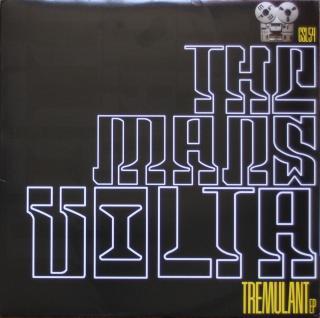
The Mars Volta - Tremulant EP, Yellow Vinyl NM
$
30


Favourite Auctions
To save auctions to your favourites, please login
If you don't have an account, please register
Description
With Original insert. Hard to find a copy this nice! NM! Limited edition! Super expensive if you could ever find a copy this clean in a record store. Over $100 for this on amazon Good luck!
Formed 2001 // Los Angeles, CA, United States
At The Drive-In splintered into Sparta and The Mars Volta. Cedric Bixler and Omar Rodriguez were the main duo behind the newly formed Mars Volta, and took the band into realms of hardcore, psychedelic rock and free jazz, rather a drastic change from ATDI's "emotional punk" sounds
The roots of The Mars Volta are found in the band At the Drive-In.[3] ATD imploded on the verge of breakthrough, partly due to boredom, partly to musical differences.[4] Then ATDI members Cedric Bixler-Zavala and Omar Rodríguez-López started flirting with an experimental, dub reggae-influenced side project called De Facto, which featured Bixler-Zavala on drums, Rodriguez-Lopez on bass, Isaiah "Ikey" Owens on keyboards, and Jeremy Michael Ward on vocals, loops and sound effects.
Due to creative differences and discomfort with mainstream success and drug abuse,[5] Rodriguez-Lopez and Bixler-Zavala quit At the Drive-In in 2001. The remaining members of the band formed Sparta. During 2001 Eva Gardner joined the members of De Facto on bass, and they recorded two songs with drummer Blake Fleming and producer Alex Newport, which became the first demo by The Mars Volta. The lineup for their first public show at Chain Reaction in Anaheim, California was Rodriguez-Lopez, Bixler-Zavala, Owens, Gardner, Ward, and drummer Jon Theodore. This lineup recorded three more tracks with Alex Newport, which became the EP Tremulant, released as a limited edition in early 2001.
After the demise of At the Drive-In, Rodriguez-Lopez and Bixler-Zavala found themselves once again starting from the ground up, touring and performing in smaller venues. In their early years The Mars Volta were characterized by chaotic live shows and very heavy drug useRegarding the recording sessions, in 2009 bassist Eva Gardner stated that:
"We were in Long Beach somewhere, and it was a really exciting time because it was just this new music. It was a new project for these guys, so they were almost really excited about it. It was great. We did three songs, and it was so fun for me too because it was the first time I had actually been in a more professional... I had done recordings before, but it was just home studios with friends and stuff. This was a more established group. It was fun to be in a professional studio, and to play with really, really great musicians."
Cedric Bixler-Zavala stated in an interview:
"The Volta is taken from a Federico Fellini book about his films, what he characterizes as a changing of scene, or a turnaround; a new scene to him is called Volta. Y'know, changing of time and the changeover. And Mars, we're just fascinated by science fiction so and it's something that ultimately looked as in anything I write, its meaning is always up to the listener. As the way we write songs and words, if it looks great on paper then to us it's like painting, so if it looks good meaning the second then people usually have a better interpretation than we ever would."
Catalog#: GSL54
Tracklist
A1Cut That City
A2
Concertina
B
Eunuch Provocateur
"Concertina", often regarded as the centerpiece of the EP, is rumoured to be a brutal condemnation of Ben Rodriguez, a former bandmate of Cedric and Omar's from At the Drive-In, whom Cedric and Omar regarded as a sociopath. According to interviews conducted with the band, they held Rodriguez responsible for tormenting Julio Venegas to the point where he committed suicide. The band later re-recorded the song alongside "Eunuch Provocateur". (These re-records have yet to surface on an official release, however they can be obtained legally from the Comatorium's trading forum).
The backwards vocals at the end of "Eunuch Provocateur" are the lyrics from the song "Itsy Bitsy Spider". Other backwards vocals in the same song can be heard saying "did mommy or daddy ever have to spank you?". These samples come from an old vinyl the band used that contained children's songs. Other notable lyrics in "Eunuch Provocateur" include the lines, "Dethroned by the comatorium... de-loused in the comatorium", which foreshadow the Mars Volta's debut full-length album, De-Loused in the Comatorium. Additionally, the title of the EP itself is drawn from the concept story of De-Loused in the Comatorium, referring to the "tremulants", creatures that dwell inside the mind of Cerpin Taxt, the main character.
Credits
- Artwork By [Layout], Photography - Omar Rodriguez, Sonny Kay
- Mastered By - Bob Ludwig
- Performer - Cedric Bixler Zavala*, Eva Catharine Gardner*, Isaiah Ikey Owens*, Jeremy Michael Ward, Jon Philip Theodore*, Omar Alfredo Rodriguez-Lopez*
- Producer - Alex Newport, Mars Volta, The
- Recorded By - Alex Newport
- Written-By - Mars Volta, The
Notes
Recorded in Long Beach, CA Oct-Dec 2001.
Mastered at Gateway.
? 2002 Shrimp Town [BMI], Dystopia [SESAC], Lopsided [SESAC], Paganroma [SESAC], Songs for Luna [ASCAP].
© 2002 Gold Standard Laboratories.
Please contact with any questions.
Goldmine Standard for listing the condition of items for sale.
Mint (M)
Absolutely perfect in every way. Certainly never been played, possibly even still sealed. Should be used sparingly as a grade, If at all.
Near Mint (NM or M-)
A nearly perfect record. Many dealers won't give a grade higher than this implying (perhaps correctly) that no record is ever truly perfect. The record should show no obvious signs of wear. A 45 RPM or EP sleeve should have no more than the most minor defects, such as almost invisible ring wear or other signs of slight handling. An LP cover should have no creases, folds, seam splits or other noticeable similar defects. No cut-out holes, either. And of course, the same should be true of any other inserts, such as posters, lyric sleeves and the like. Basically, an LP in near mint condition looks as if you just got it home from a new record store and removed the shrink wrap. Near Mint is the highest price listed in all Goldmine price guides. Anything that exceeds this grade, in the opinion of both buyer and seller, is worth significantly more than the highest Goldmine book value.
Very Good Plus (VG+)
Generally worth 50 percent of the Near Mint value. A Very Good Plus record will show some signs that it was played and otherwise handled by a previous owner who took good care of it. Record surfaces may show some signs of wear and may have slight scuffs or very light scratches that don't affect one's listening experiences. Slight warps that do not affect the sound are "OK". The label may have some ring wear or discoloration, but it should be barely noticeable. The center hole will not have been misshapen by repeated play. Picture sleeves and LP inner sleeves will have some slight wear, lightly turned up corners, or a slight seam split. An LP cover may have slight signs of wear also and may be marred by a cut-out hole, indentation or corner indicating it was taken out of print and sold at a discount. In general, if not for a couple things wrong with it, this would be Near Mint. All but the most mint-crazy collectors will find a Very Good Plus record highly acceptable.
Very Good (VG)
Generally worth 25 percent of Near Mint value. Many of the defects found in a VG+ record will be more pronounced in a VG disc. Surface noise will be evident upon playing, especially in soft passages and during a song's intro and fade, but will not overpower the music otherwise. Groove wear will start to be noticeable, as with light scratches (deep enough to feel with a fingernail) that will affect the sound. Labels may be marred by writing, or have tape or stickers (or their residue) attached. The same will be true of picture sleeves or LP covers. However, it will not have all of these problems at the same time, only two or three of them. Goldmine price guides with more than one price will list Very Good as the lowest price. This, not the Near Mint price, should be your guide when determining how much a record is worth, as that is the price a dealer will normally pay you for a Near Mint record.
Good (G), Good Plus (G+)
Generally worth 10-15 percent of the Near Mint value. Good does not mean Bad! A record in Good or Good Plus condition can be put onto a turntable and will play through without skipping. But it will have significant surface noise and scratches and visible groove wear (on a styrene record, the groove will be starting to turn white). A cover or sleeve will have seam splits, especially at the bottom or on the spine. Tape, writing, ring wear or other defects will start to overwhelm the object. If it's a common item, you'll probably find another copy in better shape eventually. Pass it up. But, if it's something you have been seeking for years, and the price is right, get it...but keep looking to upgrade.
Poor (P), Fair (F)
Generally worth 0-5 percent of the Near Mint price. The record is cracked, badly warped, and won't play through without skipping or repeating. The picture sleeve is water damaged, split on all three seams and heavily marred by wear and writing. The LP cover barely keeps the LP inside it. Inner sleeves are fully seam split, crinkled, and written upon. Except for impossibly rare records otherwise unattainable, records in this condition should be bought or sold for no more than a few cents each.
On 12-Apr-11 at 16:37:29 EDT, seller added the following information:first 1st pressing.
price rating