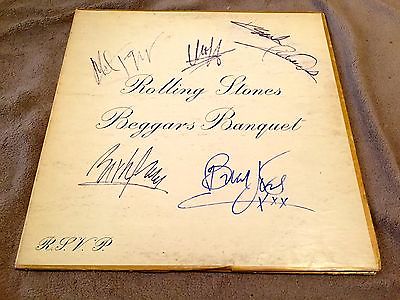
The Rolling Stones "Beggars Banquet" Autographed Album (Roots Rock)
$
350


Favourite Auctions
To save auctions to your favourites, please login
If you don't have an account, please register
Description
Released
6 December 1968
Recorded
17 March – 25 July 1968 at Olympic Studios, London
Genre
Roots rock[1]
Length
39:44
Label
Decca (UK)
London (US)
Producer
Jimmy Miller
All songs written by Mick Jagger and Keith Richards, except "Prodigal Son" by Robert Wilkins.
Side one
No.
Title
Length
1.
"Sympathy for the Devil"
6:18
2.
"No Expectations"
3:56
3.
"Dear Doctor"
3:28
4.
"Parachute Woman"
2:20
5.
"Jigsaw Puzzle"
6:06
Side two
No.
Title
Length
6.
"Street Fighting Man"
3:16
7.
"Prodigal Son"
2:51
8.
"Stray Cat Blues"
4:38
9.
"Factory Girl"
2:09
10.
"Salt of the Earth"
4:48
Critics considered the LP a return to form.[16] It was also a clear commercial success, reaching No. 3 in the UK and No. 5 in the US (on the way to eventual platinum status).[citation needed] The political correctness of "Street Fighting Man", particularly the ambivalent lyrics "What can a poor boy do/'Cept sing in a rock and roll band", sparked intense debate in the underground media.[2] Music critic Robert Christgau ranked it as the third best album of the year and "Salt of the Earth" the best pop song of the year in his ballot for Jazz & Pop magazine's annual critics poll.[25]
In a retrospective review for eMusic, music critic Ben Fong-Torres called Beggars Banquet "an album flush with masterful and growling instant classics", and said that it "responds more to the chaos of '68 and to themselves than to any fellow artists ... the mood is one of dissolution and resignation, in the guise of a voice of an ambivalent authority."[19] Colin Larkin, writing in the Encyclopedia of Popular Music (2006), viewed it as "a return to strength" which included "the socio-political 'Street Fighting Man' and the brilliantly macabre 'Sympathy for the Devil', in which Jagger's seductive vocal was backed by hypnotic Afro-rhythms and dervish yelps."[20] Larry Katz of the Boston Herald called Beggars Banquet "both a return to basics and leap forward."[18] In his review for Rolling Stone magazine, Anthony DeCurtis said that the album was "filled with distinctive and original touches", and remarked on its legacy:
For the album, the Stones had gone to great lengths to toughen their sound and banish the haze of psychedelia, and in doing so, they launched a five-year period in which they would produce their very greatest records.[2]
According to Martin C. Strong, Beggars Banquet was the first album in "a staggering burst of creativity" in a five-year period that ultimately comprised four of the best rock albums of all time.[22] In 2003, the album was ranked No. 58 on Rolling Stone magazine's list of the 500 greatest albums of all time.[26] In the same year, the TV network VH1 named Beggars Banquet the 67th greatest album of all time. The album is also featured in the book 1001 Albums You Must Hear Before You Die.[27]