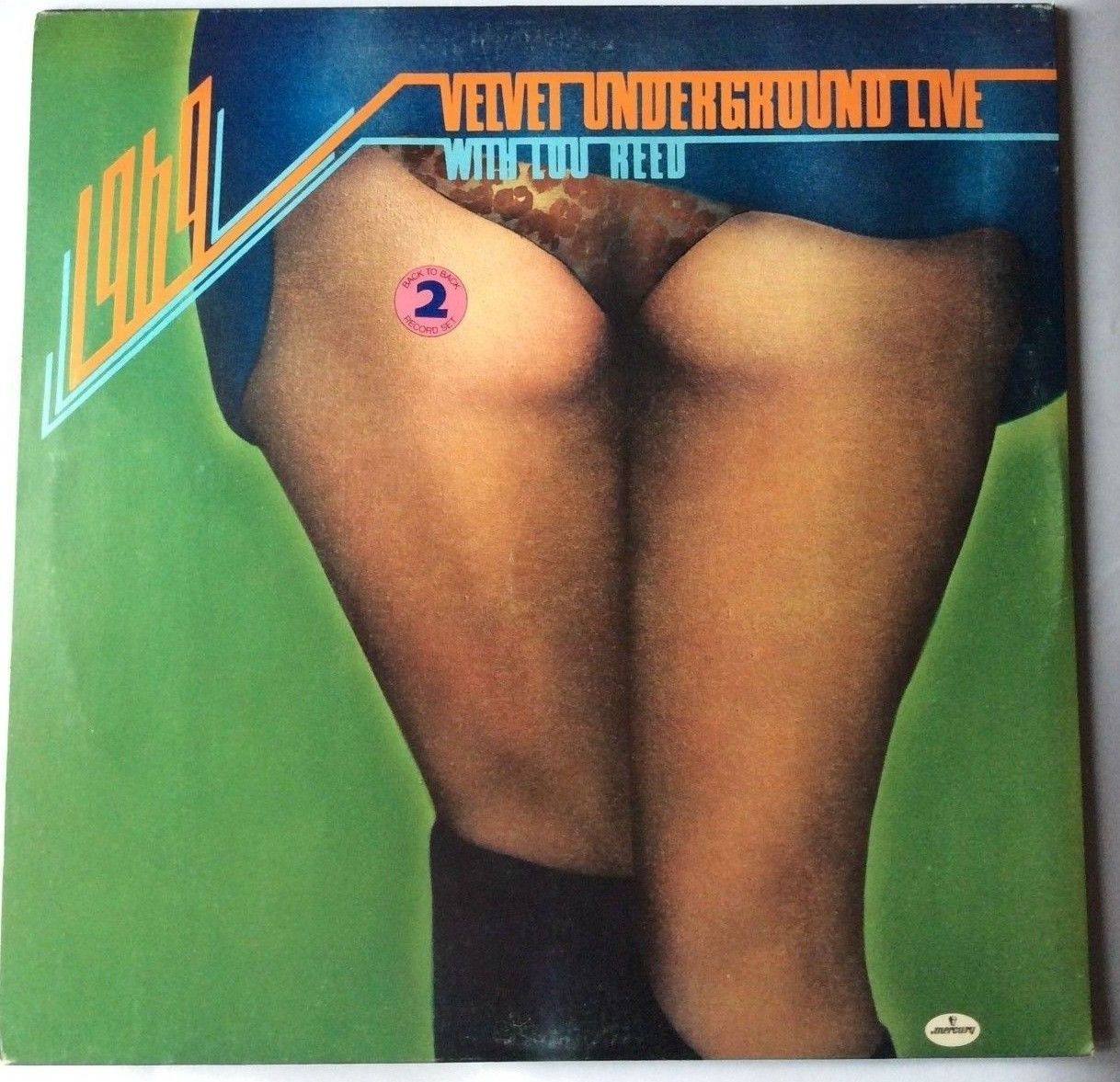
The Velvet Underground - 1969 Live with Lou Reed - DBL LP - issued 1974
£
15
$
19


Favourite Auctions
To save auctions to your favourites, please login
If you don't have an account, please register
Description
1969: The Velvet Underground Live is a live album originally released as a double album in September 1974 by Mercury Records.
During 1969, the Velvet Underground toured the United States and Canada, playing well over 70 dates.[4] By this time, the band had picked up a sizeable fan base and every now and then a fan would bring along, with consent of the band, recording equipment to record a set.
Most of the time, this would mean relatively simple hand-held recorders resulting in lo-fi audience recordings. On two occasions, however, professional equipment was used. On October 19, 1969, in the End of Cole Ave. club, Dallas, a fan who happened to be a recording engineer brought along his professional gear; and in November at The Matrix in San Francisco, the band was given permission to use the in-house four-track recording desk.
The band were given two-track mixdown tapes from the recordings for reference, but nothing was done with them until 1974, after the band had dissolved and Lou Reed had become well known as a solo artist. According to bassist Doug Yule, "The release of 1969 Live... was started by Steve Sesnick [former band manager], who had the tapes and was trying to sell them to get money for himself claiming that he owned the [band] name and the rights to the album... Somehow somebody else got involved and contacted other people in the group and basically Sesnick got done. [Lou Reed's management] took the tapes and said 'It's not yours' and released it".[5]
The mixdown tapes were submitted to Mercury Records, who agreed to release a compilation of the best performances as a double album. The compiling was done by music critic Paul Nelson, who at the time was working in A&R (artists and repertoire) at Mercury. When 1969 was released, it immediately became subject of a lawsuit as The Matrix's management had never given permission for their material to be used on a commercial release. The matter was settled out of court.
The tracks on 1969 are for the most part of good sound quality, resulting from four-track recording equipment being used. Some of the tracks feature light crackling, however, as they were sourced from acetates, the original tapes having been lost. The CD release is worse in this regard, as it appears that some tracks were sourced from a vinyl copy of the album. There is little ambiance or audience sound, however, because no audience mic was used and so the only ambience the listener gets is whatever little the vocal and drums mics picked up. This makes the record sound relatively flat and small and makes it seem that only a handful of people were present.
At the time of the album's release, three of its songs ("We're Gonna Have a Real Good Time Together", "Over You" and "Sweet Bonnie Brown"/"It's Just Too Much") had never been released in any form, two ("Lisa Says" and "Ocean") were previously only known from the versions on Reed's debut solo album, and "New Age" and "Sweet Jane" were radically different from the eventual Loaded studio versions. In addition, much of the rest of the album lends credence to a popular saying about the band—that they would not (or could not) play a song the same way twice. In particular, "I'm Waiting For The Man" (here called "Waiting For My Man") is performed in a country-rock manner; "Femme Fatale" is louder and more aggressive, and "White Light/White Heat" is extended from two-and-a-half minutes to over eight minutes of avant-garde guitar improvisation. The album is also notable for featuring songs sung by different singers from the album versions: Reed sings "New Age" (later sung by Yule on Loaded) and "Femme Fatale" (originally sung by Nico) and Yule sings "I'll Be Your Mirror" (also originally by Nico).
The album contains liner notes by Paul Nelson and by singer/songwriter Elliott Murphy.
Tracklist:
Waiting For My Man 7:00
Lisa Says 5:46
What Goes On 8:47
Sweet Jane 3:58
We're Gonna Have A Real Good Time Together 3:12
Femme Fatale 3:01
New Age 6:31
Rock And Roll 6:00
Beginning To See The Light 5:26
Ocean 10:46
Pale Blue Eyes 5:50
Heroin 9:42
Some Kinda Love 4:44
Over You 2:15
Sweet Bonnie Brown/It's Just Too Much 7:50
White Light/White Heat 8:32
I'll Be Your Mirror 2:17
© Goldmine magazine Grading Guide : Mint | Near Mint | Very Good Plus | Very Good | Good/Good Plus | Poor/Fair
Sleeve / Record grading: Nr Mint / Nr Mint
Mint (M): Absolutely perfect in every way - certainly never played, possibly even still sealed. (More on still sealed below). Should be used sparingly as a grade, if at all.
Near Mint (NM or M-): A nearly perfect record. Many dealers won't give a grade higher than this implying (perhaps correctly) that no record is ever truly perfect. The record shows no obvious sign of wear. A 45 rpm sleeve has no more than the most minor defects, such as almost invisible ring wear or other signs of slight handling.
An LP jacket has no creases, folds, seam splits or any other noticeable similar defect. No cut-out holes, either. And of course, the same is true of any other inserts, such as posters, lyric sleeves, and the like. Basically, Near Mint looks as if you just got it home from a new record store and removed the shrink wrap.
Very Good Plus (VG+): Shows some signs that it was played and otherwise handled by a previous owner who took good care of it. Record surfaces may show some slight signs of wear and may have slight scuffs or very light scratches that don't affect one's listening experience. Slight warps that do not affect the sign are OK.
The label may have some ring wear or discoloration, but is should be barely noticeable. The centre hole is not misshapen by repeated play. Picture sleeves and LP inner sleeves will have some slight wear, lightly turn-up corners, or a slight seam-split. An LP jacket may have slight signs of wear also and may be marred by a cut-out hole, indentation or corner indicating it was taken out of print and sold at a discount.
In general, if not for a couple of minor things wrong with it, this would be Near Mint. All but the most mint-crazy collectors will find a Very Good Plus record highly acceptable.
Very Good (VG): Many of the defects found in a VG+ record are more pronounced in a VG disc. Surface noise is evident upon playing, especially in soft passages and during the song's intro and fade, but will not overpower the music otherwise. Groove wear will start to be noticeable, as will light scratches (deep enough to feel with a fingernail) that will affect the sound.
Labels may be marred by writing, or have tape or stickers (or their residue) attached. The same will be true of picture sleeves or LP covers. However, it will not have all of these problems at the same.
Good (G), Good Plus (G+): Good does not mean bad! A record in Good or Good Plus condition can be put onto a turntable and will play through without skipping. But it will have significant surface noise and scratches and visible groove wear.
A jacket or sleeve has seem splits, especially at the bottom or on the spine. Tape, writing, ring wear or other defects will start to overwhelm the object. If it's a common item, you'll probably find another copy in better shape eventually. Pass it up. But if it's something you have been seeking for years, and the price is right, get it.
Record play tested on Thorens TD 320 Mk 2 with Ortofon Bronze at 1.5g through Quad 34/405-2 & Celestion Ditton 66 Studio Monitors.
price rating