Uncle Tupelo "I Got Drunk" 7" OOP Wilco Son Volt Jeff Tweedy Ryan Adams Old 97's
$
35


Favourite Auctions
To save auctions to your favourites, please login
If you don't have an account, please register
Description
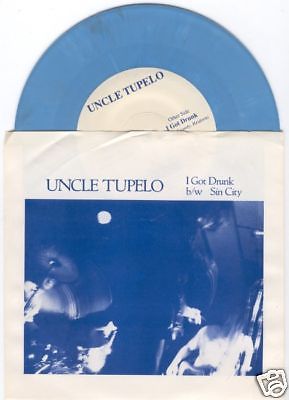
Uncle Tupelo "I Got Drunk" 7" Rockville Records (US)
Record is NM, Jacket is VG!!
Tough to Find!! Out of Print!!
Pressed on Blue Marbled Wax!
Track Listing:
A1. I Got Drunk
B/W
B1. Sin City
Uncle Tupelo was an alternative country music group from Belleville, Illinois, active between 1987 and 1994. Jay Farrar, Jeff Tweedy, and Mike Heidorn formed the band after the lead singer of their previous band, The Primitives, left to attend college. The trio recorded three albums for Rockville Records, before signing with Sire Records and expanding to a five-piece. Shortly after the release of the band's major label debut album Anodyne, Farrar announced his decision to leave the band due to a soured relationship with his co-songwriter Tweedy. Uncle Tupelo split on May 1, 1994, after completing a farewell tour. Following the breakup, Farrar formed Son Volt with Heidorn, while the remaining members continued as Wilco.
Although Uncle Tupelo broke up before it achieved commercial success, the band is renowned for its impact on the alternative country music scene. The group's first album, No Depression, became a byword for the genre and was widely influential. Uncle Tupelo's sound was unlike popular country music of the time, drawing inspiration from styles as diverse as the hardcore punk of The Minutemen and the country instrumentation and harmony of the Carter Family and Hank Williams. Farrar and Tweedy lyrics frequently referenced Middle America and the working class of Belleville.
Early career
An early poster for an Uncle Tupelo show, in the style of Chuck Wagner's original drawingThe Primitives renamed itself Uncle Tupelo after a character in a cartoon drawn by Chuck Wagner, a friend of the band's members. The name was created by combining two randomly chosen words from the dictionary; inspired by the name, Wagner drew a picture of an old, fat Elvis. The trio recorded a four-song demo tape, which won them supporting roles at the concerts of artists such as Johnny Thunders and Warren Zevon. Tweedy met Tony Margherita while moonlighting as a record clerk in St. Louis. After attending a pair of the band's concerts, Margherita offered to become its manager. Uncle Tupelo began to play regular shows at Cicero's Basement—a bar close to the campus of Washington University. Bands playing in a similar style, including Brian Henneman's Chicken Truck, often played at the venue, which by late 1988 was considered to have been the origin of a new music scene. The band temporarily expanded to a four-piece with the addition of the guitarist Alex Mutrux, but soon reverted back to a trio.
Uncle Tupelo recorded its first tracks in the studio of the pop rock singer Adam Schmitt in Champaign, Illinois. The demo Not Forever, Just for Now includes the songs "I Got Drunk" and "Screen Door", as well as early versions of several songs that would appear on their first studio album. The CMJ New Music Report gave the tape a rave review, and called Uncle Tupelo the best unsigned band of the year. The accolade attracted the attention of independent labels, and the band decided to sign with Jay Fialkov and Debbie Southwood-Smith of Giant Records (who offered to book them at CBGB in New York City). Explaining the decision, the band said that "[our] original goals don't get distorted with an independent label."
Recordings on Rockville Records
Shortly after Uncle Tupelo's signing, Giant Records changed its name to Rockville Records. The band's first album for Rockville No Depression, was recorded over ten days in January 1990, at Fort Apache South recording studio in Boston, Massachusetts. The album's thematic structure revolved around their lives as adolescents in Belleville; examples are songs about wanting to avoid factory work and songs about fearing a potential Persian Gulf War military draft. Impressed by their previous work on Dinosaur Jr's Bug, the band wanted Paul Kolderie and Sean Slade to produce the album. Slade let Farrar play on the same 1961 Gibson Les Paul SG Junior that J. Mascis originally played on Bug. The album was released on June 21, 1990, and the band celebrated by playing at Cicero's for two nights.
In between tours, Farrar, Tweedy and Heidorn formed a country cover band named Coffee Creek, along with Brian Henneman (later a member of The Bottle Rockets). Henneman impressed Uncle Tupelo, and he was invited to be a guitar technician and occasional multi-instrumentalist for the band. While Farrar and Heidorn would avoid drinking too much after shows, Tweedy would continue drinking throughout the night. Although Tweedy stopped after he began dating Sue Miller in 1991, a significant communication gap had already been opened between Tweedy and Farrar.
By March 1991, No Depression had sold an estimated 15,000 copies, and was featured in a Rolling Stone article about rising stars. However, Rockville Records refused to pay the band any royalties for the album, a theme that would continue for the remainder of the band's contract. Over seventeen days the band recorded a second album at Long View Farm in rural North Brookfield, Massachusetts. Still Feel Gone, with a more layered sound, was also produced by Kolderie and Slade, with contributions by Slade, Henneman, Rich Gilbert, Chris Bess of Enormous Richard, and Gary Louris of The Jayhawks. The band was disappointed with the production of the album and decided to discontinue working with Kolderie and Slade. Soon afterward, Uncle Tupelo recorded "Shaking Hands (Soldier's Joy)" on Michelle Shocked's album Arkansas Traveler and joined her on the accompanying tour with Taj Mahal and The Band. However, the tour only lasted for a few shows because of managerial problems between Shocked and The Band.
Alternative rock had broken into the mainstream by 1992, and an album released in that style was expected to earn the group a major-label record deal. However, Uncle Tupelo didn't want to follow in the footsteps of groups such as Nirvana, and decided to play country and folk songs "as a big 'f*ck you' to the rock scene". Peter Buck, guitarist for R.E.M., saw the trio perform at the 40 Watt Club in Athens, Georgia and sought them out after the show. Buck was impressed with a version of "Atomic Power" that the band played, and offered his services for their next album. Over a span of five days, Buck produced the group's next album, March 16-20, 1992. Buck allowed them to stay in his house during the sessions, and charged no money for his services. Brian Henneman's role was increased for this album, and he taught himself how to play mandolin and bouzouki. Despite turning away from the style of popular alternative rock, major labels began to show significant interest in Uncle Tupelo after March 16-20, 1992 was released. The album sold more than their two previous recordings combined, although Rockville was displeased that it did not conform to the style of popular alternative rock. Son Volt Wilco.
Winner pays $3.95 Shipping in the US. Internationally winner pays $7.95. All records are shipped in professional 7” & 12” box mailers. All CDs are shipped in padded bubble mailers. Buy multiple items and save on shipping. Thanks for Visiting!!
price rating