VEENA DUETTO V C PADMA VIJAYA VISHWANATH mridangam carnatic LP CLASSICAL vg++
$
140


Favourite Auctions
To save auctions to your favourites, please login
If you don't have an account, please register
Description
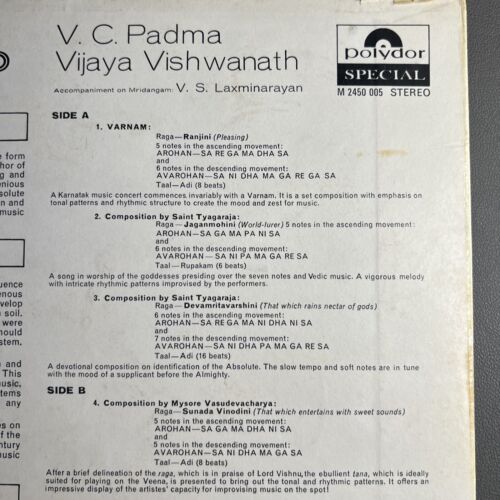
VEENA DUETTO V C PADMA VIJAYA VISHWANATH mridangam carnatic LP CLASSICAL vg++.
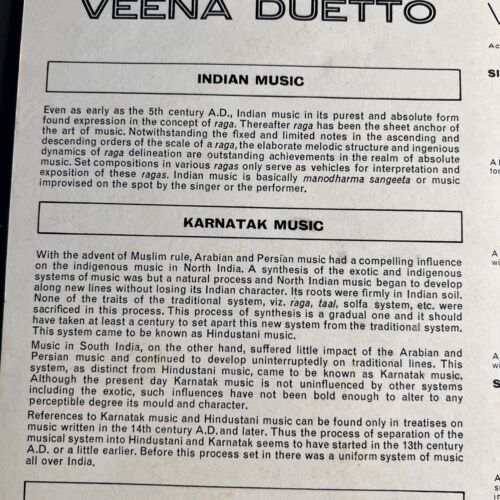
Even as early as the 5th century A.D., Indian music in its purest and absolute form found expression in the concept of raga. Thereafter raga has been the sheet anchor of the art of music. Notwithstanding the fixed and limited notes in the ascending and descending orders of the scale of a raga, the elaborate melodic structure and ingenious dynamics of raga delineation are outstanding achievements in the realm of absolute music. Set compositions in various ragas only serve as vehicles for interpretation and exposition of these ragas. Indian music is basically manodharma sangeeta or music improvised on the spot by the singer or the performer.
With the advent of Muslim rule, Arabian and Persian music had a compelling influence on the indigenous music in North India. A synthesis of the exotic and indigenous systems of music was but a natural process and North Indian music began to develop along new lines without losing its Indian character. Its roots were firmly in Indian soil.
None of the traits of the traditional system, viz. raga, taal, solfa system, etc. were sacrificed in this process. This process of synthesis is a gradual one and it should have taken at least a century to set apart this new system from the traditional system.
This system came to be known as Hindustani music.
Music in South India, on the other hand, suffered little impact of the Arabian and Persian music and continued to develop uninterruptedly on traditional lines. This system, as distinct from Hindustani music, came to be known as Karnatak music.
Although the present day Karnatak music is not uninfluenced by other systems including the exotic, such influences have not been bold enough to alter to any perceptible degree its mould and character.
References to Karnatak music and Hindustani music can be found only in treatises on music written in the 14th century A.D. and later. Thus the process of separation of the musical system into Hindustani and Karnatak seems to have started in the 13th century A.D. or a little earlier. Before this process set in there was a uniform system of music all over India,
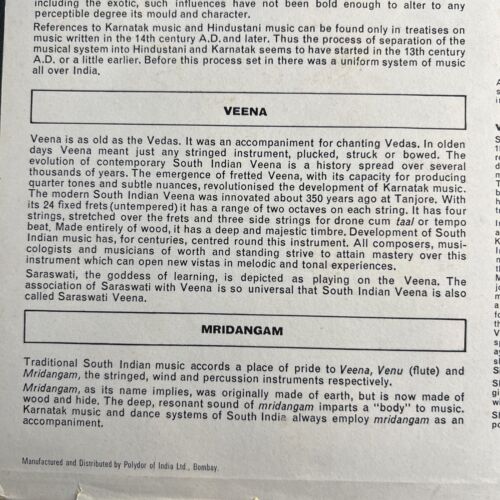
Veena is as old as the Vedas. It was an accompaniment for chanting Vedas. In olden days Veena meant just any stringed instrument, plucked, struck or bowed. The evolution of contemporary South Indian Veena is a history spread over several thousands of years. The emergence of fretted Veena, with its capacity for producing quarter tones and subtle nuances, revolutionised the development of Karnatak music.
The modern South Indian Veena was innovated about 350 years ago at Tanjore. With its 24 fixed frets (untempered) it has a range of two octaves on each string. It has four strings, stretched over the frets and three side strings for drone cum taal or tempo beat. Made entirely of wood, it has a deep and majestic timbre. Development of South Indian music has, for centuries, centred round this instrument. All composers, musicologists and musicians of worth and standing strive to attain mastery over this instrument which can open new vistas in melodic and tonal experiences.
Saraswati, the goddess of learning, is depicted as playing on the Veena. The association of Saraswati with Veena is so universal that South Indian Veena is also called Saraswati Veena.
Traditional South Indian music accords a place of pride to Veena, Venu (flute) and Mridangam, the stringed, wind and percussion instruments respectively.
Mridangam, as its name implies, was originally made of earth, but is now made of wood and hide. The deep, resonant sound of mridangam imparts a "body" to music.
Karnatak music and dance systems of South India always employ mridangam as an accompaniment.
price rating