VERY RARE ABC 1963 OUTER LIMITS #1 PREQUEL INTERVIEW
$
1,000


$ 1000
Sold For
Sep 1, 2011
Sold Date
Jan 30, 2011
Start Date
1
Number Of Bids
USA
Country Of Seller
eBay
Sold at
Favourite Auctions
To save auctions to your favourites, please login
If you don't have an account, please register
Description
VERY RARE ABC 1963 OUTER LIMITS #1 PREQUEL INTERVIEW
THERE IS SOME PHOTO FLASH ON A COUPLE OF THE PHOTOS
NO RESERVE
ONE OF A KIND ITEM!
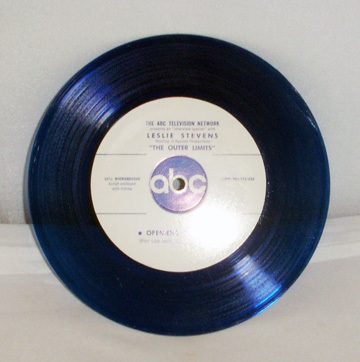
RARE VINTAGE 1963 ABC OPEN-ENDED INTERVIEW WITH CREATOR LESLIE STEVENS RECORDED BLUE VINYL RECORD OF HIS NEW SERIES
THE OUTER LIMITS
ABC RECORDS 963-172-172-USA
THIS WAS USED FOR A LOCAL COMMENTATOR TO APPEAR THAT HE WAS ACTUALLY INTERVIEWING LESLIE STEVENS. THE SCRIPT IS NOT INCLUDED, I NEVER HAD IT - THIS IS A PRE SERIES INTERVIEW - I HAVE HAD THIS IN MY COLLECTION SINCE THE EARLY 1970s AND JUST LOCATED IT IN A BOX, IT IS NOT A MODERN COPY BUT IS THE REAL THING.
I PLAYED THIS YEARS AGO AND THERE ARE GAPS WHERE THE COMMENTATOR WOULD ASK QUESTIONS, THEN IT WOULD APPEAR THAT STEVENS ANSWERED THE QUESTIONS ASKED.
THIS IS ON 33 1/3 MICROGROOVE AND IS ONE SIDED
IT IS IN IMMACULATE CONDITION, DOES NOT APPEAR THAT IT HAS BEEN PLAYED MORE THAN THE ONE TIME I PLAYED IT YEARS AND YEARS AGO
I HAVE NEVER SEEN ANYTHING LIKE THIS, IT IS EXTREMELY SCARCE AND I CANNOT FIND ANY REFERENCE TO IT ANYWHERE.
LESLIE STEVENS WAS THE CREATER OF THE OUTER LIMITS AND WAS DIRECTOR AND WRITER OF THE SERIES FIRST EPISODE "THE GALAXY BEING" THAT AIRED 16 SEPTEMBER 1963
GIFSoup
I HAVE NO IDEA WHAT THE VALUE OF THIS IS BUT IT HAS TO BE PRICELESS TO COLLECTORS, YOU WON'T FIND ANOTHER LIKE IT. I AM SURE THAT THE OTHERS THAT WERE PRESSED ARE LONG-LOST. BLUE VINYL ON THIS IS ALSO AN ODDITY FOR THE ERA.
This is a fantastic RETRO SCIENCE FICTION memorabilia item!! It is in GREAT SHAPE and very rare. THERE APPEAR TO BE NO FLAWS ON THIS ITEM. Some may be more critical than others so I ask that you please ask questions prior to bidding.
THE OUTER LIMITS INSPIRED MANY SCIENCE FICTION TELEVISION SHOWS AND MOVIES
The Outer Limits is an American television series that aired on ABC from 1963 to 1965. Similar in style to the earlier The Twilight Zone with more science fiction than fantasy stories, The Outer Limits is an anthology of discrete story episodes, sometimes with a plot twist at the end. The series was revived in 1995, airing on Showtime from 1995–1999, then on Sci-Fi Channel from 1999 until its cancellation in 2002. Each show would begin with either a cold open or a preview clip, followed by narration by someone identifying himself as the Control Voice, which was played over visuals of an oscilloscope. The earlier and longer version of the narration ran as follows.
“ There is nothing wrong with your television set. Do not attempt to adjust the picture. We are controlling transmission. If we wish to make it louder, we will bring up the volume. If we wish to make it softer, we will tune it to a whisper. We will control the horizontal. We will control the vertical. We can roll the image, make it flutter. We can change the focus to a soft blur or sharpen it to crystal clarity. For the next hour, sit quietly and we will control all that you see and hear. We repeat: there is nothing wrong with your television set. You are about to participate in a great adventure. You are about to experience the awe and mystery which reaches from the inner mind to... The Outer Limits. — Opening narration – The Control Voice – 1960s ”
Later episodes used one of two shortened versions of this introduction. The first few episodes began simply with the title screen followed by the narration and no cold open or preview clip. The Outer Limits originally was broadcast from 1963 to 1965 on the U.S. television broadcasting network ABC; in total, 49 episodes. It was one of many series influenced by The Twilight Zone and Science Fiction Theatre, though it ultimately proved influential in its own right. In the un-aired pilot, the series was called Please Stand By, but ABC rejected that title. Series creator Leslie Stevens retitled it The Outer Limits. With a few changes, the pilot aired as the premiere episode, "The Galaxy Being". Writers for The Outer Limits included creator Stevens and Joseph Stefano (screenwriter of Hitchcock's Psycho), who was the series' first-season producer and creative guiding force. Stefano wrote more episodes than any other writer for the show. Future Oscar winning screenwriter Robert Towne (Chinatown) would write "The Chameleon", which was also the final episode filmed for the first season. Two especially notable second-season episodes "Demon with a Glass Hand" and "Soldier" were written by Harlan Ellison, with the latter episode winning a Writers' Guild Award. The former was for several years the only episode of The Outer Limits available on laser-disc. The first season combined science-fiction and horror, while the second season was more focused on 'hard' science-fiction stories, dropping the recurring "scary monster" motif of the first season. Each show in the first season was to have a monster or creature as a critical part of the story line. First-season writer and producer Joseph Stefano believed that this element was necessary to provide fear, suspense, or at least a center for plot development. This kind of story element became known as "the bear". This device was, however, mostly dropped in the second season when Stefano left. (Two first-season episodes without a 'bear' are "Forms of Things Unknown" and "Controlled Experiment" the first of which was shot in a dual format as SF for The Outer Limits and as a Thriller for a pilot for an unmade series The Unknown. Actor Barry Morse who starred in "Controlled Experiment" states that this episode also was made as a pilot for an unrealized science-fiction comedy series. It is the only comic episode of The Outer Limits. Earlier Season 1 episodes with no 'bear' were "The Hundred Days of the Dragon" and "The Borderland" made before the 'bear' convention was established. Second season episodes with a 'bear' are "Keeper of the Purple Twilight", "The Duplicate Man", and "The Probe". Bears appear near the conclusion of second season episodes "Counterweight", "The Invisible Enemy", and "Cold Hands, Warm Heart".) The show's first season had distinctive music by Dominic Frontiere, who doubled as Production Executive; the second season featured music by Harry Lubin, with a variation of his Fear theme for One Step Beyond being heard over the end titles. Like The Twilight Zone, The Outer Limits had an opening and closing narration in almost every episode, by the 'Control Voice' (Vic Perrin). Both shows were unusually philosophical for science-fiction anthology series, but differed in style. The Twilight Zone stories were often like parables, employing whimsy (such as the Buster Keaton time-travel episode "Once Upon a Time") or irony, or extraordinary problem-solving situations (such as the episode "The Arrival"). The Outer Limits was usually a straight action-and-suspense show which often had the human spirit in confrontation with dark existential forces from within or without, such as in the alien abduction episode "A Feasibility Study" or the alien possession story "The Invisibles". As well, The Outer Limits was known for its moody, textured look in many episodes (especially those directed by Byron Haskin or Gerd Oswald, or photographed by Conrad Hall) whereas The Twilight Zone tended to be shot more conventionally—although there are, of course, notable exceptions to these rules of thumb on both series. However, there is some common ground between certain episodes of the two shows. As the authors of The Official Outer Limits Companion have noted, several Outer Limits episodes are often misremembered by casual fans as having been Twilight Zone episodes, notably such "problem solving" episodes as "Fun and Games" or "The Premonition". The program sometimes made use of techniques (lighting, camerawork, even makeup) associated with film noir or German Expressionism (see for example, "Corpus Earthling"), and a number of episodes were noteworthy for their sheer eeriness. Credit for this is often given to cinematographer Conrad Hall, who would go on to win three Academy Awards (and many more nominations) for his work in film. However, Hall worked only on alternate episodes of the show during the first two-thirds of the first season; the show's other cinematographers included John M. Nickolaus and Kenneth Peach. The various monsters and creatures from the first season and most props were developed by a loose-knit group organized under the name Project Unlimited. Members of the group included Wah Chang, Gene Warren and Jim Danforth. Makeup was executed by Fred B. Phillips along with John Chambers. Many creatures that appeared on 1960s Outer Limits episodes have in the 1990s or 2000s been sold as models or action figures, a large variety in limited editions as model kits to be assembled and painted by the purchaser issued by Dimensional Designs, and a smaller set of out-of-the-box action figures sold in larger quantity by Sideshow Toys. The former produced a model kit of The Megazoid from "The Duplicate Man", and both created a figure of Gwyllm as an evolved man from "The Sixth Finger". A few of the monsters reappeared in Gene Roddenberry's Star Trek series later in the 1960s. A prop head from "Fun and Games" was used in Star Trek to make a Talosian appear as a vicious creature. The moving carpet beast in "The Probe" later was used as the 'Horta' in "The Devil in the Dark", and operated by the same actor (Janos Prohaska). The process used to make pointed ears for David McCallum in "The Sixth Finger" was reused in Star Trek as well. The 'ion storm' seen in "The Mutant" (a projector beam shining through a container containing glitter in liquid suspension) became the transporter effect in Trek. The black mask from "The Duplicate Man", is used by the character Dr. Leighton in "The Conscience of the King". The Megazoid, from The Duplicate Man, was seen briefly near Captain Christopher Pike in the first Star Trek pilot "The Cage". Actors who would later appear in Star Trek included Leonard Nimoy who appeared in two episodes ("Production and Decay of Strange Particles" and "I, Robot") and William Shatner appeared (in the episode "Cold Hands, Warm Heart") as an astronaut working on a Project Vulcan. Other actors who subsequently appeared in Star Trek were James Doohan in a supporting role as a policeman in "Expanding Human", and Grace Lee Whitney in the episode "Controlled Experiment". Gene Roddenberry was often present in the Outer Limits' studios, and hired several of its staff, among them Robert Justman and Wah Chang for the production of Star Trek. Harlan Ellison contended that inspiration for James Cameron's Terminator had come in part from Ellison's work on The Outer Limits. Cameron conceded the influence. Ellison was awarded money and an end-credits mention in The Terminator (1984), stating the creators' wish "to acknowledge the works of Harlan Ellison". The series fared rather poorly in the Nielsen ratings at the time of initial broadcast (as reflected in its cancellation after only 1 and 1/2 seasons) in comparison to the more popular Twilight Zone series. However, the series was well-liked by those who did watch it. Many decades later, revered horror writer Stephen King called it "the best program of its type ever to run on network TV." In a 2002 Salon.com review of the original series, Mark Holcomb wrote that The Twilight Zone and Star Trek were more popular in part because they played things more safely than The Outer Limits, choosing to "never stray far from the rationalism that drives most American entertainment". Holcomb writes: “ Their [referring to The Twilight Zone and Star Trek] human characters are fallible, impulsive creatures uniquely adept at screwing up, but every emotion, relationship and deeply held conviction they display remains in place at the end of virtually every episode." However comforting this may have been, it tended to refute the everyday experience of the viewing audience. The Outer Limits wouldn't, or couldn't, cater to such needs. Stevens and Stefano had something much less conciliatory in mind for their show, and thus set it squarely in a universe ruled by labyrinthine pressures and transient pleasures, where meaning and morality were in constant flux and human beings fought desperately — sometimes heroically – to keep pace. This starkly recognizable yet distinctly off-kilter milieu made The Outer Limits television's most unabashedly modernist work. The 'bear' in "The Architects of Fear", the monstrously-altered Alan Leighton, was judged by some of ABC's local affiliate stations to be so frightening that they broadcast a black screen during the 'Thetan's' appearances, which in effect censored most of the shows last act. In other parts of the US the 'thetan' footage was tape delayed until after the 11 o'clock news, in others it was not shown at all. (Unlike today where all film series are transferred to VT for transmission, from the 1950s to about the mid-1980s all film series were broadcast live directly off the film print via telecine.)
THIS ITEM IS RARE AND IS PART OF SCIENCE FICTION HISTORY. VERY SCARCE!! This is NOT A COPY or pre-print but IS A REAL ITEM! See photos for complete condition. NO Reserve, all sales final. FREE SHIPPING TO THE USA WITH INSURANCE AND TRACKING
International, shipping will only be done based on location and will need to include tracking Please look at my other auctions, I have many other advertising items! You won't see another of this one of a kind historical items!
NO Reserve, all sales final. TERMS: Most items, unless noted, will be shipped USPS unless it is a heavy item (others and international extra). Item will be shipped within 48 hours upon receipt of payment unless I am out of town, if so, I will notify you upon payment.
Payment
I accept the following forms of payment:
- PayPal
Preferred Checkout
For fastest processing of this order, please use Vendio Checkout!
Shipping & Handling US Shipping (FREE) USPS First-Class Mail®
International Shipping Click button to see prices:
USPS Priority Mail International
USPS Express Mail International
FREE scheduling, supersized images
and templates. Get Vendio Sales Manager.
FREE scheduling, supersized images
and templates. Get Vendio Sales Manager.
Over 100,000,000 served. Get FREE counters from Vendio today!