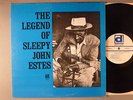
VERY RARE SLEEPY JOHN ESTES 78 "MARRIED WOMAN BLUES" E+
£
24
$
32


Favourite Auctions
To save auctions to your favourites, please login
If you don't have an account, please register
Description
YOU ARE BIDDING ON A REALLY EXCELLENT COPY OF THIS VERY RARE 78rpm RECORD OF TWO GREAT BLUES CLASSICS FROM SLEEPY JOHN ESTES ON A UK BRUNSWICK PRESSING
Born January 25, 1904, in Ripley, Tennessee, Sleepy John Estes was one of a sharecropping family of ten. His father Daniel was a guitarist, and this influenced his son to play. Young Estes was blinded in his right eye from a baseball accident at the age of six, limiting further athletic endeavors. His interest in music prompted him to build crude guitars from cigar boxes, which he played at local house parties as a child. His nickname "Sleepy" stemmed from a chronic blood pressure disorder that gave him fits of narcolepsy. In 1915, Estes moved with his family to Brownsville, Tennessee, where he met mandolinist James "Yank" Rachell.
Estes teamed with Rachell to play house parties, picnics, and the streets in the Brownsville area from 1919 to 1927. He also partnered with local harmonica player Hammie Nixon, hoboing Arkansas and southern Missouri with him from 1924 to 1927. At this time jug band music was wildly popular, so Estes started the Three J's Jug Band with Rachell and jug player Jab Jones. The Three J's played Memphis, where they competed for exposure in a competitive scene dominated by the Memphis Jug Band. Other rivals included Jack Kelly's South Memphis Jug Band, which played the prestigious Peabody Hotel weekly, and Robert Wilkins's troupe. Estes's band worked Beale Street, vying with Memphis denizens Furry Lewis, Gus Cannon, and Delta bluesman Son House for tips and houseparty jobs. When Memphis jobs were scarce the Three J's traveled north, playing the streets and parties in Paducah, Kentucky.
When the Victor recording company sent a field recording unit to Memphis in September 1929, Estes recorded several sides backed by the Three J's, with Jones playing piano instead of the jug. Other acts to record for Victor on this trip included the Memphis Jug Band, Frank Stokes, and Cannon's Jug Stompers. Victor deemed the four songs Estes recorded during these sessions worthy of release. His stature as a Memphis bluesman was assured when he was invited to record again for Victor in May 1930. This session yielded the uptempo "Milk Cow Blues," a tune Robert Johnson would later record as "Milkcow Calf Blues." In "Milk Cow Blues," Estes's clear, warbling vocals are propelled by his insistent guitar strumming. Jones pounds his piano in double time while Rachell's mandolin trills echo the vocals.
Pursuing their musical careers, Estes and Nixon moved to Chicago in 1931 where they played parties and the streets. Arkansas bluesman Big Bill Broonzy recalled in his memoirs that in 1933, Estes judged a guitar contest that Broonzy lost to Memphis Minnie. The Depression had racked the recording industry, and the Estes/Nixon team did not record until a July 1935 date with the Champion label. Among the sides recorded were "Drop Down Mama" and "Some Day Baby Blues," tunes that became staples for a later generation of bluesmen. Estes's plaintive vocals were ably accompanied by Nixon's mournful harp, creating a subtle shade of blues. They left Chicago in the late 1930s to travel the country playing lumber camps, parties, and street corners for four years.
The Decca label brought Estes to New York City to record in 1937 and again in 1938. Backed by his cousin Charlie Pickett on guitar and Nixon on harmonica, Estes again waxed fine blues but his sound remained rooted in an older Memphis style. He was paired with younger guitarist Robert Nighthawk, perhaps to modernize his sound, for his last Decca session in 1940. A year later he recorded for the Bluebird label backed by kazoos and a tub bass in a swinging session with the Delta Boys, who echoed Estes's jug band sensibilities.
Estes returned to sharecropping in Brownsville in 1941.In 1948, he and Nixon recorded again for the Ora Nelle label but the work went unreleased. Estes went completely blind in 1950 and elected to try his hand at recording again. A 1952 session for Sam Phillips's Sun Records was held at 706 Union Avenue, but the result did not approach his earlier work. Estes was rediscovered in 1962 during the blues revival that revived the careers of Mississippi John Hurt, Son House, and Skip James. He cut several albums for Delmark and returned to touring with Hammie Nixon before health problems confined him to Brownsville.
Sleepy John Estes died June 5, 1977, and is buried at Durhamville Baptist Church in Durhamville, Tennessee.
DISC DETAILS:-
UK BRUNSWICK 03562
SLEEPY JOHN ESTES BLUES VOCAL WITH GUITAR AND HARP ACCOMP
A SIDE: MARRIED WOMAN BLUES
B SIDE: DROP DOWN MAMA
Listen to a sample of Sleepy John Estes's "Drop Down Mama" (1.78MB wav)
THE RECORD IS IN EX+ CONDITION.
THIS IS A VERY RARE RECORD - DON'T MISS IT
BID NOW!!
10" 78 RPM RECORDS NEED CAREFULLY PACKING, AND I CLAIM TO HAVE THE BEST PACKAGING IN THE WORLD FOR DISPATCHING THEM!!
THE GREG'S GREAT'S SYSTEM CONSISTS OF A SPECIALLY DESIGNED INNER BOX MADE OUT OF 1" THICK POLYSTYRENE, WHICH THEN GOES INSIDE A CORREGATED OUTER CARDBOARD CARTON. THE BOXES CAN TAKE UP TO 21 RECORDS,
USUALLY FOR MAILING OVERSEAS, I RECOMMEND NO MORE THAN 7 IN A BOX, OTHERWISE IT GOES OVER THE AIRMAIL SMALL PACKET MAXIMUM WEIGHT OF 2Kgs WHICH CAUSES A LARGE HIKE IN POSTAL RATES.
I SEND OUT ON AVERAGE ABOUT 30 PARCELS A WEEK AND DISPATCH IS NORMALLY DONE ONCE A WEEK -AND I ONLY PROMISE A TEN DAY DISPATCH TIME
IF YOU REALLY HAVE AN URGENT REQUIREMENT FOR THE RECORD - BIRTHDAY PRESENT, WEDDING, FUNERAL etc PLEASE TELL ME I WILL DO MY BEST TO GET IT OUT FOR YOU URGENTLY.
IF A RECORD ARRIVES CRACKED OR BROKEN DESPITE MY BEST EFFORTS WITH THIS FANTASTIC PACKAGING I WILL REFUND THE MONEY IN FULL. - JUST SEND ME A QUICK SCAN - IF IT IS A VERY RARE RECORD I MAY ASK YOU TO SEND IT BACK OTHERWISE IT WILL BE YOURS TO KEEP OR DISPOSE OF.
Pay instantly with your debit or credit card through PayPal.price rating