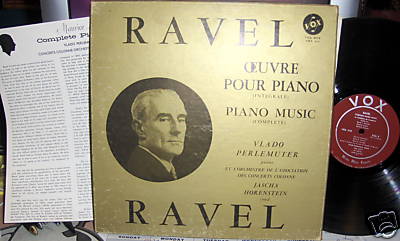
VOX 3-LPs VBX 410: Vlado Perlemuter, piano - Ravel's Piano Music - 1961 OOP - NM
$
255


Favourite Auctions
To save auctions to your favourites, please login
If you don't have an account, please register
Description
****Welcome to our eBay listing, thanks very much for looking!
****Please check out our other eBay store listings and eBay auctions for more great LPs and CDs - new items added daily!
****To access our eBay store either click on the little red door at the top right section of any of our eBay listings or, click on -
http://stores.ebay.com/Hear-The-Difference
Background on this eBay item -
Probably the rarest VOX box ever made. Supremely rare performances from the piano virtuoso, Vlado Perlemuter. Highly sought after by both music lovers and label collectors! Incredibly expensive LPs from Vox (Pathe) in France - many collectors deem the US pressings to be just as good!
This is a lovely 3 LP boxed set! The records are USA made, with the original inner sleeves and a libretto. This is an original VOX BOX (U.S.A.) 3-LP set, dating from 1961. Reference performances of these Ravel works - by none other than Vlado Perlemuter!
Vlado Perlemuter -
At his death in 2002, pianist Vlado Perlemuter remained the "one true student" of legendary composer Maurice Ravel, according to an article by Bernard Holland of the New York Times. Perlemuter was equally masterful when playing Chopin. The internationally renowned musician earned his reputation "not by dazzling pyrotechnical display," according to London's Telegraph newspaper online, "but by his deeply penetrating insights and musicianship." Due to a lack of self-promotion, the pianist was "overshadowed by ... less-inspired rivals," according to London's Guardian newspaper online. That situation was rectified when the Nimbus record label invited him to record his entire repertory. After doing so, Perlemuter was rediscovered.
Perlemuter was born on May 26, 1904, in a city then known as Kovno, now Kaunas, Lithuania. He was the third of four boys, and he lost the sight in his left eye after an accident as a toddler. He moved with his highly intellectual and musical Polish family to Paris when he was three, and he began studying piano at age nine. In Paris, Perlemuter began studying with the Polish-German pianist Moritz Moszkowski. At age 13, he was accepted into the Paris Conservatory, and he studied there with the renowned pianist Alfred Cortot, with whom he would develop a close friendship, and with composer Gabriel Fauré, the conservatory director. He won the conservatory's Premier Prix at age 15. Aside from Cortot, Busoni and Rachmaninov were the two pianists who most influenced Perlemuter's playing in his early years.
Perlemuter gave his first concerts in Paris and Geneva in 1922. The pianist's lifelong relationship with Maurice Ravel and his works began in the 1920s. He began studying the legendary composer's works for piano in 1924. He finally sought Ravel out in 1927. He studied with the legendary composer, who spent six months putting him through the paces of his work. "Teacher took student through the music meticulously and at length," Bernard Holland wrote in the New York Times in 2002. The sheet music Perlemuter possessed of Ravel's scores were covered in notes and interpretations written in the composer's own hand.
The pianist gave two concerts of Ravel's works in Paris in 1929. The composer, who praised Perlemuter for his interpretation of his music, attended both performances. In 1955 he recorded for the first time Ravel's complete piano works. The recording "became a landmark," according to Anthony Tommasini in the New York Times. When Perlemuter revisited Ravel's works again for the Nimbus record label, he is said to have played entire selections nonstop, and the recordings required very little editing and few corrections before release. Just before Perlemuter's 83rd birthday in 1987 he marked the 50th anniversary of Ravel's death by repeating his two 1929 Paris performances at London's Wigmore Hall.
Perlemuter married his wife, Jacqueline, in 1934. He suffered "the great embitterment of his life," one associate told the New York Times, midway through World War II. As a Polish Jew, he was forced to flee Paris for Switzerland. After hiding out with a series of families in unoccupied France, Perlemuter and his wife were driven to the Swiss border by a heroic baker. Much to Perlemuter's dismay, his close friend and mentor Alfred Cortot remained in France. The traumatic experience was compounded when the pianist developed tuberculosis soon after fleeing. Perlemuter's career, which had been blossoming in Paris, remained at a standstill until the war ended.
Perlemuter resumed his career in 1950, performing in Paris. He returned to the Paris Conservatory as a professor in 1951 and remained until 1976. He also shared his talents with gifted music students around the world, teaching master classes in England, Canada, and Japan. "His classes became legendary," according to the Guardian."His teaching embodied the great qualities of his own playing--an impassioned care for detail and also an architectural vision of each piece as a whole." He recorded the works of composer Fryderyk Chopin for the BBC in 1951. In 1953 he wrote the book Ravel d'Apres Ravel with Helene Jourdan-Morhange. Perlemuter's close relationship with Ravel provided an insight that "leaves us so much to learn," Holland wrote in the New York Times in 2002. The book was published in English in 1988 under the title Ravel According to Ravel.
Perlemuter was recognized by a much wider audience after he recorded and released his entire repertory on the Nimbus record label. Although it took him until he was 88 years old to complete the recordings, the result was a masterful collection consisting mostly of Ravel and Chopin, but also of Beethoven and Schumann. In a 1993 review quoted by Tommasini, New York Times critic Bernard Holland congratulated Perlemuter for his "unadorned simplicity, his refusal to milk phrases for momentary effect, in short, his insistence on letting the Classical Ravel speak for himself."
A widely acknowledged master, Perlemuter still occasionally succumbed to nerves during performance. He stormed off the stage during a 1967 concert at London's Royal Festival Hall after four unsuccessful attempts to begin Chopin's Mazurka in F-sharp minor. He returned to the stage after a few minutes to accomplish a flawless performance. He was named an Honorary Fellow of the Royal Academy of Music in 1972 and a Grand Officer of the French Legion of Honor in 1993.
As he aged, Perlemuter was plagued by memory lapses that bothered him but did not seem to bother his fans. "Those who appreciated humane, cultured, and elegant pianistic artistry easily forgave him any slips," according to the Telegraph online. His eyesight deteriorated, which ultimately did affect his technical prowess. He played his farewell concert in 1993. The master pianist died September 4, 2002, at the age of 98, at the American Hospital in Paris, leaving behind no immediate family. "One remarkable thing about him is that he never grew stale," according to his obituary in the Guardian,"that after half-a-century he still engaged in slow and humble practice ... of pieces that he had known all his life. It was not only for clarity.... His unceasing quest was rather to realise his poetic intentions." - by Brenna Sanchez
Release date: 1961
-
VOX 3-LP Set - "MAROON/Deep Red" record labels with "SILVER" lettering.
-
LPs were pressed in the U.S.A.
-
Pressings are in MONO
-
Each record comes in the original paper inner sleeves
-
Set comes with an informative LIBRETTO
-
LPs are housed in an outer box - which is very heavy and solid
-
Record Catalog Number: VBX 410
Extremely rare, this is a much sought after 3-LP set featuring the music of:
RAVEL
Music on this 3 LP set -
- Oeuvre Pour Piano (Integrale) - Piano Music (Complete)
Performed by -
- Vlado Perlemuter, piano
- Jascha Horenstein conducting Et L'Orchestre De L'Association Des Concerts Colonne
CONDITION Details:
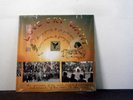
The records are housed in a large box. Each LP is in it's own original, paper inner sleeve. The colors on the front of the box are very clean and lovely, with some light color foxing. The box has no real issues - it is solid and in fantastic condition given it's age. On the whole, the corners are all intact, with some slight weakening over time. The top section of the box has become unhinged from the bottom section, so it can lift right off the bottom part. The box virtually has no problems other than a bit of shelf wear - these types of issues are frequently seen in records released of this age are are due, quite simply, to the weight of the set and the age of the set! It is very hard to expect a set of this vintage to be in near mint condition, especially since the weight of the item was so significant.
The set comes complete with a lovely libretto in near mint condition!
The LPs we visually inspected are in Near Mint Minus condition! Yes, the great thing about large multi LP sets, from a collectors perspective, is that they are rarely played. Thus, most of the time, they are in LOVELY condition! This set is no exception. The vinyl have no serious marks of any kind, only some light superficial spider marks - these are caused by sliding the LPs in and out of the inner record sleeves. The records have no significant spindle marks either. The records retain much of their original gloss and sheen. These are lovely slabs of super rare vinyl - in remarkable condition given their age. When play graded (some parts) on our audio system, the records performed very well, with only some rare, light noise that did not detract from the performance in any way.A Short Note About LP GRADING -- Mint = Only used for sealed items.
- Near Mint = Virtually flawless in every way.
- Near Mint Minus = Item has some minor imperfections, some audible.
- Excellent = Item obviously played and enjoyed with some noise.
- Very Good Plus = Many more imperfections which are noticeable and obtrusive.
Please understand that this is a very old record - as such, one cannot expect the record to sound like a brand new, audiophile pressing! Some noise is inevitable - for best results, always properly clean your LPs before playing them.
The LP is an audiophile quality pressing (any collector of fine MFSL, half speeds, direct to discs, Japanese/UK pressings etc., can attest to the difference a quality pressing can make to an audio system).
Don't let this rarity slip by!!!
price rating