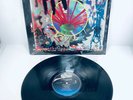
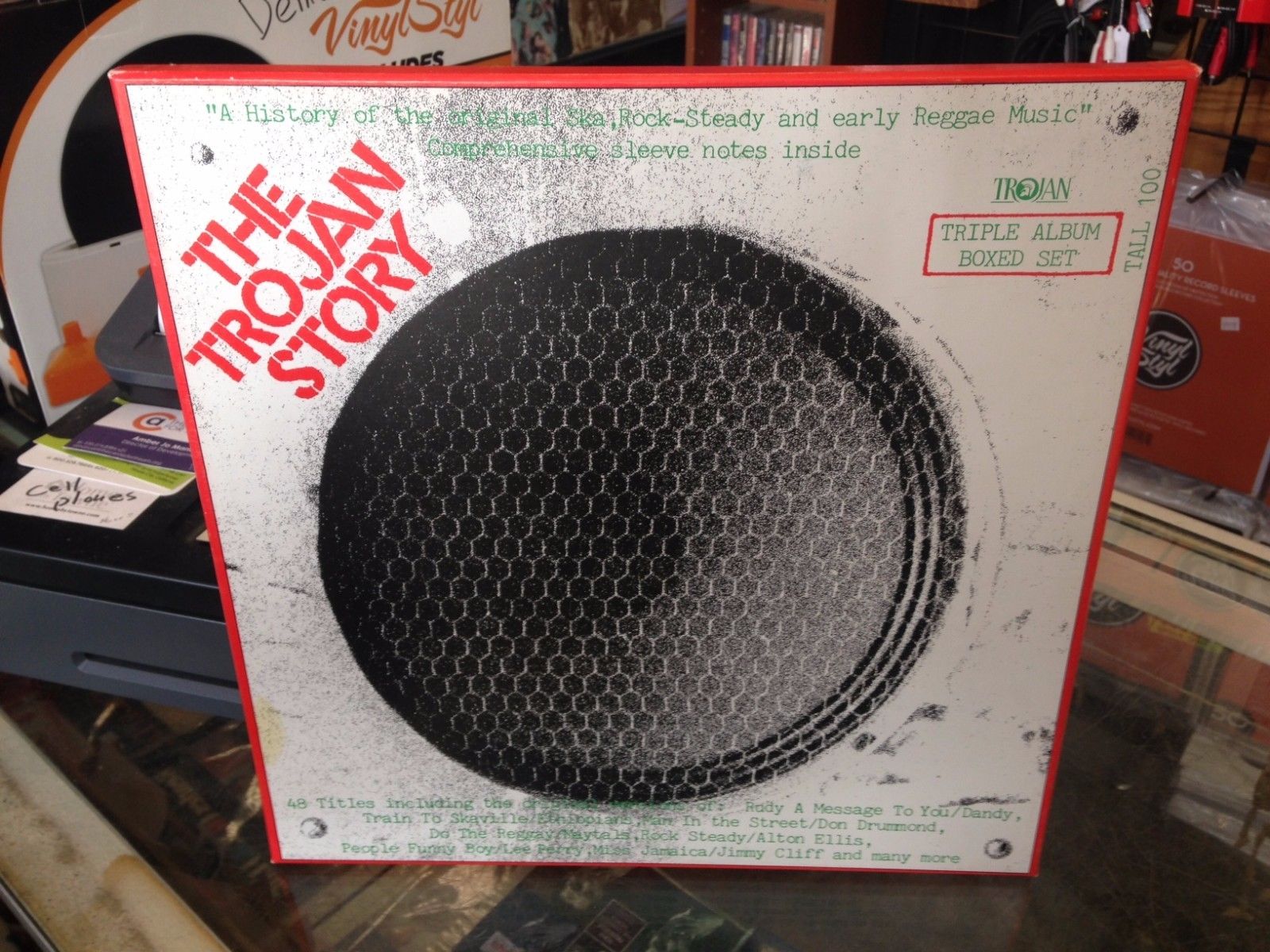
Various ?– The Trojan Story- Trojan Records ?– TALL 100 Reggae Box Set NM/NM
$
35


$ 35
Sold For
Nov 6, 2017
Sold Date
Oct 30, 2017
Start Date
$ 15
Start price
10
Number Of Bids
USA
Country Of Seller
eBay
Auctioned at
Favourite Auctions
To save auctions to your favourites, please login
If you don't have an account, please register
Description
UP FOR AUCTION:
More Images
Various ?– The Trojan Story
Label: Trojan Records ?– TALL 100 Format: 3 × Vinyl, LP, Limited Edition, MonoBox Set, Compilation
Country: UK Released: 1980 Genre: Reggae Style: Ska, Rocksteady, Reggae
Tracklist
A1 –Laurel Aitken & The Carib Beats Bartender A2 –Derrick Morgan Fat Man A3 –Eric "Monty" Morris & Drumbago All Stars Humpty Dumpty A4 –Jimmy Cliff Miss Jamaica A5 –Derrick And Patsy Housewives' Choice A6 –Jackie Edwards Tell Me Darling A7 –Kentrick Patrick Don't Stay Out Late A8 –Stranger Cole & The Duke Reid Band* Rough And Tough B1 –Kentrick Patrick Man To Man B2 –Stranger Cole Unos-Dos-Tres B3 –The Skatalites Confucius B4 –The Mellow Larks Time To Pray (Alleluia) B5 –The Blues Busters Soon You'll Be Gone B6 –Lord Tanamo I'm In The Mood For Ska B7 –The Riots Yeah Yeah B8 –Don Drummond Man In The Street C1 –Baba Brooks & The Baba Brooks Band One Eyed Giant C2 –Honey Boy Martin & Tommy McCook & The Supersonics & The Voices (6) Dreader Than Dread C3 –Owen Gray Darling Patricia C4 –Joe White and Chuck & The Baba Brooks Band Every Night C5 –The Astronauts Syncopate C6 –The Clarendonians Rules Of Life C7 –Slim Smith The New Boss C8 –Winston & George Keep The Pressure On D1 –Roy Shirley Musical Train D2 –The Techniques Oh Babe D3 –Sir Lord Comic The Great Wuga Wuga D4 –Dandy Livingstone Rudy A Message To You D5 –The Ethiopians Train To Skaville D6 –The Three Tops It's Raining D7 –The Ethiopians The Whip D8 –Desmond Dekker & The Aces Pretty Africa E1 –Alton Ellis Rock Steady E2 –Baba Brooks & The Baba Brooks Band King Size E3 –Evan And Jerry* & The Carib Beats Rock Steady Train E4 –Sugar Simone King Without A Throne E5 –Phyllis Dillon & Tommy McCook & The Supersonics Perfidia E6 –Derrick Morgan Do The Beng Beng E7 –Lynn Taitt Way Of Life E8 –The Supersonics Second Fiddle F1 –Lee "Scratch" Perry* People Funny Boy F2 –The Tennors I've Got To Get You Off My Mind F3 –The Maytals Do The Reggay F4 –The Slickers Nana F5 –The Pioneers Mama Look F6 –The Maytals Pressure Drop F7 –The Maytones Black And White F8 –The Charmers Rasta Never FailsCompanies, etc.
- Pressed By – Allied Records Ltd.
Credits
- Mastered By – MAX* (tracks: A1 to A8)
Notes
Collection of rocksteady, reggae and ska from 1961-'71, most from '66-'68.E8 and F2 are mislabeled as mentioned by ericbronson in the comments.
Liner Notes: THE TROJAN STORY
The Trojan Story triple album (not to be confused with the sequel double album released in 1976 but since deleted) was originally released in 1972 and after a successful but brief period was deleted. Following the recent spate of ska-influenced records released by many of today’s bands we felt it was time to re-issue the set in a limited edition. This time instead of a sleeve we have packaged them in a box for greater protection in view of their ever increasing historical value. The track listing is identical to the original, the music is the same (no re-mixes) and apart from some minor editing the sleeve notes haven’t been altered. When listening to these records you soon realise that probably all of today's ska bands must have laid their hands on an original copy of the Trojan Story such is the influence of this compilation on today's music.
After the 2nd World War communications between the U.S.A. and the West Indies improved tremendously and the two-way flow of visitors increased year after year. Jamaica, the largest of the islands, rapidly became the focal point of the West Indies. The main result of this increase in travel was a major American influence in all parts of Jamaican life - the most noticeable being in music. The music of Louis Jordon, Roscoe Gordon, Fats Domino, Amos Milburn, Johnny Ace and a myriad [of] other urban blues singers became the vogue. Jamaicans would tune into Radio WINZ, an American station, and listen to the blues. (Their own station RJR, was more or less committed to American pop music only.) The music was new, loud and brash - and was rhythmic and danceable. Almost overnight a new breed of entertainer sprung up - the Sound System man. Armed with powerful amplifiers and speakers, he would hire halls and play the latest R & B records from the States - usually New Orleans or Miami because they were nearest. Due to the cut-throat competition from other operators, he would scratch the labels off his records so his rivals would not know what he was playing and thus he could stay ahead with the latest sounds. Dance halls were packed every weekend while the music blasted from the speakers of men like Duke Reid, Coxone Dodd, Prince Buster, V-Rocket, Nicks, Bells, and many more. R & B was picked up by aspiring young musicians and soon dance halls were advertising local groups in addition to the Sound System. The Sound System men, quick to spot competition, realised the truth of the old adage “if you can't beat ’em, join 'em”, took the aspiring Lloyd Price's and Smiley Lewis's into the local studios--and rapidly created a market for records which became as cut-throat as the sound system scene. The early records were all extremely American in style and at a casual hearing could well have been recorded by any one of the many excellent black singers to emerge during the 'fifties. Such records emulated the New Orleans R & B sound and featured strident tenor saxes, trumpets or trombones, boogie piano and the instrument that eventually was to become most important of all, the bass.
The bass became heavier and heavier and by the end of 1961 the records began to feature a strange loping sort of shuffle rhythm, accentuated by the brass section riffing hard on the off beat. In fact it was this riff which inspired the term “Ska”, and by the end of 1962 the name had stuck. However, in the United Kingdom the music took its name from the first record label to feature the style - Melodisc's Blue Beat label, and “bluebeat” it was right up to the middle of the 'sixties. It was the big sound system men who dominated the record business then - the only exception probably being Leslie Kong of Beverley's Records, and it is interesting to see that the main record producers then are still powerful influences in the market in 1971 - ten years later. Also the big artists of ten years ago still have a strong attraction today, for instance, Jimmy Cliff, Owen Gray, Laurel Aitken, Derrick Morgan, The Bluesbusters, the Maytals, Jackie Edwards - the list goes on and on.
Since 1961 the music has gone through several different phases, the most important being Rock Steady in 1966-67 and Reggae in 1968, all of which styles are extremely well illustrated on the three records in this album.
--------------------------------------------
RECORD ONE: SIDE ONE
--------------------------------------------
“BARTENDER” by Laurel Aitken and the Carib Beats. Released 1961. One of Laurel's earliest numbers which is a blues in the vein of “One Scotch, One Bourbon, One Beer”. An “All Stars Recording”.
“FAT MAN” by Derrick Morgan. Released 1961. “Fat Man” was one of the first Jamaican records ever issued in the U.K. and is a fine example of Derrick's style, which really has hardly changed over the years. A straight R & B number with some nice saxophone work. A “Smiths” Recording.
“HUMPTY DUMPTY” by Eric “Humpty Dumpty” Morris and the Drumbago All Stars. Released 1961. An early Ska classic which when compared to the first tracks, shows first how the rhythm was modified. There is a fine guitar solo towards the end of the number, almost certainly played by Ernest Wranglin.
“MISS JAMAICA” by Jimmy Cliff. Released 1962. Jimmy Cliff's second issue in the U.K. and he certainly sounds young! Produced by Leslie Kong, it is a tight Ska number with good guitar and trombone work. A “Beverley's” Recording.
“HOUSEWIVES' CHOICE” by Derrick And Patsy. Release 1962. Derrick Morgan and Patsy duet in a style influenced by Shirley and Lee. “Housewives' Choice” was a massive seller when first issued and still sounds as good today. Produced by Leslie Kong. A “Beverley's” Recording.
“TELL ME DARLING” by Wilfred “Jackie” Edwards. Released 1963. Wilfred Edwards, or Jackie Edwards as he is now known, is the most famous ballad singer to emerge from the West Indies, and this number is a good example of his sophisticated material.
He has an enormous influence on the West Indian scene and has been the model for all Jamaican artists over the last decade. Produced by Chris Blackwell.
“DON'T STAY OUT LATE” by Kentrick Patrick. Released 1963. Kentrick Patrick, or Lord Creator as he is also known, is one of the most underrated singers from Jamaica. This particular number has an excellent brass arrangement and a great tenor solo. A “D. Darling” Recording.
“ROUGH AND TOUGH” by The Stranger and The Duke Reid Band. Released 1963. Another name who is still around today is Stranger Cole. “Rough And Tough” showcases his lazy vocal delivery and some nice trumpet work in the solo. A “Duke Reid” Recording.
--------------------------------------------
RECORD ONE: SIDE 2
--------------------------------------------
“MAN TO MAN” by Kentrick Patrick. Released 1963. Hard to believe these records were made in such tiny studios, as this is a real gem of a production with a beautiful brass arrangement and a tough beat. Kentrick Patrick must be recorded again! A “Randy's” Recording.
“UNOS-DOS-TRES” by Stranger Cole. Released 1964. A strange (no pun!) record which doesn't sound too much like Stranger, due probably to the fact that the vocal has been double-tracked. However, a strong rhythm track and good trumpet sounds in the break.
“CONFUCIUS” by The Skatalites. Released 1966. The Skatalites were the top instrumental group in the early and mid-sixties, a success due mainly to the work of their trombonist, the late Don Drummond. Drummond was rated by pianist George Shearing to be amongst the world's top five trombone players, a judgement which is borne out by his work on “Confucius”. Although the title is credited to “The Skatalites” it was in fact written by Don Drummond. A “Top Deck” Recording.
“TIME TO PRAY (ALLELUIA)” by the Mellow Larks. Released 1961. Knocked out piano leads into a great spiritual which seems to owe more to R & B than to gospel roots, especially the instrumental break! Basil Gabbidon, the leader of the Mellow Larks, went on to make several solo records. He new lives in the U.K. N.B. The title is as spelt on the original copy!
“SOON YOU'LL BE GONE” by the Blues Busters, Released 1965. The Blues Busters are one of Jamaica's longest serving vocal groups and are still very big today. They have always employed very sophisticated vocal arrangements which when coupled to a lively accompaniment as on “Soon You'll Be Gone” make for an unforgettable performance. A “Wirl” Recording.
“I'M IN THE MOOD FOR SKA” by Lord Tanamo. Released 1965. An uptempo version of the old standard, “I'm In The Mood For Love”, probably inspired by Fats Domino’s version of the song. Tanamo has a great voice he uses like an instrument, taking the melody of the song and bending and shaping it as the mood takes him (pun intended).
A relaxed sax break complements his vocals.
“YEAH YEAH” by The Riots. Released 1965. The record features those wonderful vocal gimmicks which are so typical of the Ska records of this period. What sounds like an over amplified tambourine accompanies the vocals, while the trumpet and sax solo away in the background.
“MAN IN THE STREET” by Don Drummond. Released 1965. A typical Don D. number, although the intro sounds suspiciously like “Tequila”. Plenty of brasswork with some nice riffs helping the chunky rhythm along, and of course, the inimitable Drummond trombone. Great Stuff.
--------------------------------------------
RECORD TWO: SIDE ONE
--------------------------------------------
“ONE EYED GIANT” by Baba Brooks and His Band. Released 1967. “Hey! have you seen the One Eyed Giant” goes the intro, and the band are away to a confusion of sounds. Trumpets, trombones, and saxophones take it in turn to solo behind vocal sounds galore. Baba Brooks band were and still are used on many sessions in Jamaica and no doubt the band are anonymously behind many artistes on these albums.
“DREADER THEN DREAD” by Honeyboy Martin and the Voices with Tommy McCook and the Supersonics. Released 1967. Honeyboy carries on the tradition of Prince Busters1 “Judge Dread”, and brags of his unparalleled status amongst the “rude boys”. “If anyone tries to stop me boys, they'll get sick in the head, and they’ll end up in the cemetery because they’ll be dead”, he announces with absolute finality. A “B.K. Calnek” Production.
“DARLING PATRICIA” by Owen Gray. Released 1962. No collection such as this would be complete without one of Owen Gray’s numbers. This particular song is one of his very early numbers. Owen shows a distinct Clyde McPhatter influence while the band rocks on and on. A “Beverley’s” Recording.
“EVERY NIGHT” by Joe White and Chuck with the Baba Brooks Band. Released 1966. 1966 was Joe White’s year with “Every Night” high in the Jamaican charts for months, and also the biggest West Indian record in the U.K. that year. “Every Night” is a strange song, with country and western guitar and R & B beat: Joe White’s sensitive reading of the lyrics make it a standard recording.
“SYNCOPATE” by The Astronauts. Released 1966. Produced by Terry Nelson “Syncopate” was one of the few U.K. based productions to do well. It has only a faint West Indian influence, and is more reminiscent of the instrumental rock records of 1959-1961.
“RULES OF LIFE” by the Clarendonians. Released 1966. The Clarendonians are a good example of the many vocal groups spawned by Jamaica. Like the Kingstonians (after Kingston) they take their name from a part of Jamaica (Clarendon). “I would rule my people and set them free, lead them on to victory, let them know they have a right, and fight for their rights”. The lyrics are remarkably poignant, speaking for the oppressed peoples of the world.
“THE NEW BOSS” by Slim Smith. Released 1966. An early record from Slim Smith (the “B” side of “I've Got You’re Number”) and it is typical of the changing style of Ska at that time. Practically Rock Steady in conception, it shows off Slim's voice, floating from line to line, to great advantage.
“KEEP THE PRESSURE ON” by Winston and George. Released 1966. Again a “B” side (to “Denham Town”), it was produced by the indefatigable Leslie Kong, and features the harmonising of Winston and George. George is almost certainly George Agard, half-brother of Desmond Dekker, and now a member of the Pioneers. A “Beverley’s” Recording.
--------------------------------------------
RECORD TWO: SIDE TWO
--------------------------------------------
“MUSICAL TRAIN” by Roy Shirley. Released 1967. A record which owes a lot to the “Gospel Train” theme. Roy Shirley takes the lead while some fine voices answer back on the chorus. Apart from the vocal, the record relies completely on a rhythm section, no solos at all. Instead the normal inventiveness of the accompanying musicians is concentrated on the rhythm track, so the last atoms of feeling are wrung out on every chord and drum beat.
“OH BABE” by the Techniques. Released 1966. Fats Domino has always been one of the favourite R & B singers amongst the West Indians and thus this recording of “Oh Babe” (Sick and Tired) comes as no surprise. The Techniques have long been a top group in Jamaica and include in their ranks Winston Riley, now Dave and Ansel Collins producer. Records such as this, heralding the Rock Steady era, highlighted the guitar and bass guitar, rather than the piano and brass of the ska period. A “Duke Reid” Recording.
“THE GREAT WUGA WUGA” by Sir Lord Comic. Released 1967. One of the last great Ska records “The Great Wuga Wuga” is a musical ad for Sir Lord Comic's sound system, and has some great brasswork amongst the Cassius Clay type word slinging. A “Wirl” Recording.
“RUDY A MESSAGE TO YOU” by Dandy. Released 1967. Dandy, real name Robert Thompson, was one of the first West Indians to record in the U.K., having moved here some eleven years ago. His first records were with Sugar Simone (q.v.) under the name Sugar and Dandy. “Rudy” was big success for him in '67 and dealt with the perennial Rudy theme. (Rudy Rude Boy = hooligan, petty villain.)
“TRAIN TO SKAVILLE” by The Ethiopians. Released 1967. One of the most influen[tial] Ska records and was also one of the few to reach the British pop market in a big way, nearly making the Top 40. The Ethiopians are still amongst the select few top Jamaican vocal groups, and this cut is typical of their basic style. A “Wirl” Recording.
“IT’S RAINING” by the Three Tops. Released 1966. More Rock Steady from the Duke Reid studios. The Three Tops have now disappeared from the record business, but the few records they left show them to be a talented group with a nice sense of harmony. A “Treasure Isle” Recording.
“THE WHIP” by the Ethiopians. Released 1967. Rather a misleading one as it is mainly an instrumental, the Ethiopians singing for less than half the record. The bass line is heavily prominent, showing the direction the music was to take. Produced by Mrs. Sonia Pottinger for her Gayfleet label.
“PRETTY AFRICA” by Desmond Dekker and the Aces, Released 1967. Desmond Dekker is one of the few artistes to gain and maintain an international reputation. “Pretty Africa” (misspelt on the original label as “African” shows just why. He has a unique way of torturing every syllable, often extending the vocal lines beyond the normal chord framework. Note also Leslie Kong’s clean production - that definitive guitar. A “Beverley’s” Recording.
--------------------------------------------
RECORD THREE: SIDE ONE
--------------------------------------------
“ROCK STEADY” by Alton Ellis. Released 1966. Alton Ellis' “Rock Steady” was practically the anthem of Rock Steady. His cool voice epitomises all that Rock Steady was about, emphasised by a nonchalant tenor solo. Produced by Duke Reid for “Treasure Isle” Records.
“KING SIZE” by Baba Brooks and his Band. Released 1966. “King Size” was put out as a “B” side to the Saints recording of “Brown Eyes”. However as is sometimes the case, the public went on the flip, not so surprising really, when one listens to “Brown Eyes” which today doesn’t sound that hot! “King Size” is another of the thousand Ska instrumentals knocked out in the ’sixties - Brooks treatment making it stand out above most others.
“ROCK STEADY TRAIN” by Evan and Jerry with the Carib Beats. Released 1967. Another version of the “Train” theme, this one sums up everything good about the Rock Steady style. The whole thing has the R & B Gospel influence, from the vocal to the piano, but overall the sound is a la Jamaica, Produced by E.K. McDermott for “Jolly” Records.
“KING WITHOUT A THRONE” by Sugar Simone. Released 1967. What R & B was to Ska, Soul was to Rock Steady and Reggae. Sugar Simone,
Dandy's erstwhile partner, made what was probably the best soul record ever produced in Britain (“Suddenly”), but unfortunately the fickle pop buying public rejected it. However, a West Indian shop manager in Brixton started to play the “B” side in his crowded shop and before you could say “Sugar Simone”, the word was out and the record started to sell in large quantities, to the West Indian public alone. Produced by K. Foster for “Sue” Records.
“PERFIDIA” by Phyllis Dillon with Tommy McCook and the Supersonics. Released 1967. Tommy McCook and his band put down a firm rhythm behind Phyllis Dillon who, along with Marcia Griffiths, is one of Jamaica's top female singers. She exudes artistry with every note right down to the sensual “sock it to me” in the middle. Produced by Duke Reid for “Treasure Isle” Records.
“DO THE BENG BENG” by Derrick Morgan. Released 1968. A later record backed by a female chorus. A rather ordinary dance record redeemed by the giant rhythm section. Produced by Leslie Kong for “Beverley’s” Records.
“WAY OF LIFE” by Lynn Tait. Released 1968. Biting tenor sax takes the lead for practically all the record, with Lynn Tait’s guitar - punctuating the lines with short chords and sharp notes. This release was originally listed as being by Joe White.
“I’VE GOT TO GET YOU OFF MY MIND” by the Tennors. Released 1968. More in the Rock Steady vein, the Tennors really big hit was “Ride Your Donkey” (the “A” side of this record), and made several other “Donkey” records but never emulated their earlier success. Produced by George Murphy.
--------------------------------------------
RECORD THREE: SIDE TWO
--------------------------------------------
“PEOPLE FUNNY BOY” by Lee (King) Perry. Released 1968. One of Lee Perry's greatest solo records, the lyrics reflect one of life’s oldest situations, the man who turns his back on his friends after he has feathered his own nest. Lee Perry is now producing records rather than performing himself, and has several hits to his name, most notably “Return of Django” by the Upsetters. “People Funny Boy” was Produced by Lee for his own label “Upsetter”.
“SECOND FIDDLE” by the Supersonics. Released 1968. Tommy McCook's band, The Supersonics, go through their paces on one of the best instrumentals of 1968, penny whistle and clarinet carrying the melody. Produced by Duke Reid for “Treasure Isle” Records.
“DO THE REGGAY” by the Maytals, Released 1968. A historic disc in that it was practically the first to use reggae in the title, albeit spelt differently. Much more uptempo than the previous Rock Steady style, it is easy to see why it has caught the public's imagination. The bass guitar really starts to cook as the record wears on, spurring the group to greater heights of abandon. They must be the most exciting group in Jamaica. Produced by Leslie Kong for “Beverley’s” Records.
“NANA” by The Slickers. Released 1968. The Slickers are a newer vocal group, greatly resembling the Pioneers in their close harmony and delivery. “Nana” was a very big seller in both Jamaica and the U.K. in 1968, and helped get the music off the ground over here by being played in clubs who usually concentrated on straight pop or soul. Produced by Neremiah Reid.
“MAMA LOOK “by The Pioneers. Released 1969. The Pioneers, Jackie Robinson, Sidney Crooks, and George Agard are now big pop names, but this record is an accurate reflection of their earlier style. An influential record, for a year later the Maytals changed the lyrics, called it “Monkey Man” and made the British charts! Produced by Joel Gibson for “Amalgamated”.
“PRESSURE DROP” by the Maytals. Released 1970. A rousing scorcher of a number by the Maytals. They just don't let the pressure drop. One hopes that it can't be long before they gain recognition. Produced by Leslie Kong, it is one of his finest productions. A “Beverley's” Recording.
“BLACK AND WHITE” by The Maytones. Released 1971. Although Greyhound made the charts the world over with their pop reggae hit “Black And White”, a myriad cover versions came out in Jamaica to capture the home market. Although this one lacks the finesse of Greyhounds', it has a lot more emphasis on the rhythm, with the guitar riding the best. Produced by A. Ranglin for “G.G.” Records.
“RASTA NEVER FAILS” by the Charmers. Released 1971. The Charmers, under the direction of Lloyd Charmers, get down to the roots in this Rastafarian song using percussive rhythm with a very loose harmony giving a tribal effect. This type of production is coming more and more to vogue. Produced by Lloyd Charmers for “Splash” Records.
designed by Bamber Forsyth.
TALL 100
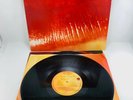
Lp is in M-, Cover in NM, Insert in NM
price rating