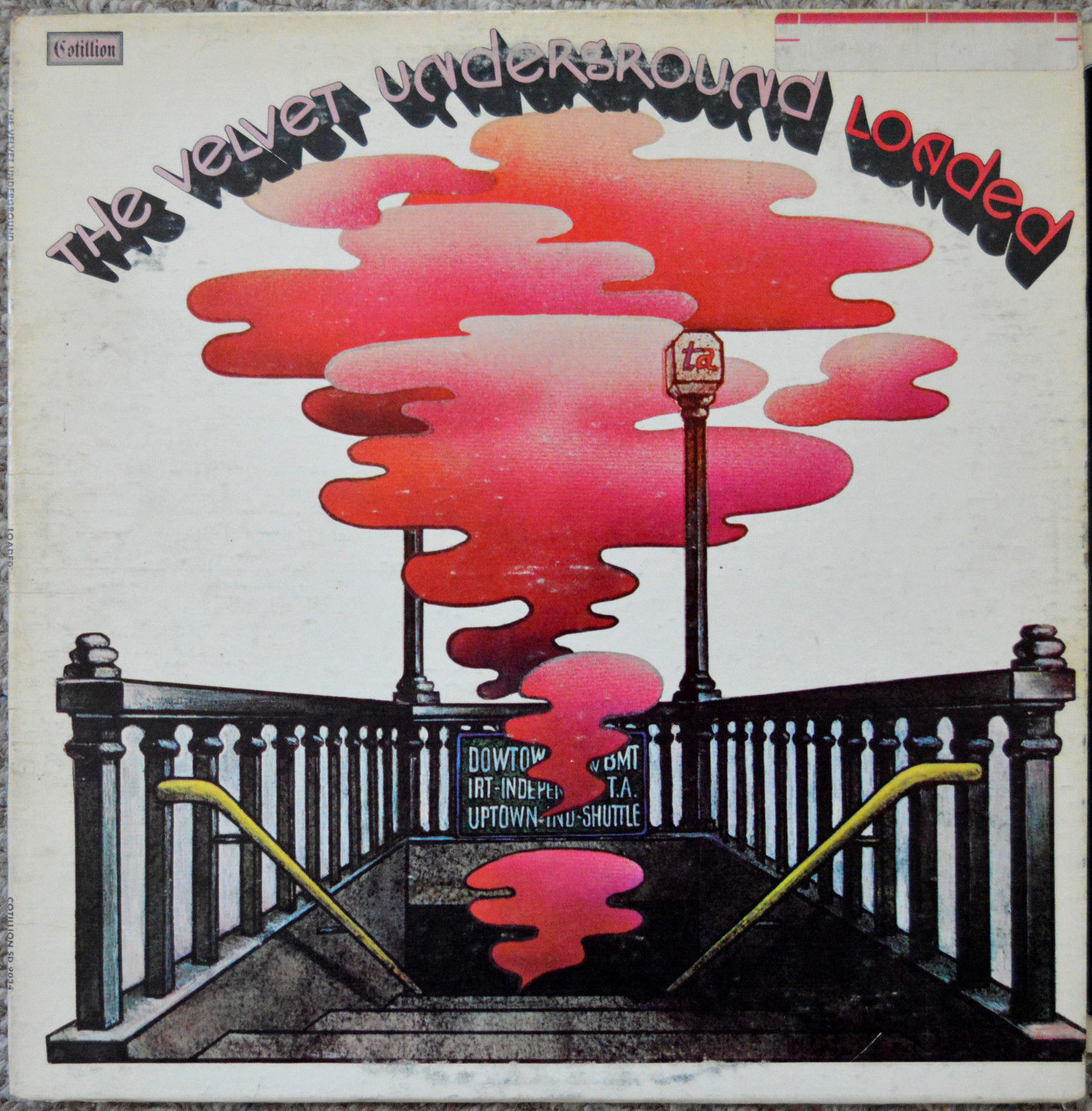
Velvet Underground LOADED - Original 1970 Cotillion Records Pressing - VG/VG
$
19


Favourite Auctions
To save auctions to your favourites, please login
If you don't have an account, please register
Description
PLEASE READ COMPLETE AUCTION DESCRIPTION
BEFORE BIDDING
_______________
PAYMENT DUE WITHIN
5 DAYS
OF AUCTION CLOSING
_______________
RECORDS ARE VISUALLY GRADED
UP FOR AUCTION IS:
Velvet Underground
LOADED
Cotillion Records
1970
RECORDS ARE VISUALLY GRADED
VG/VG
Loaded is the fourth studio album by American rock band the Velvet Underground, released in November 1970 by Atlantic Records' subsidiary label Cotillion. It was the final album recorded featuring founding member and main songwriter Lou Reed, who left shortly before its release.
In 2012, Loaded was ranked 110 on Rolling Stone magazine's list of the 500 greatest albums of all time.
Loaded was a commercial effort aimed at radio play, another step away from the Warhol-influenced experimental days of their earlier albums. The album's title refers to Atlantic's request that the band produce an album "loaded with hits". Singer/bassist Doug Yule said, "On Loaded there was a big push to produce a hit single, there was that mentality, which one of these is a single, how does it sound when we cut it down to 3.5 minutes, so that was a major topic for the group at that point. And I think that the third album to a great extent shows a lot of that in that a lot of those songs were designed as singles and if you listen to them you can hear the derivation, like this is sort of a Phil Spector-ish kind of song, or this is that type of person song."
Reed was critical of the album's final mix. He left the Velvet Underground on August 23, 1970, but Loaded wasn't released until three months later, in November. After its release, Reed maintained in interviews that it had been re-edited and resequenced without his consent.
One of Reed's sore points resulting from that unauthorized re-editing was that the "heavenly wine and roses" melody was cut out of "Sweet Jane". In the original recording, this part was intended to provide a perfectly flowing bridge to a full-fledged plagal cadence two-chord version of the chorus (earlier choruses in the song have a 4-chord riff). In Reed's initial solo performances, he would include the verse (see for instance American Poet), until 1973, when he would routinely leave it out, as the bridge fits less well in a more hard rock version (as heard for instance on Rock 'n' Roll Animal). However, the post-Reed, Doug Yule-led Velvets always performed the song with the verse included. A career-spanning retrospective of Reed's recordings with the Velvet Underground and as a solo artist, NYC Man (The Ultimate Collection 1967–2003), which Reed compiled himself, uses the shorter version. When asked about the shortened versions of "Sweet Jane" and "New Age" and Reed's long-standing claims that they were re-edited without his consent, Yule claimed that Reed had in fact edited the songs himself. "He edited it. You have to understand at the time, the motivation was... Lou was, and all of us were, intent on one thing and that was to be successful and what you had to do to be successful in music, was you had to have a hit, and a hit had to be uptempo, short, and with no digressions, straight ahead basically, you wanted a hook and something to feed the hook and that was it. 'Sweet Jane' was arranged just exactly the way it is on the original Loaded release exactly for that reason—to be a hit! 'Who Loves The Sun' was done exactly that way for that reason—to be a hit."[3]
Reed also felt snubbed by being listed third in the credits on the album; and by the large photo of Yule playing piano; and by all the songwriting credits improperly going to the band, rather than Reed himself. Newer releases have satisfied many of Reed's concerns: he is now properly acknowledged as the main songwriter for the album; he is listed at the top of the band line-up and, since the 1995 box set Peel Slowly and See, another mix is available, restoring "Sweet Jane", "Rock & Roll" and "New Age" to the full-length versions Reed had originally penned.
Although she is credited on the sleeve, the album does not feature Velvet Underground stalwart drummer Maureen Tucker, as she was pregnant at the time. Drumming duties were performed mainly by bassist Doug Yule, recording engineer Adrian Barber, session musician Tommy Castanero and Doug Yule's brother Billy. Lou Reed commented that "Loaded didn't have Maureen on it, and that's a lot of people's favorite Velvet Underground record, so we can't get too lost in the mystique of the Velvet Underground... It's still called a Velvet Underground record. But what it really is is something else."[4] Sterling Morrison had strong feelings about Yule's increased presence on Loaded, saying: "The album came out okay, as far as production it's the best, but it would have been better if it had real good Lou vocals on all the tracks." While Morrison contributed guitar tracks to the album, he was also attending City College of New York and juggling his time between the sessions and classes, leaving most of the creative input to Reed and Yule.[5] Doug Yule claimed that "Lou leaned on me a lot in terms of musical support and vocal arrangements. I did a lot on Loaded. It sort of devolved down to the Lou and Yule recreational recording". Of the ten songs that make up Loaded, Yule's lead vocals were featured on four songs: "Who Loves the Sun", which opens the album, "New Age", "Lonesome Cowboy Bill", and "Oh! Sweet Nuthin'". In addition to his lead vocal parts, Yule handled all of the bass, piano and organ duties, and also recorded several lead guitar tracks. The guitar solos on "Rock and Roll", "Cool it Down", "Head Held High" and "Oh! Sweet Nuthin'" were all played by Yule.[6]
Original copies of the album have no silence in between the first two songs, "Who Loves the Sun" and "Sweet Jane", with the first note of the latter being heard at the precise moment the former completely fades. Some later pressings break the segue with the insertion of a few seconds of silence.
The artwork for the album features a drawing of the Times Square subway station entrance, with "downtown" misspelled as "dowtown".
In 2003, Loaded was #110 on Rolling Stone's reissue of their 500 greatest albums of all time. The album contains two well-known Velvet Underground songs, "Sweet Jane" and "Rock & Roll", both of which are still heard regularly on classic rock FM radio stations. The album was covered live in its entirety by rock band Phish as one of their "Halloween musical costume" concerts on October 31, 1998. In 2012, lead guitarist Graham Coxon cited Loaded as an influence on Blur.
All songs written by Lou Reed.
Side one
No. Title Length
1. "Who Loves the Sun" 2:45
2. "Sweet Jane" 4:06
3. "Rock & Roll" 4:44
4. "Cool It Down" 3:06
5. "New Age" 5:11
Side two
No. Title Length
6. "Head Held High" 2:58
7. "Lonesome Cowboy Bill" 2:45
8. "I Found a Reason" 4:17
9. "Train Round the Bend" 3:22
10. "Oh! Sweet Nuthin'" 7:29
Personnel
The Velvet Underground
Lou Reed – vocals, lead guitar, rhythm guitar, piano
Doug Yule – bass, piano, keyboards, lead guitar, fuzz bass, drums, percussion, backing vocals, lead vocals on "Who Loves the Sun", "New Age", "Lonesome Cowboy Bill", "Oh! Sweet Nuthin', and "Ride Into The Sun (Session Outtake)"
Sterling Morrison – lead guitar, rhythm guitar, possible backing vocals
Maureen Tucker – drums: credited, but does not appear due to maternity leave;
Additional musicians
Adrian Barber – drums on "Who Loves the Sun"[6]
Tommy Castagnaro – drums on "Cool It Down" and "Head Held High"
Billy Yule – drums on "Lonesome Cowboy Bill" and "Oh! Sweet Nuthin'"
Technical staff
Adrian Barber – engineer
Geoff Haslam, Shel Kagan and the Velvet Underground – producers
RECORDS ARE VISUALLY GRADED
__________________
Grading Records
Grading Records
The following is the grading system first developed by Goldmine Records. Virtually all methods currently in use for the grading of records, is based in some way, shape, or form, on this system. Rather than offer some variation of the original system first developed by Goldmine, the Record Collector's Guild will display the Goldmine record grading method in it's entirety.
Visual or Play Grading?
In an ideal world, every record would be played before it is graded. But the time involved makes it impractical for most dealers, and anyway, it's rare that you get a chance to hear a record before you buy through the mail. Some advertisers play-grade everything and say so. But unless otherwise noted, records are visually graded.
How to Grade
Look at everything about a record. It's playing surface, it's label, it's edges...under a strong light. Then based on your overall impression give it a grade based on the following criteria:
- Mint (M) Absolutely perfect in every way. Certainly never been played, possibly even still sealed.(More on still sealed under "Other Considerations"). Should be used sparingly as a grade, If at all.
- Near Mint (NM or M-) A nearly perfect record. Many dealers won't give a grade higher than this implying (perhaps correctly)that no record is ever truly perfect.
The record should show no obvious signs of wear. A 45 RPM or EP sleeve should have no more than the most minor defects, such as almost invisible ring wear or other signs of slight handling.
An LP cover should have no creases, folds, seam splits or other noticeable similar defects. No cut-out holes, either. And of course, the same should be true of any other inserts, such as posters, lyric sleeves and the like.
Basically, an LP in near mint condition looks as if you just got it home from a new record store and removed the shrink wrap.
Near Mint is the highest price listed in all Goldmine price guides. Anything that exceeds this grade, in the opinion of both buyer and seller, is worth significantly more than the highest Goldmine book value. - Very Good Plus (VG+) Generally worth 50 percent of the Near Mint value.
A Very Good Plus record will show some signs that it was played and otherwise handled by a previous owner who took good care of it.
Record surfaces may show some signs of wear and may have slight scuffs or very light scratches that don't affect one's listening experiences. Slight warps that do not affect the sound are "OK".
The label may have some ring wear or discoloration, but it should be barely noticeable. The center hole will not have been misshapen by repeated play.
Picture sleeves and LP inner sleeves will have some slight wear, lightly turned up corners, or a slight seam split. An LP cover may have slight signs of wear also and may be marred by a cut-out hole, indentation or corner indicating it was taken out of print and sold at a discount.
In general, if not for a couple things wrong with it, this would be Near Mint. All but the most mint-crazy collectors will find a Very Good Plus record highly acceptable. - Very Good (VG) Generally worth 25 percent of Near Mint value. Many of the defects found in a VG+ record will be more pronounced in a VG disc. Surface noise will be evident upon playing, especially in soft passages and during a song's intro and fade, but will not overpower the music otherwise. Groove wear will start to be noticeable, as with light scratches (deep enough to feel with a fingernail) that will affect the sound.
Labels may be marred by writing, or have tape or stickers (or their residue) attached. The same will be true of picture sleeves or LP covers. However, it will not have all of these problems at the same time, only two or three of them.
Goldmine price guides with more than one price will list Very Good as the lowest price. This, not the Near Mint price, should be your guide when determining how much a record is worth, as that is the price a dealer will normally pay you for a Near Mint record. - Good (G), Good Plus (G+) Generally worth 10-15 percent of the Near Mint value. Good does not mean Bad! A record in Good or Good Plus condition can be put onto a turntable and will play through without skipping. But it will have significant surface noise and scratches and visible groove wear (on a styrene record, the groove will be starting to turn white).
A cover or sleeve will have seam splits, especially at the bottom or on the spine. Tape, writing, ring wear or other defects will start to overwhelm the object.
It is a common item, you'll probably find another copy in better shape eventually. Pass it up. But, if it's something you have been seeking for years, and the price is right, get it...but keep looking to upgrade. - Poor (P), Fair (F) Generally worth 0-5 percent of the Near Mint price. The record is cracked, badly warped, and won't play through without skipping or repeating. The picture sleeve is water damaged, split on all three seams and heavily marred by wear and writing. The LP cover barely keeps the LP inside it. Inner sleeves are fully seam split, crinkled, and written upon.
Except for impossibly rare records otherwise unattainable, records in this condition should be bought or sold for no more than a few cents each.
Other Considerations
Most dealers give a separate grade to the record and it's sleeve or cover. In an ad, a record's grade is listed first, followed by that of the sleeve or the cover.
- With Still Sealed (SS) records, let the buyer beware! Unless it'a a U.S. pressing from the last 10-15 years or so. It's too easy to reseal one. Yes, some legitimately never-opened LP's from the 1960's still exist. But if you're looking for a specific pressing, the only way you can know for sure is to open the record.
© 1997
PAYMENT DUE WITHIN
5 DAYS
OF AUCTION CLOSING
price rating


![Nina Simone: The Complete Philips Albums [VINYL] Nina Simone Vinyl](https://www.popsike.mobi/php/thumbnail.php?url=https://www.popsike.pics/pix/20170208/371861478878.jpg)


![The Complete Matrix Tapes by Velvet Underground (Record, 2019) [New Sealed]](https://www.popsike.mobi/php/thumbnail.php?url=https://www.popsike.pics/pix/20250808/157227739221.jpg)