Vitaphone Disk, Reel 1 "A Man's Man" Greta Garbo -lost
$
311


Favourite Auctions
To save auctions to your favourites, please login
If you don't have an account, please register
Description
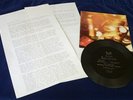
Here is an important auction! This is an authentic Vitaphone Disk from Reel 1 of "A Man's Man" (1929). The original dust jacket is included. The disk is marked as played nine times (out of 40). There is an arrow and a "1", hand-written with a grease pencil, at the start. The first five playes are ticked off with "Schenley" written beneath (The Schenley Theatre was a movie house near the University of Pittsburgh), then the next five plays are marked. The original dust jacket is stamped "STORE FLAT TO AVOID WARPAGE", along with the remains of the broken seal. The disk is, of couse, single-sided. It shows no cracks or warpage - I have no way to play this, so I only make a visual inspection.
This gets even better! "A Man's Man" (1929) is a LOST movie that stars Willaim Haines, Josephine Dunn, Sam Hardy, Mae Busch, John Gilbert, and Greta Garbo!!!! According to the Internet Movie Database and the Vitaphone Project, the sound discs (containing a musical score and sound effects, but no dialog) to this film exist, and are held at the UCLA Film and Television Archive in Los Angeles This might be the only Vitaphone disk to the movie in private hands. Do you know of another?
(From Wikipedia): Vitaphone was a sound film process used on features and nearly 2,000 short subjects produced by Warner Brothers and its sister studio First National from 1926 to 1930. Vitaphone was the last, but most successful, of the sound-on-disk processes. The soundtrack was not printed on the actual film, but was issued separately on 16-inch phonograph records. The discs would be played while the film was being projected. Many early talkie, such as "The Jazz Singer" (1927), used the Vitaphone process. (The name "Vitaphone" derives from the Latin and Greek words, respectively, for "living" and "sound.")
A Vitaphone-equipped theater used special projectors, an amplifier, and speakers. The projectors operated as normal motorized silent projectors would, but also provided a mechanical interlock with an attached phonograph turntable. When the projector was threaded, the projectionist would align a start mark on the film with the picture gate, and would at the same time place a phonograph record on the turntable, being careful to align the phonograph needle with an arrow scribed on the record's label.
When the projector rolled, the phonograph turned at a fixed rate, and (theoretically) played sound in sync with the film passing the picture gate simultaneously. Unlike the prevailing speed of 78 r.p.m. for phonograph discs, Vitaphone discs were played at 33-1/3 r.p.m. to increase the playing time to match the 11-minute running time of a reel of film. Also unlike most phonograph discs, the needle on Vitaphone records moved from the inside of the disc to the outside
The Vitaphone process made several improvements over previous systems:
- Amplification - The Vitaphone system was one of the first to use electronic amplification, using Lee deForest's Audion Tube. This allowed the sound of the phonograph to be played to a large audience at a comfortable volume.
- Fidelity - In the early days, Vitaphone had superior fidelity to sound-on-film processes, particularly at low frequencies. Phonographs also had superior dynamic range, on the first few playings.
These innovations notwithstanding, the Vitaphone process lost the early format war with sound-on-film processes for many reasons:
- Distribution - Vitaphone records had to be distributed along with film prints, and shipping the records required a whole infrastructure apart from the already-existing film distribution system. Additionally, the records would wear out after an estimated 20 screenings (a checkbox system on the record indicated the number of plays), and had to be replaced. This consumed even more distribution overhead. Damage and breakage were also inherent dangers.
- Synchronization - Vitaphone had severe and notorious synchronization problems. If a record skipped, it would fall out of sync with the picture, and the projectionist would have to manually restore sync. Additionally, if the film print became damaged and was not precisely repaired, the length relationship between the record and the print could be lost, also causing a loss of sync. The Vitaphone projectors had special levers and linkages to advance and retard sync, but it required the continual attention of the operator, and this was impractical. The system for aligning start marks on film and start marks on records was far from exact.
- Editing - A phonograph record cannot be physically edited, and this significantly limited the creative potential of Vitaphone films. Warner Brothers went to great expense to develop a highly complex phonograph-based dubbing system, using synchronization phonographs and Strowger switch-triggered playback phonographs (working very much like a modern sampler.)
Here is a rare chance to own a fantastic bit of Talkie history! This might be the only Vitaphone Disk from this movie in private hands, so I will have it professionally packed. Therefore, please add $30.00 shipping.
price rating






![BUNBURY - Greta Garbo Vinyl LP] Signed Amoeba Records Meet & Greet](https://www.popsike.mobi/php/thumbnail.php?url=https://www.popsike.pics/pix/20230616/175774011842.jpg)

