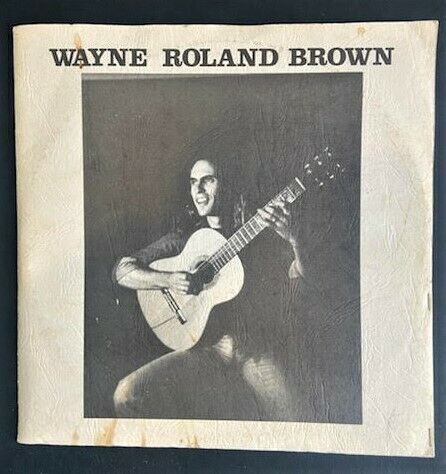
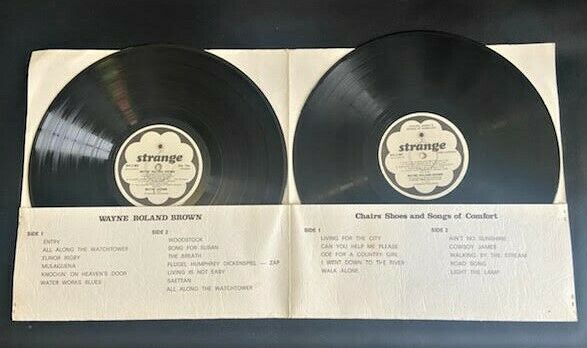
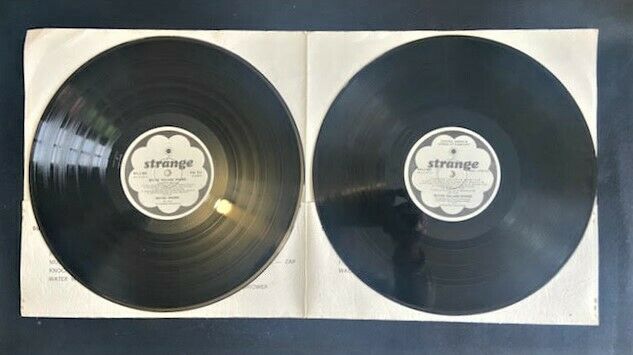
Wayne Roland Brown, double album, Chairs Shoes and Songs of Comfort. Signed
A$
50
$
33
Favourite Auctions
To save auctions to your favourites, please login
If you don't have an account, please register
Description
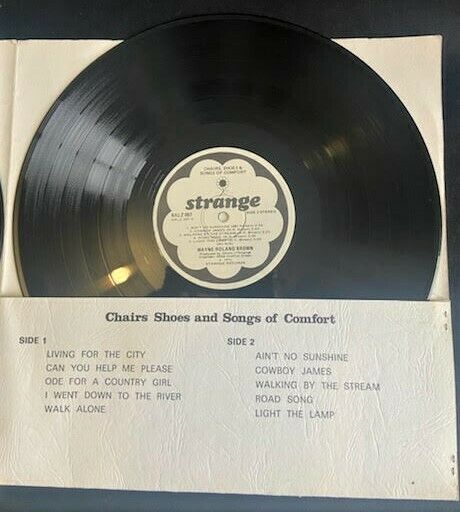
Here's a Very Interesting find from 1975 this is a double LP set, the 1st album is self titled Wayne Roland Brown and the 2nd album titled Chairs Shoes and Songs of Comfort.
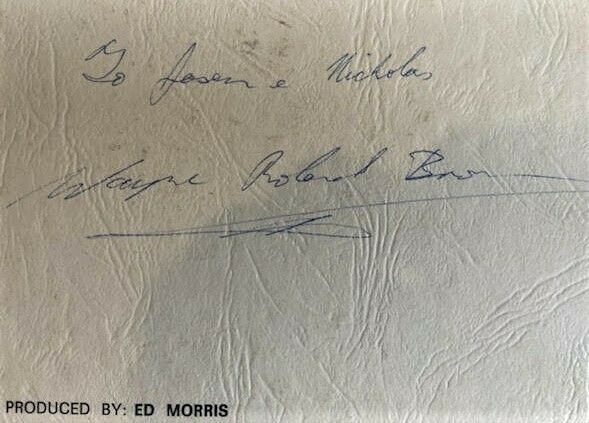
The gatefold album cover is signed on the back, " To Jason and Nicholas, Wayne Roland Brown " see pics. A very interesting double album, and Very Rare!!
Wayne Roland Brown was a Wellington singer songwriter. His first recordings were in 1975, where he released two albums on the Strange label. The first was self titled "Wayne Roland Brown" and the second was "Fast Mover". These two albums were also packaged together as a double album the same year and it was released as "Chairs, Shoes and Songs Of Comfort".
New Zealand raised, Nashville based singer-songwriter, multi-instrumentalist and one-time opal miner Wayne Roland Brown has recorded 15 albums and had his share of hits and misses.
Wayne Roland Brown is the epitome of the travelling minstrel, educating people about different cultural and musical expressions in a career that has taken him to 34 countries over the past 40 years. Along the way he collected and learned to play a vast number of musical instruments, worked with some of the industry’s best musicians and producers and only narrowly escaped the fame that he once eagerly pursued.
Brown grew up in a number of central North Island towns, leaving New Zealand for a time as a youngster to live in Canada after his father died. When he returned in his late teens, writing and performing music had become a passion.
Brown was half of the duo Harper & Brown, played clubs with fellow songwriter Reece Kirk, and was in demand as a solo act. His first recording was with Harper & Brown for the single 'Dream No.47' b/w 'Sermon (In Rememberance of the Nameless)' recorded for Tala Records in a studio above an electronics shop in Levin, and released in 1972. Rob Harper played bass, fiddle and harmonies and Brown sang and let rip on his guitar and wah-wah pedal, which he’d recently acquired.
BROWN WAS ALWAYS KEEN TO EXPERIMENT AND LEARN DIFFERENT INSTRUMENTS, ADDING A SITAR TO HIS PERFORMANCES EARLY ON.
While studying law at Victoria University he began to do pub gigs around Wellington with fellow songwriter Reece Kirk. One day Edd Morris from Strange Records turned up, and being suitably impressed he booked time at EMI studios. Brown worked with sound engineer Michael Grafton-Green, who’d recently arrived from Abbey Road Studios in London along with a new 8-track tape machine and desk. They managed to record, mix and complete the master acetate for what became Wayne Roland Brown’s first album in six hours. It included originals, Joni Mitchell’s ‘Woodstock’ and two versions of Dylan’s ‘All Along the Watchtower’, one an eerie rendition with Brown playing church organ and the other a sparser take. “I used to open and close my concerts with that song so I did the same on the album. Everyone was stoned in those days so I guess it was just part of the deal,” he says.
Brown was always keen to experiment and learn different instruments, adding a sitar to his performances early on. His philosophy was that if nobody told him he couldn’t do it, he’d just give it a go. Sometimes the result was embarrassing, but mostly, he says it worked.
Signed to Pye, his contract was taken up by RCA when Pye wound down its activities in New Zealand in 1975. Brown repackaged his first two recordings as the double album Chairs, Shoes And Songs Of Comfort and began selling them at his gigs.
Contracted to RCA for two more albums, the songwriter continued to explore different styles. The albums Stealer Of Hearts and Fools And Pretenders were released in New Zealand and Australia in time for his move across the ditch. He picked up work in pubs, clubs and strip joints – “whatever kept bread on the table and the rent paid” – and was the opening act for Brian Cadd, Billy Thorpe & the Aztecs and other top Australian artists.
His folksy, storytelling style and diversity on so many instruments endeared him to the Australian Arts Council, opening the doors for a relationship that would last 25 years.
“They’d put me on a plane with a pilot, 18 to 20 musical instruments and a small sound system and we’d fly to remote communities and schools, including the opal towns.”
Being stranded by torrential rain at Lightning Ridge in the outback of northwestern New South Wales was a life changing experience. “I got to know the miners, drank beer with them at the pub and bowling club and listened to their stories. One of them gave me a rough opal, which I took back to Sydney. After having it cut I made a lot of money.” Brown was hooked and began making regular trips back to Lightning Ridge, investing in opal and gemstone mining.
price rating