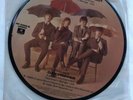
"Yellow Submarine" Canadian release by The Beatles
$
25


Favourite Auctions
To save auctions to your favourites, please login
If you don't have an account, please register
Description
The price includes shipping and handling!
"Yellow Submarine" 45rpm record by "The Beatles"!
The record is in excellent condition, has been test played and sounds wonderful with no scratches or background noise.
Now for some background information regarding the song "Yellow Submarine":
#5715 Capital Records 1966 original Canadian release on Orange and Yellow Swirl without “A Subsidy Of …” in perimeter label print. Print on perimeter is white. "Yellow Submarine" is a 1966 song by The Beatles (credited to Lennon/McCartney), and lead sang by Ringo Starr. The song was better received in Britain than in the United States. The single went to #1 on every major British chart, remained at #1 for four weeks and charted for 13 weeks. It won an Ivor Novello Award for the highest certified sales of any single issued in the UK in 1966. However, it failed to reach #1 on the American charts.
McCartney was living in Jane Asher's parents' house when he found the inspiration for the song: "I was laying in bed in the Asher's garret... I was thinking of it as a song for Ringo, which it eventually turned out to be, so I wrote it as not too rangey [too many notes] in the vocal, then started making a story, sort of an ancient mariner, telling the young kids where he'd lived. It was pretty much my song as I recall... I think John helped out. The lyrics got more and more obscure as it goes on, but the chorus, melody and verses are mine." The song began as being about different coloured submarines, but evolved to include only a yellow one.
In 1980, Lennon talked about the song: "'Yellow Submarine' is Paul's baby. Donovan helped with the lyrics. I helped with the lyrics too. We virtually made the track come alive in the studio, but based on Paul's inspiration. Paul's idea. Paul's title... written for Ringo." Donovan added the words, "Sky of blue and sea of green". McCartney also said: "It's a happy place, that's all. You know, it was just... We were trying to write a children's song. That was the basic idea. And there's nothing more to be read into it than there is in the lyrics of any children's song."
Produced by George Martin and engineered by Geoff Emerick, "Yellow Submarine" was finished after five takes on 26 May 1966, in Studio Two at Abbey Road Studios, with special effects being added on 1 June 1966. On the second session the studio store cupboard was ransacked for special effects, which included chains, a ship's bell, tap dancing mats, whistles, hooters, a tin bath filled with water, wind and thunderstorm machines, as well as a cash register.
Lennon blew through a straw into a pan of water to create a bubbling effect, McCartney and Lennon talked through tin cans to create the sound of the captain's orders, and Abbey Road assistant engineers John Skinner and Terry Condon twirled chains in a tin bath to create water sounds. After the line, "and the band begins to play", Emerick found a recording of a brass band and changed it slightly so it could not be identified, although it is thought to be a recording of Georges Krier and Charles Helmer's 1906 composition, "Le Reve Passe". To stay with the children's story theme, the original recording had a spoken intro by Starr, but the idea was abandoned on June 3 1966. "Yellow Submarine" was mixed on the 2nd and 3rd of June, and finished on 22 June 1966.
It was released in the UK on 5 August as a 'double A-side' with "Eleanor Rigby", and in the United States on 8 August.
In the United States, the single was #2 on the Billboard "Hot 100", #1 in Record World, and #2 in Cashbox.
The single went to #1 on every major British chart, remained at #1 for four weeks (August 18, 1966 - September 8, 1966) and charted for 13 weeks. It won an Ivor Novello Award for the highest certified sales of any single issued in the UK in 1966.
Various people unofficially contributed to the recording: Neil Aspinall, Pattie Boyd, Mal Evans, Marianne Faithfull, and Brian Jones (providing sound effects and "party" noises; laughter, clinking glasses, and background chatter) as well as chauffeur Alf Bicknell. When the overdubs were finished, Evans strapped on a marching bass drum and led everybody in a line around the studio doing the conga dance whilst banging on a bass drum.
As far as the B-side (or in this case the double A-side) of "Yellow Submarine"… "Eleanor Rigby" is a song by The Beatles primarily written by Paul McCartney. With a double string quartet arrangement by George Martin, and striking lyrics about loneliness, the song continued the transformation of the group, started in Rubber Soul, from a mainly pop-oriented act to a more serious and experimental studio band.
As is true of many of McCartney's songs, the melody and first line of the song came to him as he was playing around on his piano. The name that came to him, though, was not Eleanor Rigby but Miss Daisy Hawkins. In 1966, McCartney recalled how he got the idea for his song:
“
I was sitting at the piano when I thought of it. The first few bars just came to me, and I got this name in my head... 'Daisy Hawkins picks up the rice in the church'. I don't know why. I couldn't think of much more so I put it away for a day. Then the name Father McCartney came to me, and all the lonely people. But I thought that people would think it was supposed to be about my Dad sitting knitting his socks. Dad's a happy lad. So I went through the telephone book and I got the name McKenzie.
”
McCartney originally imagined Daisy as a pre-pubescent girl, but anyone who cleaned up in churches would probably be older. If she were older, she might have missed not only the wedding she cleans up after but also her own.
McCartney said he came up with the name Eleanor from actress Eleanor Bron, who had starred with the Beatles in the film Help!. Rigby came from the name of a store in Bristol, Rigby & Evens Ltd, Wine & Spirit Shippers, that he noticed while seeing his then-girlfriend Jane Asher act in The Happiest Days Of Your Life. He recalled in 1984, "I just liked the name. I was looking for a name that sounded natural. Eleanor Rigby sounded natural."
The Beatles finished the song in the music room of John Lennon's home at Kenwood. John Lennon, George Harrison, Ringo Starr, and their friend Pete Shotton all listened to McCartney play his song through and contributed ideas. Starr contributed the line "writing the words of a sermon that no one will hear " and suggested making "Father McCartney" darn his socks, which McCartney liked. Shotton then suggested that McCartney change the name of the priest, in case listeners mistook the fictional character in the song for McCartney's own father.
The song is often described as a lament for lonely people or a commentary on post-war life in Britain.
McCartney couldn't decide how to end the song, and Shotton finally suggested that the two lonely people come together too late as Father McKenzie conducts Eleanor Rigby's funeral. At the time, Lennon rejected the idea out of hand, but McCartney said nothing and used the idea to finish off the song, later acknowledging Shotton's help.
"Eleanor Rigby" does not have a standard pop backing; none of the Beatles played instruments on it, though John Lennon and George Harrison did contribute harmony vocals. Instead, McCartney used a string octet of studio musicians, composed of four violins, two cellos, and two violas, all performing a score composed by producer George Martin. For the most part, the instruments "double up"—that is, they serve as two string quartets with two instruments playing each part in the quartet. Microphones were placed close to the instruments to produce a more vivid and raw sound. George Martin asked musicians to play without vibrato and recorded two versions, one with and one without, the latter of which was used. McCartney's choice of a string backing may have been influenced by his interest in the composer Antonio Vivaldi. Lennon recalled in 1980 that "Eleanor Rigby" was "Paul's baby, and I helped with the education of the child ... The violin backing was Paul's idea. Jane Asher had turned him on to Vivaldi, and it was very good." The octet was recorded on 28 April 1966, in Studio 2 at Abbey Road Studios and completed in Studio 3 on 29 April and on 6 June. Take 15 was selected as the master.
George Martin, in his autobiography All You Need Is Ears, takes credit for combining two of the vocal parts, having noticed that they would work together contrapuntally.
"Eleanor Rigby" was released on a double A-side single with "Yellow Submarine" on Parlophone in the United Kingdom and Capitol in the United States. It spent four weeks at number one on the British charts, but in America it only reached the eleventh spot. The song was nominated for three Grammys and won the 1966 Grammy for Best Contemporary (R&R) Vocal Performance, Male or Female for McCartney
In the 1980s, a grave of an Eleanor Rigby was discovered in the graveyard of St. Peter's Parish Church in Woolton, Liverpool, and a few yards away from that, another tombstone with the last name McKenzie scrawled across it. During their teenage years, McCartney and Lennon spent time "sunbathing" there; within earshot distance of where the two had met for the first time during a fete in 1957. Many years later McCartney stated that the strange coincidence between reality and lyric could be a product of his subconscious, rather than being a meaningless fluke. The actual Eleanor Rigby was born in 1895 and lived in Liverpool, possibly in the suburb of Woolton, where she married a man named Thomas Woods. She died on 10 October 1939 at age 44, which, because 1940 was a leap year, was exactly one year to the day before Lennon was born. Whether this Eleanor was the inspiration for the song or not, her tombstone has become a landmark to Beatles fans visiting Liverpool. In June 1990, McCartney donated a document dating from 1911 which had been signed by the 16-year-old Eleanor Rigby to Sunbeams Music Trust, instantly attracted significant international interest from collectors because of the significance and provenance of the document. The nearly 100-year-old document was sold at auction in November 2008 for £115,000. The Daily Telegraph reported that the uncovered document "is a 97-year-old salary register from Liverpool City Hospital." The name E. Rigby is printed on the register, and she is identified as a scullery maid. Her great grand-daughter is actress Emma Rigby.
price rating





![Rick Parfitt ?– Over And Out The Band's Mix [12'' VINYL LP] NEW & SEALED](https://www.popsike.mobi/php/thumbnail.php?url=https://www.popsike.pics/pix/20200924/373232731298.jpg)