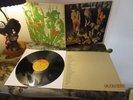
Yes ? The Yes Album ? RARE 1971 Atlantic Records Original Monarch Press Vinyl LP
$
25


Favourite Auctions
To save auctions to your favourites, please login
If you don't have an account, please register
Description
Welcome to Classic Cadillac Records! My goal is to provide each and every customer with the best possible buying experience, no matter the size of the order. Unlike most sellers, I advertise all my items clearly and in as much detail as possible, without shouting at you in all caps. I take multiple high quality pictures and never use stock photos, so you know exactly what you’re buying. I take great pride in my work and go the extra mile, which can clearly be seen in my listings compared to other sellers that put minimal effort into theirs. I visually grade all my records as accurately as possible and will never grade anything above Near Mint unless it’s still sealed. Please note that a visual grade can differ from a play grade, and am happy to spot check a record upon request. All orders are shipped within 1 business day (usually sooner) and packed with extra care to ensure fast, safe arrival. I combine shipping on multiple orders to save you money and gladly ship worldwide. Please look closely at all pictures, read all relevant details and ask any questions you may have before buying. I offer a full 30-day return policy on everything I sell, so buy with confidence! And most importantly, thanks for looking!
The Yes Album Studio album by Yes Released 19 February 1971 Recorded 17 July 1970 ("Clap")Autumn 1970 Venue Lyceum Theatre, London ("Clap") Studio Advision Studios, Fitzrovia, London Genre
- Progressive rock[1]
- proto-prog[2]
- Yes
- Eddie Offord
(1970) The Yes Album
(1971) Fragile
(1971) Singles from The Yes Album
- "Your Move"
Released: 5 March 1971
The Yes Album is the third album by the English progressive rock band Yes, released on 19 February 1971 by Atlantic Records. It is their first album with guitarist Steve Howe, who replaced Peter Banks in 1970, and their last in the 1970s to feature keyboardist Tony Kaye.
The album was the first by the group not to feature any cover versions of any songs, which had been a staple of their material until that point. The band spent mid-1970 writing and rehearsing new material at a farmhouse at Romansleigh, Devon, and the new songs were recorded at Advision Studios in London in the autumn. While the album retained close harmony singing, Kaye's Hammond organ and Chris Squire's melodic bass, as heard on earlier releases, the new material also covered further styles including jazz piano, funk and acoustic music, with all band members contributing ideas, and tracks were extended in length to allow music to develop. Howe contributed a variety of guitar styles, including a Portuguese guitar, and recorded a solo acoustic guitar piece, "Clap", live at the Lyceum Theatre, London.
The album was a critical success and a major commercial breakthrough for Yes, who had been at risk of being dropped by Atlantic Records due to the commercial failures of their first two albums. It reached number 4 in the UK and number 40 in the US, and was later certified Platinum by the Recording Industry Association of America for surpassing one million copies. The album has been reissued on CD several times, and was given a Blu-ray release in 2014 remixed by Steven Wilson.
Background
Yes had already recorded two albums for Atlantic Records by mid-1970, but neither had been commercially successful and the label was considering dropping them. They had replaced founding member Banks with Howe, who enjoyed playing a wider variety of styles, including folk and country music, and played a mix of electric and acoustic guitars. Singer Jon Anderson later said that Howe could "jump from one thing to the other, very fast, very talented." After some warm-up gigs with Howe, the band moved to Devon to write and rehearse new material. They arrived at a cottage in Churchill, north of Barnstaple, but the group felt restricted there and were not to allowed to make any noise after dark. They advertised in the local paper for a new location, and moved to Langley Farm in Romansleigh, near South Molton, some 20 miles away. Howe in particular enjoyed working on the farm, and eventually bought it. Following rehearsals, the band booked Advision Studios in London with producer Eddie Offord and spent the autumn recording. The band enjoyed the sessions, and soon had enough material ready for an album.
In November 1970, the group were involved in a car accident returning from a gig in Basingstoke. The band all suffered shock, and Kaye broke a foot. He had to do the next few gigs, and the album cover's photo shoot, with it in plaster.
Howe mostly used a Gibson ES-175 semi-acoustic guitar and a Martin OO-18 acoustic for recording, though he did attempt to play a variety of styles with the two instruments. Kaye's main instruments were the Hammond organ and piano, including a solo on "A Venture". Kaye had previously played the Hammond M-100, but for this album used the B-3, a move which he saw as "a turning point". He was not interested in playing electronic keyboards, which had started to appear on the market. This proved to be a problem with the other members of the band, and Kaye thought his style conflicted too much with Howe's. He left the group during rehearsals for the follow-up album in mid-1971, to be replaced by Rick Wakeman.
Songs
Steve Howe played a Portuguese guitar, credited as a "vachalia", on "Your Move".Yes had started their career being a covers band, performing radical re-arrangements of hit songs, and their first two albums included covers in this vein. However, The Yes Album was the first to feature group-written material in its entirety. Some familiar elements remained; Anderson, Howe and Squire sang three-part vocal harmony throughout the record, while Squire's melodic bass and Bill Bruford's spacious drumming made up their unique rhythm section.
"Yours Is No Disgrace" originated from some lyrics written by Anderson with his friend David Foster. This was combined with other short segments of music written by the band in rehearsals. Howe worked out the opening guitar riff on his own while the rest of the band took a day's holiday. The backing track was recorded by the group in sections, then edited together to make up the final piece.
Howe's solo acoustic tune, "Clap" (wrongly written as "The Clap" in original album pressings), was influenced by Chet Atkins and Mason Williams' "Classical Gas". The piece was written to celebrate the birth of Howe's son Dylan on 4 August 1969. The version that appears on the album was recorded live at the Lyceum Theatre in London on 17 July 1970.
The spacey, electronic-sounding effect in "Starship Trooper" was achieved by running the guitar backing track through a flanger. Anderson wrote the bulk of the song, while Squire wrote the "Disillusion" section in the middle. The closing section, "Würm" is a continuous cadenza of chords (G-E?-C) played ad lib. It evolved from a song called "Nether Street" by Howe's earlier group, Bodast.
"I've Seen All Good People" is a suite of two tunes. Anderson wanted the piece to start quietly and develop, leading into a large church organ sound, before moving into the funky second movement. The band had difficulty recording the initial "Your Move" section, which was resolved by making a tape loop of bass and drums, over which Howe overdubbed a Portuguese 12-string guitar, miscrediting it as a "vachalia" on the album's credits. Gnidrolog's Colin Goldring played recorder on the track.
Anderson wrote "A Venture" in the studio, which was arranged by the rest of the band. Kaye played piano on the track, contributing a jazzy solo towards the end. Howe played a guitar solo on the original recording, but it was left off the final mix, which faded out just as it started. The song was never played live by the original group, but an arrangement was worked out when Yes decided to play the whole album live in 2013.
Anderson was inspired to write the lyrics for "Perpetual Change" by the view of the countryside from the cottage at Churchill. The middle of the track features a polyrhythmic structure, where two pieces of music in different time signatures are playing simultaneously.
Cover
A mannequin's head, similar to this one, was used in the front cover shot.The front cover was shot by Phil Franks the day after the Basingstoke gig accident. Franks had already taken some photos from the Lyceum gig, but felt he needed something more for the front cover. The band showed up late having been in hospital earlier that day, and only 30 minutes were available for a shoot. Unable to get a satisfactory photo in the studio, Franks took the band round to his flat, grabbed a polystyrene mannequin head from a bin, put a 1,000 watt bulb in the kitchen light fitting, and improvised the shot. Franks credited the sleeve designer, Rolling Stone art director Jon Goodchild, for making the cover a success. When Yes performed a live version of "Yours is No Disgrace" for the German television series Beat-Club in April 1971, footage of the band was combined with that of another mannequin head spinning over a chair, mimicking the cover's concept.
The inside of the album's gatefold sleeve shows Kaye playing a Hammond organ, while the front cover showed his leg in plaster, following the accident. Anderson is credited as "John Anderson" on the album but he had dropped the "h" from his first name by the next album, Fragile.
Release
The Yes Album was released in the UK on 19 February 1971. It was a commercial success and was the band's breakthrough album, selling around 60,000 copies upon release and reaching number 4 in the UK. and number 40 in the US. It has been certified Platinum by the Recording Industry Association of America for selling over one million copies.
Squire later said a key reason for the success was that there was a postal strike which prevented chart returns being sent, and reducing the available ones to a few retailers in London. Yes had the largest fanbase in these stores, and that allowed a good chart position. By the time the strike had ended, the album had started to sell well due to its initial apparent success.
The 1971 Italian issue of the album differs from the original UK issue in two respects. The title on the front cover is "The Yes" instead of "The Yes Album", although the spine bears the correct title; and the track "The Clap" appears as the third track on the second side.
Reception
Professional ratings Review scores Source Rating Allmusic Robert Christgau B? Pitchfork (8.1/10) Rolling Stone (positive) Rolling Stone The Rolling Stone Record Guide The Daily Vault B+The album had a positive reception from critics. John Koegel, writing for Rolling Stone, praised the instrumental unity between Squire, Howe and Kaye, but missed the cover versions present in earlier releases. The album is one of three by Yes to appear in the book 1,000 Recordings to Hear Before You Die. Author Tom Moon preferred the group unity that he felt was missing on later releases and gave a positive impression of Anderson's vocals, saying the melodies in "I've Seen All Good People" were "instantly singable and still somehow deep."
Anderson was worried about the initial response to the album, but after about a month noticed that fans started singing along at concerts, and concluded that this musical style could be developed and still remain popular. Kaye concluded that overall it was "quite a simple album, considering where Yes went onto from there." Rush singer and bassist Geddy Lee included The Yes Album among his favourite albums. Genesis keyboardist Tony Banks has said it his favourite Yes album and preferred the band when Kaye was a member. "It was the addition of Steve Howe's guitar pyrotechnics that finally allowed Yes to find their true identity. The Yes Album is a giant leap forward," wrote J. D. Considine in The New Rolling Stone Album Guide
Track listing
Side one No. Title Writer(s) Length 1. "Yours Is No Disgrace" Jon Anderson, Chris Squire, Steve Howe, Tony Kaye, Bill Bruford 9:41 2. "Clap" Howe 3:17 3. "Starship Trooper"- a. "Life Seeker"
- b. "Disillusion"
- c. "Würm"
- 3:29
- 2:20
- 3:40
- a. "Your Move"
- b. "All Good People"
- 3:32
- 3:24
price rating


![Halcyon Digest [VINYL] Deerhunter Vinyl](https://www.popsike.mobi/php/thumbnail.php?url=https://www.popsike.pics/pix/20161210/311757384831.jpg)