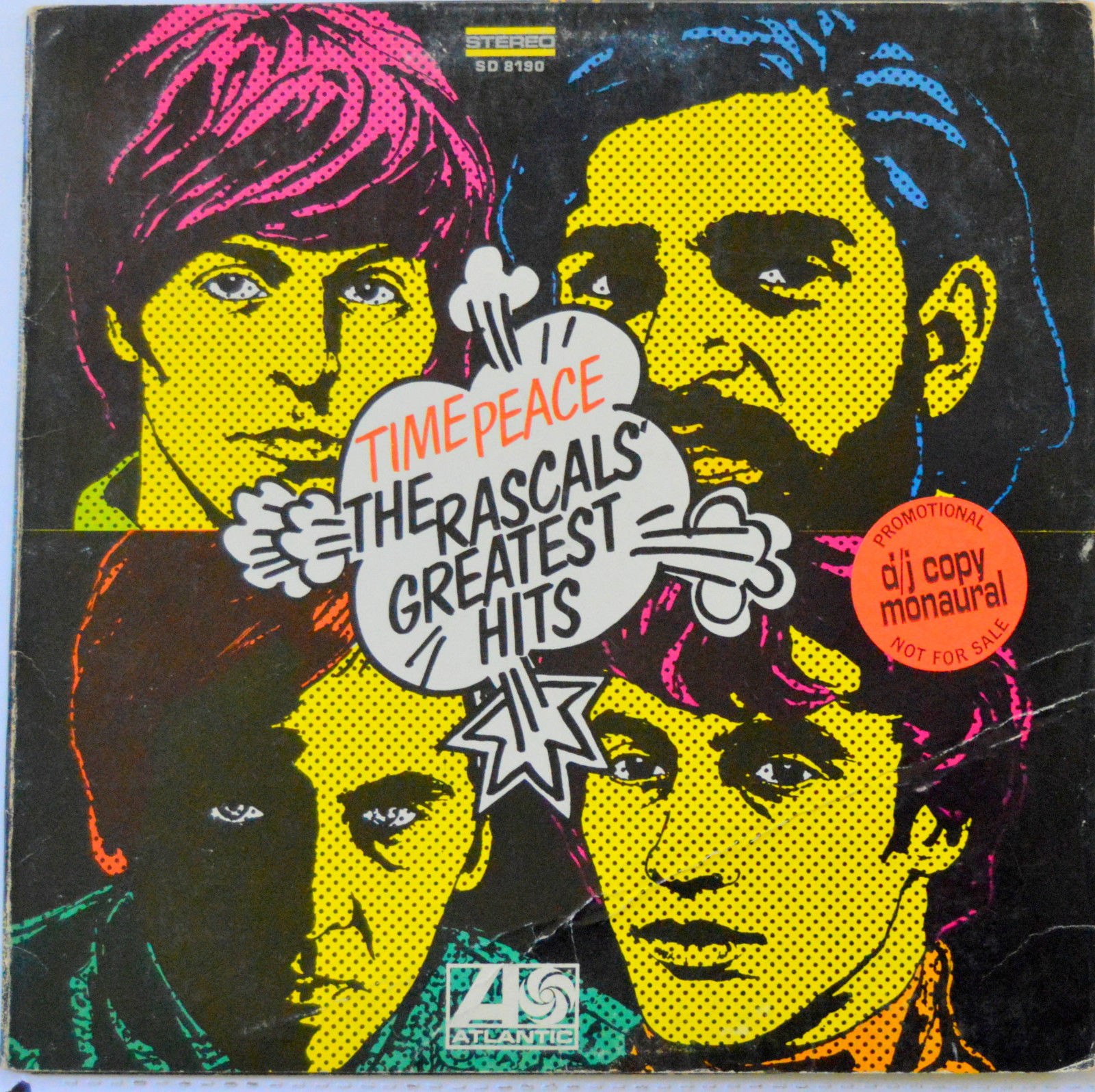
Young "Rascals" Time Peace Greatest Hits - 1968 ULTRA-RARE "MONO" WL PROMO
$
50


Favourite Auctions
To save auctions to your favourites, please login
If you don't have an account, please register
Description
PLEASE READ COMPLETE AUCTION DESCRIPTION
BEFORE BIDDING
_______________
PAYMENT DUE WITHIN
5 DAYS
OF AUCTION CLOSING
_______________
Records
are
Visually Graded
UP FOR AUCTION IS:
Young Rascals
Time Peace
The Rascals' Greatest Hits
ULTRA-RARE DJ 1968 MONO WL PROMO Vinyl
DJ PROMO NOT FOR SALE "stereo" Cover
VG+ cover / VG vinyl
The album is the only such compilation released during the group's active career. Although billed to their later name, most of the material came from when the group was known as The Young Rascals. It contains all their singles through 1968's earlier "A Beautiful Morning", as well as some of their R&B treatments from early in their career.
Packaging consisted of a gatefold album cover with front and back consisting of dot-based newspaper cartoon-style drawing of the four group members, with song titles in speech balloons; the interior gave complete song credits on one side, and an ensemble photograph on the other side whose artsy nature and 1968-style dress, together with the album's punning title, foretold the thematic and artistic direction the group was about to undertake.
Time Peace was the group's most commercially successful album, reaching number one on the Billboard Pop Albums chart by September 1968. It also topped the Cash Box albums chart with a run in the Top 10 for 20 consecutive weeks. Moreover, showing the group's white soul label was well earned, Time Peace also reached number four on the Billboard Black Albums chart. It was RIAA-certified as a gold record on September 4, 1968. It also grew in critical regard; Rolling Stone's Dave Marsh called it a "glorious chronicle" and Allmusic's Bruce Eder said it is "arguably the greatest greatest-hits album of the '60s."
Track listing
Side One
"I Ain't Gonna Eat Out My Heart Anymore" (Pam Sawyer, Laurie Burton) – 2:41
The Rascals' first single (Atlantic #2312, 1965); also included on the 1966 album The Young Rascals
"Good Lovin'" (Rudy Clark, Arthur Resnick) – 2:28
The Rascals' second single (Atlantic #2321, 1966), and first #1 hit; also included on The Young Rascals
"You Better Run" (Felix Cavaliere, Eddie Brigati) – 2:25
The A-side of the Rascals' third single (Atlantic #2338, 1966); later included on the 1967 album Groovin'
"Come On Up" (Cavaliere) – 2:41
The Rascals' fourth single (Atlantic #2353, 1966), also included on the 1967 album Collections
"Mustang Sally" (Bonny Rice) – 3:59
Uncut version from The Young Rascals
"Love is a Beautiful Thing" (Cavaliere, Brigati) – 2:30
Originally released as the B-side of "You Better Run"; later included on Collections
"In the Midnight Hour" (Wilson Pickett, Steve Cropper) – 4:00
From The Young Rascals
Side Two
"(I've Been) Lonely Too Long" (Cavaliere) – 2:57
Uncut version from Collections
"Groovin'" (Cavaliere, Brigati) – 2:25
The Rascals' second #1 single (Atlantic #2401), released in 1967; also included on Groovin'
"A Girl Like You" (Cavaliere, Brigati) – 2:46
The follow-up Top 10 single to "Groovin'" (Atlantic #2424, 1967); also included on Groovin'
"How Can I Be Sure" (Cavaliere, Brigati) – 2:50
The Rascals' third Top 10 single of 1967 (Atlantic #2438); also included on Groovin'
"It's Wonderful" (Cavaliere, Brigati) – 2:40
LP version (without the "Mardi Gras" special effects coda) from the 1968 album Once Upon a Dream
"Easy Rollin'" (Cavaliere, Brigati) – 2:55
From Once Upon a Dream
"A Beautiful Morning" (Cavaliere, Brigati) – 2:32
Non-LP single from 1968 (Atlantic #2493)
Personnel
The Rascals
Felix Cavaliere – vocals, keyboards
Eddie Brigati – vocals, percussion
Gene Cornish – vocals, guitar
Dino Danelli – drums
Records
are
Visually Graded
Goldmine Grading System
Grading Records
The following is the grading system first developed by Goldmine Records. Virtually all methods currently in use for the grading of records, is based in some way, shape, or form, on this system. Rather than offer some variation of the original system first developed by Goldmine, the Record Collector's Guild will display the Goldmine record grading method in it's entirety.
Visual or Play Grading?
In an ideal world, every record would be played before it is graded. But the time involved makes it impractical for most dealers, and anyway, it's rare that you get a chance to hear a record before you buy through the mail. Some advertisers play-grade everything and say so. But unless otherwise noted, records are visually graded.
How to Grade
Look at everything about a record. It's playing surface, it's label, it's edges...under a strong light. Then based on your overall impression give it a grade based on the following criteria:
- Mint (M) Absolutely perfect in every way. Certainly never been played, possibly even still sealed.(More on still sealed under "Other Considerations"). Should be used sparingly as a grade, If at all.
- Near Mint (NM or M-) A nearly perfect record. Many dealers won't give a grade higher than this implying (perhaps correctly)that no record is ever truly perfect.
The record should show no obvious signs of wear. A 45 RPM or EP sleeve should have no more than the most minor defects, such as almost invisible ring wear or other signs of slight handling.
An LP cover should have no creases, folds, seam splits or other noticeable similar defects. No cut-out holes, either. And of course, the same should be true of any other inserts, such as posters, lyric sleeves and the like.
Basically, an LP in near mint condition looks as if you just got it home from a new record store and removed the shrink wrap.
Near Mint is the highest price listed in all Goldmine price guides. Anything that exceeds this grade, in the opinion of both buyer and seller, is worth significantly more than the highest Goldmine book value. - Very Good Plus (VG+) Generally worth 50 percent of the Near Mint value.
A Very Good Plus record will show some signs that it was played and otherwise handled by a previous owner who took good care of it.
Record surfaces may show some signs of wear and may have slight scuffs or very light scratches that don't affect one's listening experiences. Slight warps that do not affect the sound are "OK".
The label may have some ring wear or discoloration, but it should be barely noticeable. The center hole will not have been misshapen by repeated play.
Picture sleeves and LP inner sleeves will have some slight wear, lightly turned up corners, or a slight seam split. An LP cover may have slight signs of wear also and may be marred by a cut-out hole, indentation or corner indicating it was taken out of print and sold at a discount.
In general, if not for a couple things wrong with it, this would be Near Mint. All but the most mint-crazy collectors will find a Very Good Plus record highly acceptable. - Very Good (VG) Generally worth 25 percent of Near Mint value. Many of the defects found in a VG+ record will be more pronounced in a VG disc. Surface noise will be evident upon playing, especially in soft passages and during a song's intro and fade, but will not overpower the music otherwise. Groove wear will start to be noticeable, as with light scratches (deep enough to feel with a fingernail) that will affect the sound.
Labels may be marred by writing, or have tape or stickers (or their residue) attached. The same will be true of picture sleeves or LP covers. However, it will not have all of these problems at the same time, only two or three of them.
Goldmine price guides with more than one price will list Very Good as the lowest price. This, not the Near Mint price, should be your guide when determining how much a record is worth, as that is the price a dealer will normally pay you for a Near Mint record. - Good (G), Good Plus (G+) Generally worth 10-15 percent of the Near Mint value. Good does not mean Bad! A record in Good or Good Plus condition can be put onto a turntable and will play through without skipping. But it will have significant surface noise and scratches and visible groove wear (on a styrene record, the groove will be starting to turn white).
A cover or sleeve will have seam splits, especially at the bottom or on the spine. Tape, writing, ring wear or other defects will start to overwhelm the object.
It is a common item, you'll probably find another copy in better shape eventually. Pass it up. But, if it's something you have been seeking for years, and the price is right, get it...but keep looking to upgrade. - Poor (P), Fair (F) Generally worth 0-5 percent of the Near Mint price. The record is cracked, badly warped, and won't play through without skipping or repeating. The picture sleeve is water damaged, split on all three seams and heavily marred by wear and writing. The LP cover barely keeps the LP inside it. Inner sleeves are fully seam split, crinkled, and written upon.
Except for impossibly rare records otherwise unattainable, records in this condition should be bought or sold for no more than a few cents each.
Other Considerations
Most dealers give a separate grade to the record and it's sleeve or cover. In an ad, a record's grade is listed first, followed by that of the sleeve or the cover.
- With Still Sealed (SS) records, let the buyer beware! Unless it'a a U.S. pressing from the last 10-15 years or so. It's too easy to reseal one. Yes, some legitimately never-opened LP's from the 1960's still exist. But if you're looking for a specific pressing, the only way you can know for sure is to open the record.
© 1997
PAYMENT DUE WITHIN
5 DAYS
OF AUCTION CLOSING
price rating