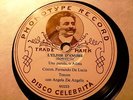
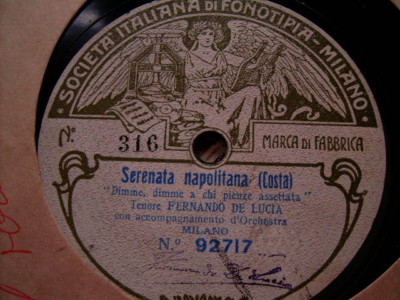
1909 FERNANDO DE LUCIA MILAN FONOTIPIA Serenata Napol78
$
34


Favourite Auctions
To save auctions to your favourites, please login
If you don't have an account, please register
Description
WEEK 3 of 3 weeks of great auctions
IMPORTANT: I AM HAPPY COMBINE MULTIPLE SHIPMENTS.
IF YOU WIN MULTIPLE ITEMS DO NOT USE EBAY CHECK OUT to get low combined postage. Send me an invoice request instead.
Great 1909 MILAN Record on original Gramo Concert Record label
The greatest of all tenors: Fernando De Lucia
on great MILAN FONOTIPIA
FERNANDO DE LUCIA [t].
DeLucia’s 32 Fonotipia recorded sides (two unpublished) of Italian songs were all recorded from Jan. 10, 1911 through Jan. 14.
Fonotipia 92717/92718 [XPh4479/XPh4463]. SERENATA NAPOLITANA(Costa)/CHI SA! (Tosti).
FERNANDO DE LUCIA [t]. DeLucia’s 32 Fonotipia recorded sides (two unpublished) of Italian songs were all recorded from Jan. 10, 1911 through Jan. 14. 1082. 11” Fonotipia 92708/92710 [XPh4481/4480]. CARMELA (E. De Curtis)/VOCE ‘E NOTTE (G. De Curtis). One tiny (harmless) scr. side one. Cons. 2. $20.00. 1079. 11” Fonotipia 92717/92718 [XPh4479/XPh4463]. SERENATA NAPOLITANA (Costa)/CHI SA! (Tosti). Cons. 2. $20.00THIS IS AN ORIGINAL MILAN FONOTIPIA, not a US repressing 10" 3/8 78 rpm record
Condition:
VERY GOOD PLUS shiny and unworn, but light scratches throughout. 12 mm scratch will sound on serenata/
Fernando De Lucia (b. Naples, 11 October 1860[1] or 1 September 1861, died there, 21 February 1925) was an Italian tenor opera singer and teacher who was famous in his lifetime as a performer and interpreter, and acquired a great posthumous reputation among record-collectors as a leading exponent of a particular style of singing.
Early career
De Lucia studied at the Naples Music Conservatory with Vincenzo Lombardi and Beniamino Carelli.[2] He made his debut at the Teatro di San Carlo, Naples, as Gounod's Faust.[3] Over the next two or three years he sang in Spain, South America and in the smaller Italian opera houses, in Linda di Chamounix, Dinorah, L'elisir d'amore, Fra Diavolo and La sonnambula.[4] While in Madrid he was procured by Augustus Harris and Herman Klein for his first London appearances in the Drury Lane season of 1887,but although Klein liked his Alfredo, he went comparatively unnoticed owing to the London debut of Jean de Reszke.[5] His Almaviva in Il barbiere di Siviglia (a role later closely associated with him) was described as 'truly detestable' by The Times.[6]
[edit] Mascagni, Rome and Florence
In 1891 he took part in the world premiere of L'amico Fritz (Fritz Kobus) (31 October 1891, with Emma Calv?, Synnemberg and Lherie), by Pietro Mascagni, at the Costanzi Theatre, Rome.[7] For a singer later upheld (by some) as the model of bel canto style[8] it was originally quite otherwise, as the creator of Mascagni's original verismo roles that de Lucia was famous, and he was at the centre of the European Mascagni craze of the early 1890s.[9] (L'amico Fritz had its Covent Garden premiere on 23 May 1892.[10]) In November de Lucia was at Florence opera house creating the lead in Mascagni's third opera, I Rantzau[11]
[edit] Verismo firsts in London, 1893
De Lucia's verismo career continued with the first England performance (19 May 1893), conducted by Enrico Bevignani, of Leoncavallo's I pagliacci, with Melba, Victor Maurel and Mario Ancona (Tonio), taking the role of Canio first created at Milan a year earlier by Giraud.[12] Klein describes an audience breathless with excitement, and de Lucia's burning intensity in the role, a triumph of realism.[13] Mascagni made his own London debut at Covent Garden conducting L'amico Fritz on June 19 1893 with Calv?, de Lucia, Pauline Joran and Dufriche.[14] Soon afterwards, with Calv?, and accompanied by Paolo Tosti, de Lucia sang excepts from Cavalleria for Queen Victoria at Windsor. On July 7 of that year, with Melba, Ancona, David Bispham and Castelmary he gave the first England (Covent Garden) performance of I Rantzau. This was not a great success.[15]
[edit] London and Milan
In 1893 de Lucia sang in New York. He performed his Canio with Melba and Ancona, and this was esteemed: but he was not admired as Don Ottavio in Don Giovanni nor as the Duke of Mantua. He did not repeat the experience.[16] In London in 1894 he was performing both Cavalleria rusticana and I pagliacci (together) at Covent Garden with Ancona, and Shaw admired the 'altogether exceptional dramatic force' which their performances gave to the works.[17] That season he was also in a bilingual (French-Italian) Faust, with Melba, Ancona and Bauermeister. Shaw thought the role of Faust too heavy for de Lucia: his 'dramatic instinct helped him well through a part in which he seemed likely to be overweighted. Several times in the garden scene he found the right musical treatment with exceptional success.'[18] That was also his verdict of his Duke in a Rigoletto with Melba, Ancona and Giulia Ravogli, though he got through the music 'adroitly and pluckily'.[19]
De Lucia made a debut at La Scala in 1895 with the world premiere of Mascagni's Silvano, and he also appeared in the first Milan performances of Puccini's La boh?me (Rodolfo) and La Navarraise of Massenet.[20] At Covent Garden in that year, the first for nearly a decade in which Jean de Reszke did not appear, he shared the principal tenor work with Francesco Tamagno and Albert Alvarez.[21] David Bispham thought him admirable in Fra Diavolo that year, with Bispham and Mme Amadi (Lord and Lady Allcash), Marie Engle (Zerlina), Vittorio Arimondi and Antonio Pini-Corsi (brigands).[22]
In 1896 in Milan he appeared as Cavaradossi in Tosca, and again as Almaviva.[23] In 1897 he sang in a State Concert at Buckingham Palace for the Royal Jubilee.[24] At the Costanzi Theatre, Rome on 22 November 1898 he gave the first performance of Osaka in Mascagni's Iris,[25] and at Covent Garden on 12 July 1900 he played Cavaradossi in the first performance of Tosca in England, supporting the Floria Tosca of Milka Ternina, with Antonio Scotti as Scarpia and Luigi Mancinelli conducting.[26]
De Lucia was admired in Carmen, in I pescatori di perle, and for his singing of Rossini, Bellini and Verdi.[27] His last London season was in the 1905 company assembled by Henry Russell for the Waldorf Theatre (now the Strand Theatre), together with Alessandro Bonci, Ancona and Pini-Corsi.[28] His Milan La Scala farewell was as Rodolfo in 1916, and at the San Carlo in Napoli in 1917. His final appearance before the public was at the funeral of Enrico Caruso in 1921.[29] In his later years he lived in his home town of Naples and taught at the Conservatory there, in which he himself had been trained.[30]
[edit] Vocal technique
Although de Lucia's stage career was particularly associated with the work of Mascagni and the performance of the verismo operas (including the key moment of the Cavalleria rusticana premiere), the vocal technique projected in his recordings is not the strenuous, declamatory or histrionic style associated with the verismo movement in opera, but the converse. He had a lighter than usual voice for heroic roles, and his delivery was studied, measured, and in some ways artificial. In particular his Barber of Seville recordings, 'Ecco ridente', 'Se il mio nome', 'Numero quindici', etc., show a studied display of fioritura, ornament, portamento and breath control which appear to be a deliberate statement of the so-called bel canto style, or at least of its mannerisms which were being displaced by the different vocal resources demanded of the verismo tenor.[31]
Shaw wrote of him in June 1892, having seen his l'amico Fritz with Calve, 'Signor de Lucia succeeds Valero and Lubert as artificial tenor in ordinary to the establishment. His thin strident forte is in tune and does not tremble beyond endurance; and his mezza voce, though monotonous and inexpressive, is pretty as prettiness goes in the artificial school.'[32] In 1894 Shaw speaks of de Lucia and Beduschi both as tenors 'of the Gayarre school, without the goat-bleat of its extreme disciples,'[33] and this comment gives the clue.[34] Like Valero (and Francesco Vignas), Gayarre was taught by Melchiorre Vidal in Madrid. Vidal's pupil Rosina Storchio was also closely associated with verismo premieres. De Lucia, in Spain in the 1880s, had imbibed this example.
As a tenor d'artifice, Shaw is associating him with other tenors using a similar vocal method (such as Alessandro Bonci, Giuseppe Anselmi, Fiorello Giraud and Aristodemo Giorgini), in which a fast, narrow vibrato seems to be integral with the breath control used to sustain the portamenti and ornaments of the style. It is debated whether this is a true inheritance of the bel canto tradition of the age of Rubini or whether it is a product of flawed breath control in the method of the later 'tenor d'artifice'.
[edit] Recording career
Gramophone Company Recordings. De Lucia had a long relationship with the gramophone, which among later collectors acquired an almost legendary status. He recorded the following titles for the Gramophone Company between 1902 and 1908.[35] The dates are the issue dates: more than one date indicates two separate recordings. All are 10" records unless otherwise shown. The partners in duets are Antonio Pini-Corsi (bar), Maria Galvany (sop), Giuseppina Huguet (sop), Celestina Boninsegna (sop) and Ernesto Badini (bar).
'Stradella': Aria di chiesa (Piet?, Signore!) 1907.
Mozart, Don Giovanni: Il mio tesoro, 1908. Dalla sua pace, 1908.
Rossini, Il barbiere di Siviglia: Ecco ridente, 1902; 1904 (12"); 1908 (12"). Se il mio nome, 1908. Numero quindici (w. Pini-Corsi), 1906. Ah, qual colpo inaspettato (w. Galvany), 1908; (w. Huguet and A. Pini-Corsi), 1906 (12"). All'idea di quel metallo (w. Pini-Corsi), 1906 (12").
Bellini, La sonnambula: Ah! perch? non posso odiarti?, 1908. Son geloso del zeffiro (w. Galvany), 1908 (12"). Prendi, l'anel ti dono (w. Galvany), 1908 (12").
Donizetti, La favorita: Una vergine, un'angiol di dio, 1904. L'elisir d'amore: Obbligato obbligato (w. Badini), 1907.
Verdi, Luisa Miller: Quando le sere al placido, 1908 (12"). Rigoletto: La donna e mobile, 1902. La traviata: Un d?, felice, 1904. Dei miei bollenti spiriti, 1906 (12"). Parigi, o cara, noi lasceremo (w. Huguet), 1906 (12").
Wagner, Lohengrin: Cigno gentil, 1902. Deh, non t'incantan, 1906. S'ei torna alfin, 1906. Cigno fedel, 1907 (12"). Cessarono i canti alfin (w. Huguet), 1907 (12"). Mai deve domandarmi (w. Huguet), 1907 (12").
Bizet, Carmen: Il fior che avevi 1902; 1907 (12"). La tua madre (w. Huguet), 1907 (12"). Pearl fishers: Della mia vita, 1906. Mi par d'udir ancora, 1906. Non hai compreso (w. Huguet), 1906 (12").
Gounod, Faust: Salve dimora, 1906. Tardi si fa (w. Boninsegna), 1904 (12"); (w. Huguet), 1907 (12"). Romeo e Giulietta, Deh sorgi, o luce, 1908.
Thomas, Mignon: La tua bell'alma, 1906. Ah non credevi tu, 1906. Addio, Mignon, 1905 (12").
Massenet, Manon: Il sogno, 1902; 1907. Werther: Ah! non mi ridestar, 1902.
Mascagni, Cavalleria rusticana: Siciliana, 'O Lola', 1902.
Giordano, Fedora: Amor ti vieta, 1902. Mia madre, 1904. Vedi, io piango, 1904.
Puccini, Tosca: Recondita armonia, 1902.
Cilea, Adriana Lecouvreur: L'anima ho stanca, 1904. Lontananza, 1904.
Neapolitan. Anon: Fenesta che lucive, 1902. Baldelli: A suon di baci, 1902. Barthelemy: Sulla bocca amorosa, 1908. Triste ritorno, 1908. Serenamente, 1909. Cannio: Carmela sua, 1909. di Capua: O sole mio! 1908. Costa: Napulitanata, 1902. Tu sei morta nella vita mia, 1902. Era di maggio, 1908. Oil?, oil?, 1909. de Curtis: A Surrentina, 1909.Denza: Occhi di fata, 1904. Gambardella: Nun me guardate, 1909. Ricciardi: Luna l?, 1909. Tosti: Serenata, 1904. Ideale, 1902. Marechiare, 1902.
Fonotipia Records. De Lucia also recorded 30 Neapolitan songs for the Fonotipia label (later subsumed under Odeon Records). This company began recording exclusively celebrities in October 1904, having been founded for that purpose by Baron d'Erlanger as the Societ? Italiana di Fonotipia, Milano.[36] The de Lucia titles had the catalogue numbers 92695 to 92724: the 92000 sequence was cut between 1907 and 1914 on the characteristic ten and three-quarter inch Fonotipia record, and these were probably made after cessation of work for Gramophone Co.: some duplicate the HMV songs.
Phonotype Records.[37] Not to be confused with Fonotipia, de Lucia later established his own recording company, the Phonotype Company, mainly to ensure that his art was suitably immortalized. These include many operatic titles, including a near-complete Barber of Seville.
Pls check my other auctions for more great records and phonograph items:
** Note: all items will be on line Tuesday April 4 after 8:30 pm PDT **
http://shop.ebay.com/carsten_sf/m.html
http://shop.ebay.com/carsten_sf/m.html
====
This is WEEK 2 of three consecutive weeks of auctions.
I am happy to hold your items and bill you at the end of the auction cycle (April 10).
Pls send me a note if you would like me to hold records
Multiple item shipping: I am happy to combine items for shipment in one parcel.
If you win multiple items, pls send me an INVOICE REQUEST to calculate the correct postage. Ebay check out will not give you the multiple item discount!
Records will be packed safely between corrugated cardboard in a sturdy box with plenty of padding for safe shipment.
Shipment is usually Media Mail, unless another service is requested. Shipping is at your risk, I will be happy to insure items at your cost.
I charge actual postage plus a small fee for packing materials
As always, I guarantee your satisfaction. If you don't like the item, just return it, and I will refund the full purchase price.
If you are in the San Francisco area, I encourage pick-up in person.
US Domestic Shipping:
Here is a rough guideline for US Media Mail Shipping:
Prices below are for regular 78 rpm records. Up to about 5 records, I will ship Edison Discs for the same rates. Above that and for international shipments, it will be actual weight plus a small packing charge (1-2$)
1 record: 4$
2 records: 5$
5 records: 6$
10 records: 8$
International Buyers:
I am very happy to ship records worldwide.
Prices below are for regular 78 rpm records. For Edison Discs in international shipments, it will charge for the actual weight plus a small packing charge (1-2$) - for small quantities, it will not be much different from the charge for regular 78s.
Pls contact me for a shipping estimate, or send me an invoice request after close of auction.
Be aware that US Postal Rates can be high. Here are some examples.
Your best bet is the Large Priority box, everything that fits into a 12"x12"x5 1/2" box up to 20 pounds ships for 60$ (35$ Canada) worldwide.
However, I can get competitive rates from FedEx and the US Postal service for any kind of parcel weight
Germany (is pretty much the same for most countries, incl Japan and Western Europe)
1 record = 2 lbs 20$
4 lbs = 35$
20 lbs in 12x12" box 60$
Canada
1 record = 2 lbs 10$
4 lbs = 18$
20 lbs in 12x12" box ((12" albums won't fit)= 35$
I may be able to get some slightly better FedEx rates.
Pls email with your address for an estimate.
To estimate your shipment, pls go to
http://www.usps.com/tools/calculatepostage/welcome.htm?from=home_header&page=calculatepostage
My zip code is 94107.
Assume 1 pound per record plus 1 pound for packing.
AND AGAIN -THANK YOU FOR YOUR INTEREST
As you can see from my feedback, I take great care in presenting, grading and shipping your items. I really want you to be happy with the purchase. If you feel that anything is wrong with the item or the shipping, contact me and we will work it out !!!
Pls contact me with your country, home town and postal code before bidding for an estimate.
=====
As always, I would appreciate any suggestions and corrections from you, pls contact me with any question.
Thank you very much, and good luck bidding !!!
price rating