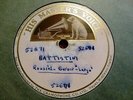
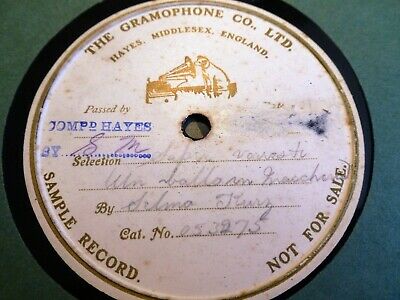
1911 TEST PRESSING SELMA KURZ VIENNA G&T Ballo in Maschera PAGENARIE Saper Vorre
$
23


Favourite Auctions
To save auctions to your favourites, please login
If you don't have an account, please register
Description
Please wait for me to send you an invoice. DO NOT USE EBAY CHECKOUT if you want the lowest possible postage.
Welcome to my auctions of great records
This is my FINAL WEEK. Auctions will end on June 9 – I WILL PACK AND BILL YOUR RECORDS after the close on JUNE 9, due to the very high number of records, pls allow 48 HOUR for me to send you an invoice.
PLEASE DO NOT PAY before I send you an invoice, otherwise the Ebay system will charge you a higher shipping charge.
International shipping: approx postage 1x10"=$25: 1x12"=$25 to $35: 10"Album 4 Rec=50$: 12" Album 2 Rec=50$
HOWEVER in most cases I can get you SIGNIFICANT savings by using other services. Pls contact me for a quote.
About 30% less to Canada. Pls ignore international postage displayed in Ebay, rates are too high
Please wait for me to send you an invoice. DO NOT USE EBAY CHECKOUT if you want the lowest possible postage.
Selma Kurz was one of the most remarkable coloratura singers: Hired by Gustav Mahler, director of the Vienna Hofoper, he discovered and developed her ability for extremely long trills. Kurz became the Diva assoluta of the Vienna Hofoper, and bloody fights were fought in the Galleries between the Kurz clique and the Mitzi clique (Maria Jeritza)
Ballo in Maschera PAGENARIE Saper Vorreste
early Gramophone Record w raised rim matrix 570m 12" 78 rpm
Condition:EXCELLENT MINUS, unworn scuffs, plays E very quiet rare ticks
A SUPERB COPY
Selma Kurz (October 15, 1874, Biala, Austrian Silesia - May 10, 1933, Vienna) was an Austrian operatic soprano with a brilliant coloratura technique.
Background
Bielitz and Biala were twin cities in the manner of Buda and Pest, or Minneapolis and St Paul. Today they are a single city known as Bielsko-Biala, in the Polish province of Silesia, 35 miles to the south of Katowice. When Selma Kurz was born they were Austrian cities, located in the so-called Quadrilateral, that is to say, the small remnant of Silesia left to Austria after the bulk of that province was ceded to Prussia following the War of Austrian Succession, in the Eighteenth Century. The future prima donna was actually born in Biala, the poorer of the two towns, to a very humble Jewish family of eleven children. She grew up, however, in the slightly more prosperous neighbouring municipality of Bielitz.
While still a girl she was taken to a convent of nuns, with the hope that she might learn to be a seamstress; the nuns quickly discovered the beauty of her voice, however, and she also often sang in the local synagogue. These circumstances led local people to raise some money so that she could go to Vienna and audition for professor G?nsbacher, a prominent vocal teacher. G?nsbacher did not teach women, but wrote some important letters of recommendation. Little Selma was thus enabled to visit the imposing Schloss Totis, the Viennese residence, en vill?ggiature, of the famous patron of the arts, count Nicholas [Mikl?s] Esterhßzy de Galßntha, who agreed to pay for her lessons with another prominent vocal pedagogue, Johannes Ress.
Once her career was established, Selma Kurz consulted such world-renowned voice teachers as Jean de Reszke in Nice and Mathilde Marchesi in Paris, as well as the soprano Felicie Kaschowska, well-known in Vienna; but she always called herself, above all, a pupil of Ress.
[edit] Career
[edit] D?but
She was first heard in Vienna at a student concert of Ress pupils on March 22, 1895. She got good notices and offers poured from many opera houses, especially the ones in provincial Germany, which were always looking for new talent. She made her d?but in the title-role of Ambroise Thomas's opera Mignon, at the Stadttheater, Hamburg, on May 12, 1895. She appeared there and at Frankfurt-am-Main for the next four seasons, singing all manner of roles, including Eudoxie in Hal?vy's La Juive, Elisabeth in Wagner's Tannh?user and, believe it or not, Carmen.
[edit] Vienna
Gustav Mahler, music director of the Vienna Imperial and Royal Court Opera, heard Kurz in Frankfurt towards the end of 1898 and asked her to audition for him at the Habsburg capital. He immediately offered her a fate-sealing contract and she made her d?but at the theatre that would become her artistic and spiritual home, also as Mignon, on September 3, 1899.
Her success in Vienna would be swift and total, and would last to the end of her musical career, thirty years later. Mahler himself, hearing her perfect trill and wonderfully placed high-notes in the Trovatore Leonora's Act IV aria, suggested that she ought to study the Hochkoloratur repertory, in which she would become the Hofoper's prima donna assoluta.
The Court Opera director carefully introduced her to this repertoire by letting her sing Rosina (in The Barber of Seville), the pages Urbain in Les Huguenots and Oscar in Un ballo in maschera, Juliette and Martha; but she soon moved on to Elvira in Ernani, Lakm?, Konstanze, Gilda, Violetta (in La traviata) and, last but not least, Lucia di Lammermoor.
It was Kurz's legendary singing in Mahler's 1903 revival of Ballo, as well as in Goldmark's Queen of Sheba, that cemented her immense popularity with the Viennese public. (As Astaroth in The Queen of Sheba, perhaps her most famous role, she held audiences spellbound with her vocalization of the so-called Lockruf or 'Siren Call.') It also led to her being elevated to the position of Kaiserliche und K÷nigliche Kammers?ngerin ('Imperial and Royal Court Singer') at the age of 29. She was often thereafter in attendance of His Holy Apostolic Majesty, Franz Josef I, Emperor of Austria and King of Hungary, always a devoted admirer of her art.
In the year-long Mozart festival performances organized to celebrate the composer's 150th birthday, Kurz sang Fiordiligi in Cos? fan tutte in 1905 and Konstanze in Die Entf?hrung aus dem Serail a year later. Also in 1906, on the occasion of a much-acclaimed Caruso gala, she sang Gilda in Rigoletto, with Titta Ruffo in the title role. This was Ruffo's only appearance in Vienna.
Although she had great triumphs in coloratura roles, Kurz did not neglect her lyric repertory. Indeed, of the 992 performances she would give at the Vienna Hofoper (later Staatsoper), more than 100 would be devoted to Mim? in Puccini's La boh?me. She also created that composer's Madama Butterfly for Vienna (1907) as well as Saffi in Strauss's Der Zigeunerbaron (1910).
She sang Tatiana (Eugene Onegin) and Sophie (Der Rosenkavalier) in 1911 and, in one of the many high points of her Viennese career, created Zerbinetta in the world premi?re of the second version of Richard Strauss' Ariadne auf Naxos, on October 4, 1916. She sang Zerbinetta 36 times in Vienna.
In Vienna she sang every imaginable role, from Tchaikovsky's Violanta and Wagner's Elsa (in Lohengrin) and Sieglinde (in Die Walk?re) to Marguerite in Gounod's Faust, Massenet's Manon, Frau Fluth in Nicolai's Merry Wives of Windsor and Rosalinde in Johann Strauss' Die Fledermaus. Next to Mim? in Boh?me, her most frequently heard roles were Gilda, Violetta and the Trovatore Leonora.
Her last performance at the great theatre in the Ringstra?e, where so many of her triumphs had been acclaimed by two generations of opera lovers from all over Europe and the world, took place on February 12th, 1927. This appearance, as Rosina in Barbiere, closed one of the most glorious operatic careers in the twentieth century.
Her very last public appearance occurred in September 1932 at the baptism of Archduke Stefan (1932-1998), son of Archduke Anton and Princess Ileana of Romania. Although already mortally ill, the Imperial and Royal Kammers?ngerin sang Mozart's Ridente la calma and the Bach-Gounod Ave Maria as a gesture to the baby's grandmother, Queen Marie of Rumania, who had long been a close personal friend. Selma Kurz died nine months later.
[edit] Her Career Outside Vienna
Form the outset Selma Kurz was widely required all over Europe and she appeared successfully in both opera and concert at the Grand Op?ra in Paris, the Princely Op?ra in Monte Carlo, Rome, Salzburg, Warsaw, Prague, Budapest, Amsterdam, Ostend, Bucharest and Cairo.
In London she was first heard in May 1904 in Rigoletto, with Caruso and Maurice Renaud. She then sang her famous page, Oscar, in Masked Ball, with Giannina Russ, Caruso, Antonio Scotti and Marcel Journet.
The following year she again sang Ballo with Caruso and Mario Sammarco as well as her other favourite page role, Urbain in Les Huguenots, opposite Emmy Destinn, Caruso, Scotti, Journet and that wonderful American baritone, Clarence Whitehill. She also appeared in Gounod's Rom?o et Juliette opposite Charles Dalmor?s' Romeo. Incredibly she also repeated, in these two seasons of coloratura successes, her Elisabeth in Tannh?user, with Karl Burrian in the title role.
In 1907 she was heard again at Covent Garden, this time in Lucia, with Alessandro Bonci, no less, as Edgardo. She repeated Rigoletto (with Bonci and Sammarco) and Ballo (with Amedeo Bassi) and added, of all things, Catalani's Loreley, obviously a Bassi vehicle. She was then not heard at the Royal Opera until 1924, when she sang Boh?me and Traviata with casts that were only mere shadows of the glory we have been reading about. Her London appearances were very successful, notwithstanding the enmity of the all-powerful Nellie Melba, as entrenched at Covent Garden as Kurz was in Vienna.
Selma Kurz was many times invited to appear in the United States and received several tempting offers from the Metropolitan Opera in New York. None of these managed to induce her so far from Vienna and her family. It was only in 1921 that she finally sailed for the New World, appearing one single time in concert at the New York Hippodrome. This was supposed to be the first concert of a long tour, but she immediately took ill (she had possibly had a heart attack) and the tour was cancelled. She immediately returned to Vienna where she had a long convalescence before she could return to performing with a voice that, all agreed, was never quite the same.
[edit] Last Years
In 1910, Selma Kurz married a prominent gynecologist of world-wide reputation, Professor Dr Joseph Halban, who later was knighted by the Emperor, becoming Ritter Joseph von Halban. With him she had two children, Desir?e and Georg. "Desi" Halban became a noted concert soprano who, among other things, recorded Mahler's Fourth Symphony with Bruno Walter, an occasion that must have seemed almost like a family reunion! Notwithstanding her always delicate heath, Selma von Halban-Kurz had a notably happy family life in her palatial Vienna home until, in 1929, she became ill with cancer. After a harrowing battle with this disease, which her loving daughter called truly a martyrdom, she died on May 10, 1933, in Vienna, the city that had always loved and cherished her.
It was the municipal authorities that insisted that the great Imperial and Royal Kammers?ngerin be buried in a lovely spot at the Zentralfriedhof, the Central Cemetery where Vienna's great sons and daughters are interred. There she lies, not far from Mozart, Beethoven, Schubert and Brahms.
[edit] Appreciation
[edit] Recordings
She left over 150 78rpm sides. The first were made for Berliner in 1900. These were followed by Zonophone and Gramophone & Typewriter disks, 1901-1906. She made a long and glorious series for HMV (now EMI) in 1907-1914. These are by far the best. Around 1910 she recorded three cylinders for Edison. After the war she recorded for Deutsche Grammophon/Polydor, 1923-24, an interesting series that nonetheless shows a decline in the voice. In 1924-25 she again recorded for HMV, which even made a number of electrical recordings of her singing, including a remarkable version of the "Siren Call" from The Queen of Sheba, complete with superb trill.
A series of great Records about Dixie, the Civil War, early One Step, Cakewalk and Blackface performers
issued first in 1901 Record No 485 on rare COLUMBIA CONDITIONS RECORD
NO 485
Here take 4 without performers named
ANNOUNCED Edward Favor What do you of Think O'HOOLIHAN
Edward Favor singing w piano, a second person shouting comments
10" 78 rpm record
Condition:
VERY GOOD PLUS, plays w hissy swish, light fuzziness on top
More Great Records on sale right now:
http://shop.ebay.com/carsten_sf/m.html
http://shop.ebay.com/carsten_sf/m.html
====
A Quick NOTE ON GRADING AND SHIPPING:
As you can see from my feedback, I try hard to earn your POSITIVE FEEDBACK and FIVE STAR RATINGS.
If for any reason your transaction was NOT SATISFACTORY, pls contact me and I will work something out with you. YOU WILL NEVER HAVE A REASON TO GIVE ME A NEGATIVE RATING or a LOW STAR RATING.
Quick note on grading:
The Grade (Excellent to Poor, I don't give Mint) refers to the WEAR of the record. Any other defects are stated separately
When I listen to a record, I may also give it an aural grade (again E to P), and make a SUBJECTIVE judgment of the pressing quality for hiss and surface noise.
"SUPERQUIET" is basically noiseless, like a vinyl pressing.
"VERY QUIET" is an exceptionally quiet record for a given pressing.
"Quiet" is a record that is a great example without undue noise for a give pressing.
These judgments are SUBJECTIVE and will depend one the styli, phonograph etc. you use on your own equipment.
Multiple item shipping: I am happy to combine items for shipment in one parcel.
If you win multiple items, pls send me an INVOICE REQUEST to calculate the correct postage. Ebay check out will not give you the correct multiple item discount!
Records will be packed safely between corrugated cardboard in a sturdy box with plenty of padding for safe shipment.
Shipment is usually Media Mail, unless you request another service. Shipping is at your risk, I will be happy to insure items at your cost.
I charge actual postage plus a small fee for packing materials
As always, I guarantee your satisfaction. If you don't like the item, just return it, and I will refund the full purchase price.
If you are in the San Francisco area, I encourage pick-up in person.
US Domestic Shipping:
Here is a guideline for US Media Mail Shipping:
Prices below are for regular 78 rpm records. Up to about 5 records, I will ship Edison Discs for the same rates. Albums from Album Sets count as 1 record. Above that and for international shipments, it will be actual weight plus a small packing charge (1-3$ depending on size of shipment)
1 record: 4.75 – 5.50$
2 records: 6.50$
5 records: 8.00$
10 records: 12.00$
MANY MORE RECORDS: Don't worry. I safely ship 40 - 50 pounds of records double boxed in moving boxes, and even then Media Mail will probably not exceed 35$.
Please send me a message if you would like to lower your shipping rates!
I am very happy to ship records worldwide.
Please use the EBAY shipping cost only as a guideline. My actual charges are usually lower
One record usually ships for 25$ for 10" 25-35$ for most 12" records (Less for Canada).
For certain destinations I can get SIGNIFICANTLY LOWER rates from FedEx and the US Postal service for any kind of parcel weight, and will make use of all the cost-saving shipment methods
Pls contact me for a shipping estimate, or send me an invoice request after close of auction.
AND AGAIN -THANK YOU FOR YOUR INTEREST
As you can see from my feedback, I take great care in presenting, grading and shipping your items. I really want you to be happy with the purchase. If you feel that anything is wrong with the item or the shipping, contact me and we will work it out !!!
As always, I would appreciate any suggestions and corrections from you, pls contact me with any question.
Thank you very much, and good luck bidding !!!
price rating