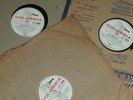
1922 NATHAN GLANTZ Or CHICKIE Fox Trot Tell me if you want somebody EDISON 51335
$
25


Favourite Auctions
To save auctions to your favourites, please login
If you don't have an account, please register
Description
A series of great Edison Diamond Discs, Pathe, Rex, Lyric, Operaphone and other Vertical format records
Click this link for more great Edison, Pathe and Vertical Records in my other listings!
More great Jazz and Vocal Records in my other listings!
Two great Jazz Age dances by Nathan Glantz Orchestra with a laughing/ sobbing clarinet
Desirable paper label pressing
Rec Numb 51335-R 51335-L Take C C Title Chickie - Foxtrot (Mills) Tell me if you want somebody else - Foxtrot Artist Nathan Glantz (O-dance) Nathan Glantz (O-dance) Recorded 1924.04.15 1924.04.15 Place NYC NYC Comment acoustic acousticDesirable Paper Label Edison Diamond Disc VERTICAL 78 rpm record
Condition: Better than EXCELLENT PRISTINE ,
plays E+ Exceptionally quiet
GREAT VOLUME
A CHOICE COPY
Nathan Glantz Biography by Eugene Chadbourne
The esteemed leader of the Nathan Glantz Orchestra came from an era of American musical history when bandleaders merrily churned out as many records as possible -- sometimes under their real names, sometimes under someone else's real name, and sometimes under the name of someone who didn't even exist. In the Roaring Twenties,Glantz had one of the most prominent orchestras in New York City, a result of which was a masquerade along the shelves of what were basically the first private jazz and dance band record collections. The Hollywood Dance Orchestra was quite often the Glantz aggregation, while the Roy Collins Dance Orchestra, behind a series of hits, was a name utilized not only by Glantz but by the Joseph Samuels Orchestra. This was apparently something of a tradition with these bandleaders, as the year before both Glantz and Samuels pretended to be the Continental Dance Orchestra, having not yet discovered the commercial importance of fabricating a bandleader named Roy Collins.
These sort of practices may seem downright bizarre by the standards of the so-called modern music industry, whose fans might not accept the concept of, say, Kid Rock not really existing, his music performed by John Maher on some records and Snoop Doggy Dogg on others. The actual process behind the '20s recording situation is basically sort of mundane, beginning naturally with the business practices of recording companies. A firm would hire a "leader" to arrange a session. The only obligatory talent of a leader would be the state of mind to contact a group of musicians for this date, and pay them. Sessions such as these would be happening back to back. A trumpet player might be staying on for the session scheduled after a Glantz date he was hired for, only for the next session the trumpet guy was the one hired as leader. It just so happened he wanted a good C-melody saxophone for his date, so he hires Glantz -- as a sideman. The resulting confusion means it is quite often next to impossible to track the activities of bands and musicians from the '10s and '20s, a situation that listeners who loathe the overblown stars of later eras can daydream about bitterly.
Some of the most famous sides actually released under the name of the Nathan Glantz Orchestra include the dark, probing "Ask Her When Shadows Fall" on the Ajax label, the endearing "Dearie" on Champ, and "Sitting in a Corner," a vintage Edison "Diamond Disk." Tallying up all the different names, Glantz played his stack of saxophones on more than 100 different recording sessions between 1916 and 1927.
price rating





![LONE STAR (UFO URIAH HEEP) firing on all six JAPAN orig LP w/OBI rare [FREE P+P]](https://www.popsike.mobi/php/thumbnail.php?url=https://www.popsike.pics/pix/20111026/370554417058.jpg)









![Phil Collins - Hello, I Must Be Going [LP] (180 Gram) 2016- Sealed](https://www.popsike.mobi/php/thumbnail.php?url=https://www.popsike.pics/pix/20160428/381615193231.jpg)