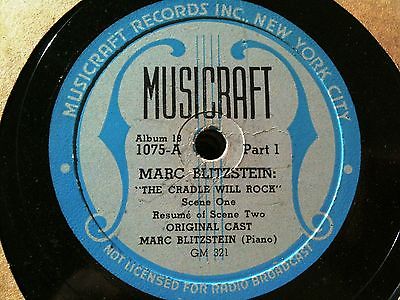
1938 ORSON WELLES MARC BLITZSTEIN orig Cast CRADLE WILL ROCK Musicraft 78
$
76


Favourite Auctions
To save auctions to your favourites, please login
If you don't have an account, please register
Description
Welcome to my auctions of great records
This is my FINAL WEEK of 3 weeks of great auctions – I WILL PACK AND BILL YOUR RECORDS after the close on September 27.
PLEASE DO NOT PAY before I send you an invoice. It will take me up to 48 hours to pack your records, but this is the ONLY WAY to get you the LOWEST POSTAGE. If you pay before I sent you an invoice, the EBAY system will charge you a HIGHER POSTAGE for shipping.
International shipping: approx postage 1x10"=$25: 1x12"=$28: 10"Album 4 Rec=45$: 12" Album 2 Rec=45$
About 30% less to Canada. Pls ignore international postage displayed in Ebay, rates are too high
Please wait for me to send you an invoice. DO NOT USE EBAY CHECKOUT if you want the lowest possible postage.
A series of great Violin, Piano and Orchestra records on rare labels, from 1902 Monarch to 1940 War Germany recordings.
Complete recording of this famous Musical directed by ORSON WELLES
The Cradle Will Rock is a 1937 musical by Marc Blitzstein. Originally a part of the Federal Theatre Project, it was directed by Orson Welles, and produced by John Houseman. The musical is a Brechtian allegory of corruption and corporate greed and includes a panoply of societal figures. Set in "Steeltown, USA", it follows the efforts of Larry Foreman to unionize the town's workers and combat wicked, greedy businessman Mr. Mister, who controls the town's factory, press, church and social organization. The piece is almost entirely sung-through, giving it many operatic qualities, although Blitzstein included popular song styles of the time.
The WPA temporarily shut down the project a few days before it was to open on Broadway, so to avoid government and union restrictions, the show was performed with Blitzstein playing piano onstage and the cast members singing their parts from the audience.[1]
The original cast consisted of John Adair, Guido Alexander, Marc Blitzstein, Peggy Coudray, Howard Da Silva, George Fairchild, Robert Fransworth, Edward Fuller, Will Geer, Maynard Holmes, Frank Marvel, Charles Niemeyer, Le Roi Operti, Jules Schmidt, George Smithfield, Olive Stanton, and Bert Weston.[2]
A slightly abridged version of Welles's 1937 Mercury Theatre production with narration by Blitzstein was recorded in April 1938 and released on the Musicraft label (number 18). It was the first original cast recording ever made.
Orig prod. MUSIC & WORDS: Marc Blitzstein.
NARRATION & PIANO: Marc Blitzstein.
CAST: Olive Stanton, Howard Da Silva, Blanche Collins, Edward Fuller, Jules Schmidt, Ralph MacBane, Peggy Coudray, Maynard Holmes, Dulce Fox, Marian Rudley, George Fairchild.
78/Musicraft 12" album 18;
7x12" records NO ALBUM
Condition: Excellent, 2 mm blister on 1, scuffs on 2, tiny blisters on 5, lightest 4 mm scratch on 10, light rubs tiny blisters on 14, slight warp not affecting play
The Cradle Will Rock”(Original cast recording)(1938)
Added to the National Registry: 2002 Essay by Howard Pollack (guest post)* Marc Blitzstein Original label Original album packaging
The opera “The Cradle Will Rock”(1936-37), composer-librettist Marc Blitzstein’s first big success, proved a turning point in his career, and its premiere, a legendary event in the annals of the American theater.Born into a Philadelphia family of Jewish-Russian heritage, Blitzstein (1905-1964), early in life, earned some notice as a piano prodigy, but he increasingly turned his attention to musical composition, which he studied with Rosario Scalero at the Curtis Institute, Nadia Boulanger in Paris, and Arnold Schoenberg in Berlin. Completing his education while still in his early twenties, and settling in New York, he spent the next ten years eking out a living as a lecturer and writer on contemporary music, of which he had vast knowledge, while periodically retreating to Europe to compose a variety of instrumental, vocal, and stage works. Although primarily homosexual, during these years he usually traveled with his lover and later wife, the writer Eva Goldbeck, to whom he dedicated most of his early scores, and who died tragically young of anorexia in 1936, just prior to the creation of “The Cradle Will Rock.”Blitzstein radical tendencies, partly conditioned by his socialist family, initially took artistic expression in his interest in avant-garde trends, very much including the music of Stravinsky. But in the course of the 1930s, as he became increasingly involved with the New York’s Composers’ Collective, he successfully absorbed more popular currents, including not only the music of German composers Kurt Weill and Hanns Eisler, but the theatrical ideas of one of their principal collaborators, playwright Bertolt Brecht. Writing the lyrics and music for some satirical revues, Blitzstein proved not only a distinctive songwriter, one able to set a catchy melody to unusually pungent harmonies, but a fine lyricist as well, with a special talent for clever rhymes and witty conceits, and for combining words and music so that the whole sounded utterly natural and spontaneous. In late 1935, playing for Brecht a three-person musical sceneon the theme of prostitution that he had written for the Composers’ Collective, the German playwright told him, “Why don’t you expand this? In our society, prostitution can involve many more things than just our lily white bodies. There is prostitution for gain in so many walks of life: the artist, the preacher, the doctor, the lawyer, the newspaper editor. Why don’t you pit them against this scene of literal selling?” In this suggestion, Blitzstein found the inspiration for “The Cradle Will Rock,” set in Steeltown, U.S.A., in which, on the night of a big steel union drive, a prostitute, The Moll, finds herself in night court with a kindly vagrant, Harry Druggist, and the union organizer, Larry Foreman, but also, by mistake, with the town’s anti-union Liberty Committee, including Reverend Salvation, Editor Daily, Dr. Specialist, two artists (Yasha, a violinist, and Dauber, a painter), and President Prexy and Professors Mamie and Trixie of Steeltown University. As the Liberty Committee awaits the town’s steel magnate Mr. Mister to bail them out, flashbacks explore the corruption and venality of the committee members, in particular, their willingness to do the bidding of the Mister family for personal gain: Reverend Salvation preaches the gospel of Mrs. Mister; Editor Daily hires Mr. Mister’s son Junior as a foreign journalist; Yasha and Dauber kowtow to Mrs. Mister; President Prexy expands the school’s compulsory military training; and Dr. Specialist covers up the violent assault of a pro-union worker. Harry Druggist confesses, much to his regret, that he, too, succumbed to Mr. Mister’s machinations. At the climax, Mr. Mister arrives and attempts to bribe Larry Foreman as well, but the union organizer rebukes his offer, after which word arrives that the steel union drive has been successful. Something of the opera’s stagecraft and structure owed a debt to playwright Clifford Odets’s similarly pro-union “Waiting for Lefty” (1935), and naturally to Brecht, to whom Blitzstein dedicated the work, while the music, written for singing actors as opposed to classically trained singers, showed the influences of not only Stravinsky, Weill, and Eisler, but also a wide range of vernacular American musics, including the blues. One of its most striking features involved its intricate and carefully calibrated employment of such traditional resources as recitative, song, chorus, accompanied and unaccompanied dialogue, and instrumental music, along with such novel ones as speech-song, accented recitation, and both accompanied and unaccompanied rhythmic recitation. All this resulted in a stunning organic fluidity that constituted an exciting new development in the history of world musical theater. In early 1937, the youthful team of producer John Houseman and director Orson Welles decided to mount the work with the unit of the Federal Theatre Project (FTP) that they administered, namely, Project 891. A division of the Works Progress Administration (WPA), the Federal Theatre Project, headed by Hallie Flanagan, launched during its brief tenure (1935-39) hundreds of productions of old and new plays around the country at affordable prices, thus enriching America’s theatrical life enormously, while providing modest salaries to, in any given year, about ten thousand people associated with the theater. Given the rising tide of opposition against the Federal Theatre in Congress on account of the group’s alleged leftist bias, Flanagan had her concerns about funding a work like “Cradle” that touched on one of the most divisive and controversial issues of the day in so partisan a fashion; but she gave her assent nonetheless. “It took no wizardry to see that this was not a play set to music, nor music illustrated by actors,” she recalled, “but music + play equaling something new and better than either.” Restricted by whom they could hire, Houseman and Welles nonetheless snagged two rising stars for the production: Will Geer (later Grandpa Walton on the television series “The Waltons”) for the part of Mr. Mister, and Howard Da Silva (born Howard Silverblatt, and later to originate the role of Jud Fry in “Oklahoma!”) as Larry Foreman. They also engaged an orchestraof over 30players and a small interracial chorus. Welles helped design elaborate sets for a production described by Houseman as falling “somewhere between realism, vaudeville and oratory.” However, days before the show’s scheduled June 16, 1937, premiere at the Maxine Elliott’s Theatre, the WPA announced cuts in their arts program, including the postponement of any new play. “This was obviously censorship under a different guise,” recalled Blitzstein. Surely not coincidentally, escalating turmoil in the steel industry recently had reached a new peak with the Memorial Day Massacre, in which the Chicago police fired into a crowd demonstrating against Republic Steel, leaving ten dead and scores wounded. On opening night, faced with a padlocked theater manned by security guards, Houseman and Welles, fearing that the play now never would be produced, at the last minute found an available theater, the Venice, and led the hundreds of ticket-holders who had gathered outside the Maxine Elliott’s uptown for an impromptu renegade performance--without sets, costumes, or orchestra. Because union rules, ironically, made it impossible for actors without Actors’ Equity membership to appear on a commercial stage, Welles proposed that the actors perform their parts from the audience, with Blitzstein on stage narrating and playing the piano. Although they stood the chance of losing their much-needed jobs, most of the cast and crew agreed to this scheme. Amid the hubbub of opening night, it remained uncertain whether the show actually would proceed as planned, but as Blitzstein, alone on stage at a piano, began to sing the opening number, in one of the most riveting moments in the history of the American theater, the young, slender actress playing The Moll, Olive Stanton, seated in a loge box, started to sing along, taking over the number as the lighting director, Abe Feder, illuminated her with a makeshift follow spot. “If Olive Stanton had not risen on cue in the box,” recalled another cast member, “I doubt if the rest of us would have had the courage to stand up and carry on.” At the end of the performance, the house erupted in what Orson Welles later described as “that mighty, loving explosion which can be heard but once or twice in a theatre lifetime.” This renegade production gave another two weeks of performances, fortunately without any negative repercussions for the cast, although Welles subsequently resigned from the WPA, and Houseman, who did not have American citizenship, found himself forced out under new WPA guidelines that forbade the hiring of aliens. Houseman and Welles went on to form their own company, the Mercury Theatre, which gave more performances of “The Cradle Will Rock,” with Blitzstein at the piano, as at the Venice, but with cast members now seated in chairs onstage. Houseman and Welles presented this “oratorio version” during the 1937-38 season, not only at the Mercury Theatre, but then, in a co-production with Sam Grisman, at the Windsor Theatre. During this period, the opera featured some slight changes of personnel, including replacing Will Geer with Ralph MacBane as Mr. Mister. In April 1938, Musicraft, a small, new record company, released an abridged recording of the work with the Windsor cast, and with Blitzstein at the piano and providing his own narration to help fill in some of the holes. In subsequent years, the work retained some presence in the repertory, especially among small community and school theaters, who typically presented the piece with spare sets and piano accompaniment, as in its early days. Only rarely was the piece heard with orchestra. In 1947, for instance, Leonard Bernstein, who had played the piano in the work’s Boston-area premiere in 1939, conducted the opera with a cast accompanied by the New York City Symphony. And in 1960, the New York City Opera gave a full-fledged production, with sets, costumes, and orchestra, as originally intended. But these performances proved exceptional. Later recordings of this classic work similarly featured piano as opposed to orchestral accompaniment. Meanwhile, the Musicraft release, represented here in the National Recording Registry, remains not only historically important (as the recording world’s first recognized “original cast recording”)but compelling in its own right, with the performers, most of whom had been with the show from the beginning, delivering an enormously vital account of the piece, alternately deeply poignant and piercingly sardonic.
More Great Records on sale right now:
http://shop.ebay.com/carsten_sf/m.html
http://shop.ebay.com/carsten_sf/m.html
====
A Quick NOTE ON GRADING AND SHIPPING:
As you can see from my feedback, I try hard to earn your POSITIVE FEEDBACK and FIVE STAR RATINGS.
If for any reason your transaction was NOT SATISFACTORY, pls contact me and I will work something out with you. YOU WILL NEVER HAVE A REASON TO GIVE ME A NEGATIVE RATING or a LOW STAR RATING.
Quick note on grading:
The Grade (Excellent to Fair, I don't give Mint) refers to the WEAR of the record. Any other defects are stated separately
When I listen to a record, I may also give it an aural grade (again E to F), and make a SUBJECTIVE judgment of the pressing quality for hiss and surface noise.
"SUPERQUIET" is basically noiseless, like a vinyl pressing.
"VERY QUIET" is an exceptionally quiet record for a given pressing.
"Quiet" is a record that is a great example without undue noise for a give pressing.
These judgments are SUBJECTIVE and will depend one the styli, phonograph etc. you use on your own equipment.
Pls check my other auctions for more great records and phonograph items:
Multiple item shipping: I am happy to combine items for shipment in one parcel.
If you win multiple items, pls send me an INVOICE REQUEST to calculate the correct postage. Ebay check out will not give you the multiple item discount!
Records will be packed safely between corrugated cardboard in a sturdy box with plenty of padding for safe shipment.
Shipment is usually Media Mail, unless another service is requested. Shipping is at your risk, I will be happy to insure items at your cost.
I charge actual postage plus a small fee for packing materials
As always, I guarantee your satisfaction. If you don't like the item, just return it, and I will refund the full purchase price.
If you are in the San Francisco area, I encourage pick-up in person.
US Domestic Shipping:
Here is a guideline for US Media Mail Shipping:
Prices below are for regular 78 rpm records. Up to about 5 records, I will ship Edison Discs for the same rates. Albums from Album Sets count as 1 record. Above that and for international shipments, it will be actual weight plus a small packing charge (1-3$ depending on size of shipment)
1 record: 4.50 – 5.00$
2 records: 5.75$
5 records: 7.50$
10 records: 9.50$
MANY MORE RECORDS: Don't worry. I safely ship 40 - 50 pounds of records double boxed in moving boxes, and even then Media Mail will probably not exceed 30$.
Please send me a message if you would like to lower your shipping rates!
International Buyers:
All'attenzione degli acquirenti italiani:
ATTENTION TO ITALIAN BUYERS:
Due to rare problems with delivery in ITALY, I will NOT GUARANTEE delivery of parcels sent by US Postal Service First Class and Priority Mail. If you prefer secure delivery, I will be happy to quote you either Registered Mail or shipment by FEDEX
I am very happy to ship records worldwide.
Please use the EBAY shipping cost only as a guideline. My actual charges are usually lower
One record usually ships for 25 – 28$ (Less for Canada).
I can get competitive rates from FedEx and the US Postal service for any kind of parcel weight, and will make use of all the cost-saving shipment methods
Pls contact me for a shipping estimate, or send me an invoice request after close of auction.
AND AGAIN -THANK YOU FOR YOUR INTEREST
As you can see from my feedback, I take great care in presenting, grading and shipping your items. I really want you to be happy with the purchase. If you feel that anything is wrong with the item or the shipping, contact me and we will work it out !!!
As always, I would appreciate any suggestions and corrections from you, pls contact me with any question.
Thank you very much, and good luck bidding !!!




![LOS SONAMBULOS [ROCK DEL ANGELITO] NM WL PROMO 1960 MEXICO R&R 45 Ray Smith](https://www.popsike.mobi/php/thumbnail.php?url=https://www.popsike.pics/pix/20221208/225288063311.jpg)