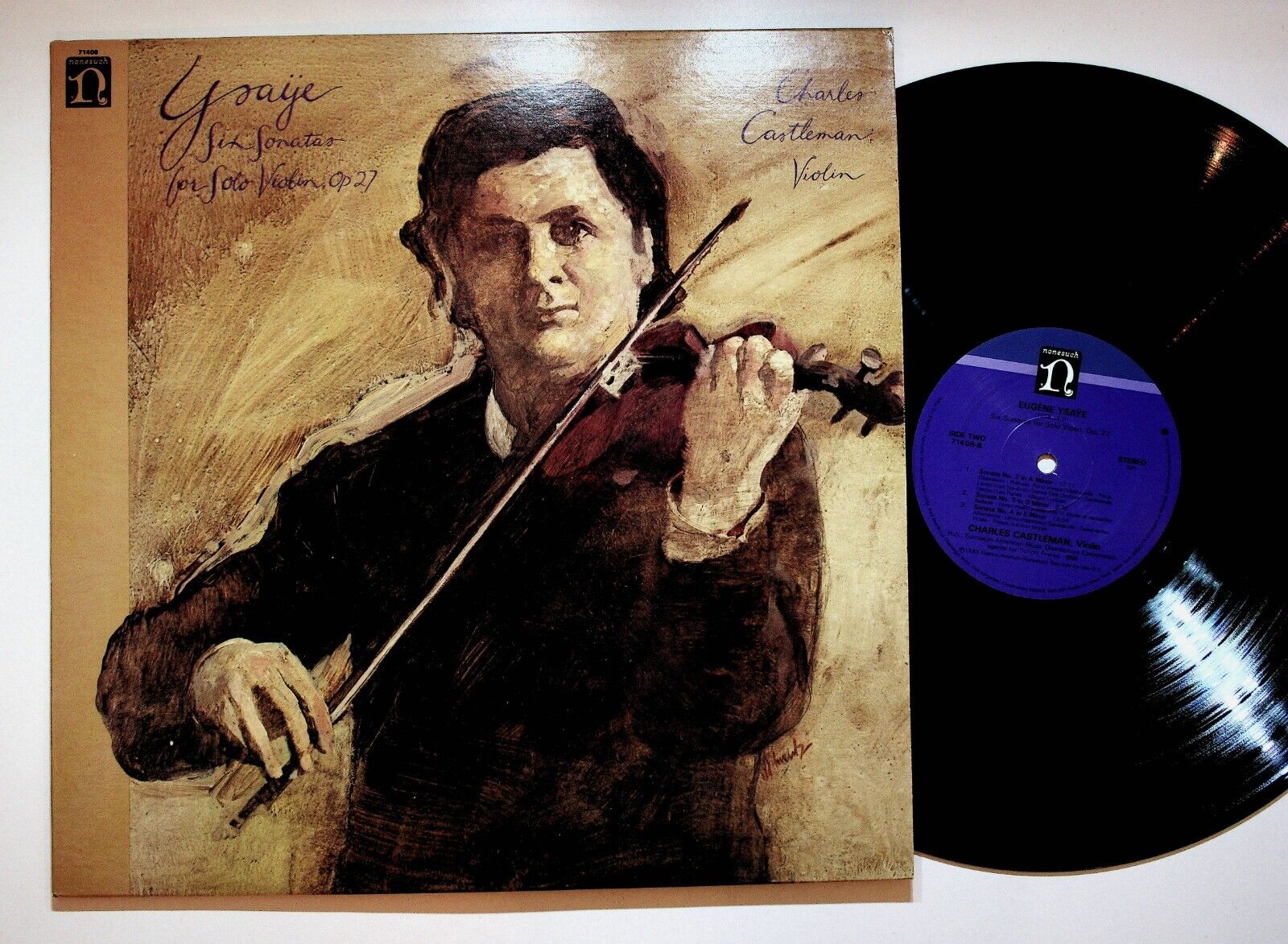
1983 Eugene Ysaye Six Sonatas Solo Violin Charles Castleman Vinyl LP Record VG+
$
23


Favourite Auctions
To save auctions to your favourites, please login
If you don't have an account, please register
Description
Yes we combine shipping for multiple purchases. Add multiple items to your cart and the combined shipping total will automatically be calculated.
1983 Eugene Ysaye Six Sonatas For Solo Violin Op. 27 Charles Castleman Vinyl LP Record VG+
Record Grade per Goldmine Standard: VG+
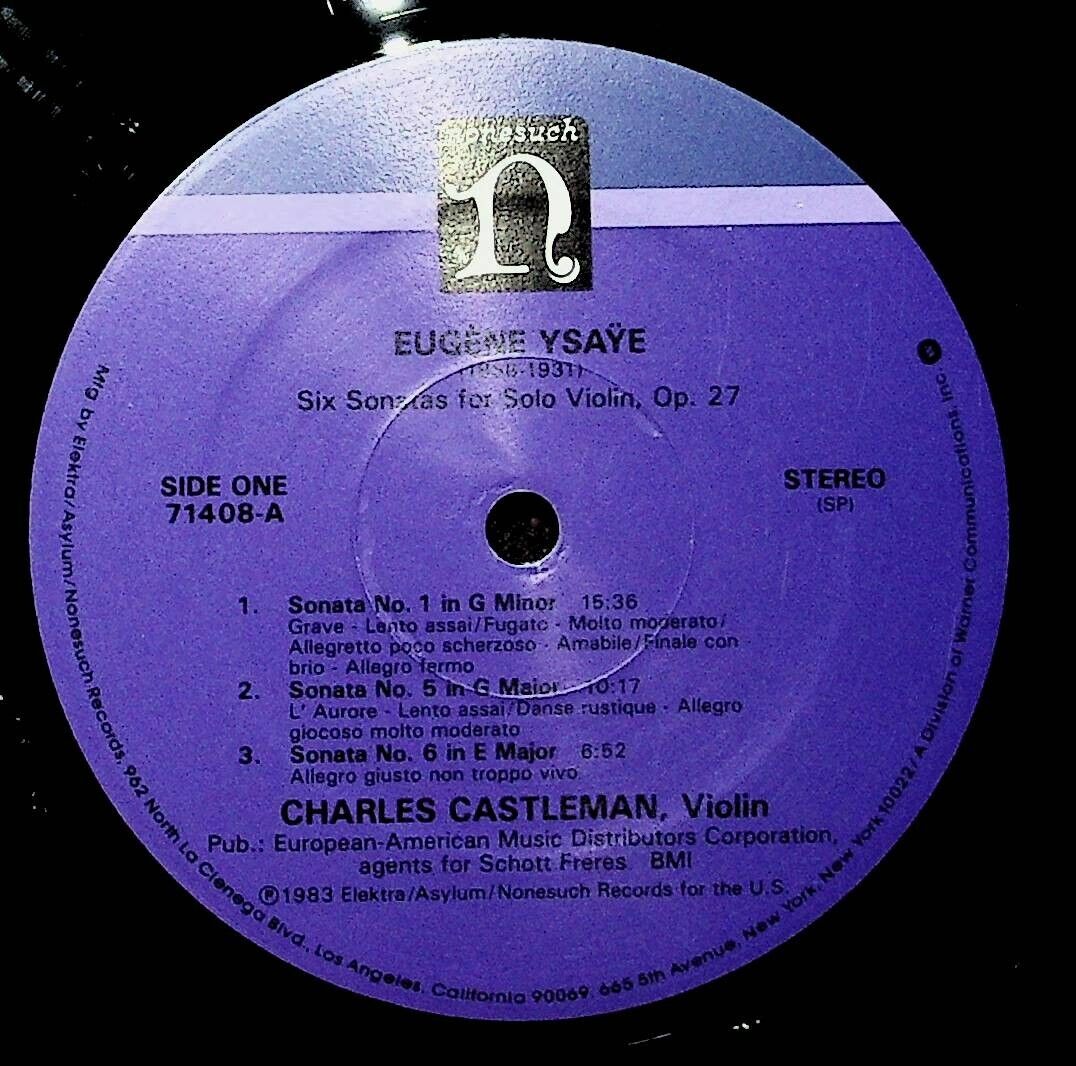
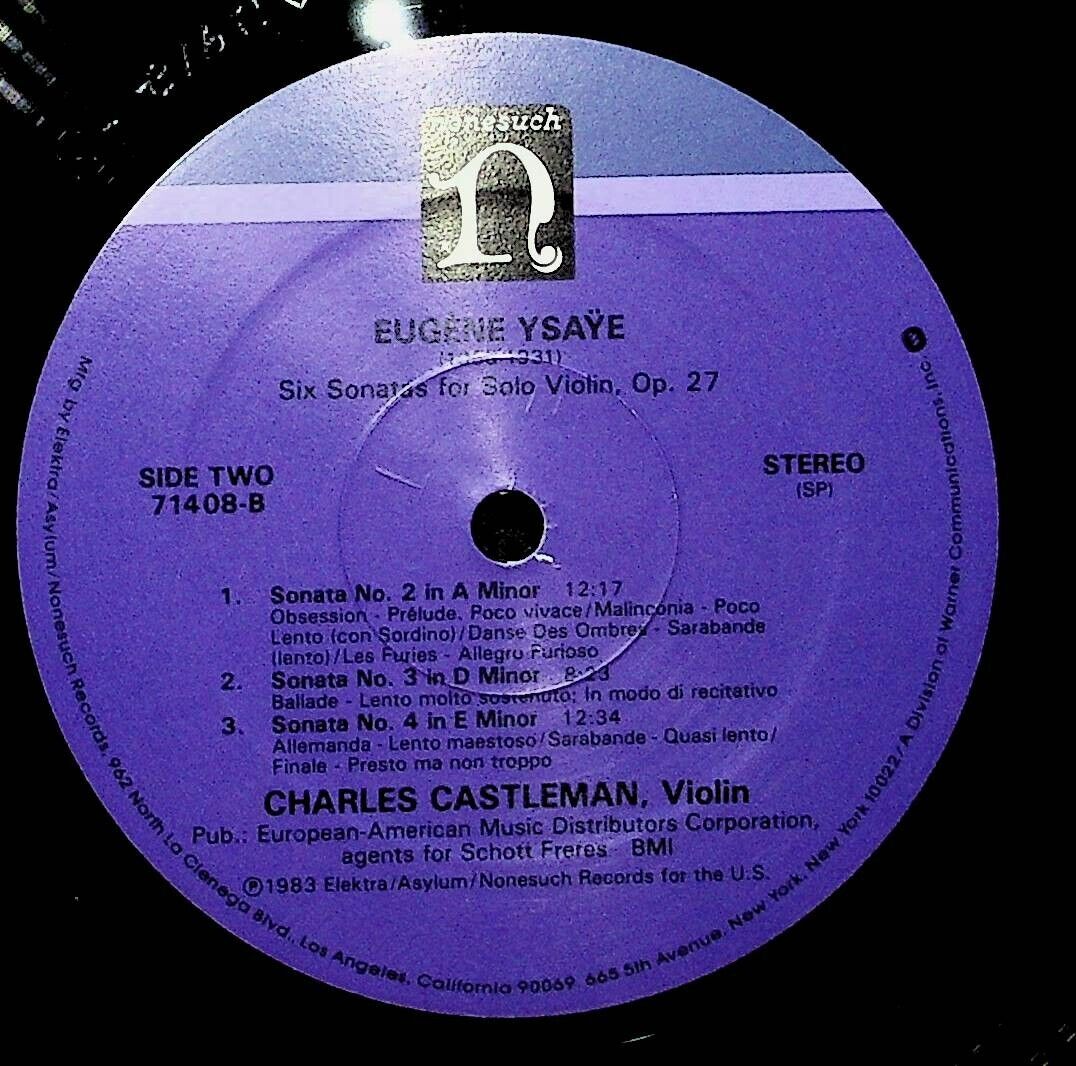
EUGENE YSAYE (1858-1931) Six Sonatas for Solo Violin, Op. 27 SIDE ONE 1. Sonata No. 1 in G Minor (for Joseph Szigeti) 15:36 I. Grave. Lento assai II. Fugato. Molto moderate III. Allegretto poco scherzoso. Amabile IV. Finale con brio. Allegro fermo 2. Sonata No. 5 in G Major (for Mathieu Crickboom) 10:17 I. L’ A uro re. Lento assai II. Danse rustique. Allegro giocoso molto moderate 3. Sonata No. 6 in E Major (for Manuel Quiroga) 6:52 I. Allegro giusto non troppo vivo SIDE TWO 1. Sonata No. 2 in A Minor (for Jacques Thibaud) 12:17 I. Obsession. Prelude. Poco vivace II. Malinconia. Poco Lento, (con Sordino) III. Danse Des Ombres. Sarabande (lento) IV. Les Furies Allegro Furioso 2. Sonata No. 3 in D Minor (for Georges Enesco) 8:23 I. Ballade. Lento molto sostenuto. In modo di recitativo. 3. Sonata No. 4 in E Minor (for Fritz Kreisler) 12:34 I. Allemanda. Lento maestoso II. Sarabande Quasi lento III. Finale. Presto ma non troppo CHARLES CASTLEMAN, Violin Johann Sebastian Bach's jix Sonatas and Partitas for Solo Violin, S. 1001-1096 (Nonesuch 73030) served as a model tor Eugene Ysaye's virtuosic Six Senatespour Violon Seal, Op. 27 of 1924. At this stage of his life, Ysaye’s career as a concert violinist was rapidly drawing to a close. As early as 1918, Ysaye had written the following pathetic lines: My hands are giving me trouble, the trembling has increased and after writing for afew minutes, my pen begins to zig-zag in an alarming fashion. On the 24th of February, 1924, the violin bow fell from Ysaye’s hand while he was stand- ing on the stage of a theatre in Dublin during a concert tour. Many violinists blame Ysaye’s unusual grip of the bow — using the thumb and only the first three fingers —for the technical difficulties that assailed his playing late in life. It is more probable, however, that these pro- blems resulted from Parkinsonism (a calcifica- tion of the basal ganglia in the mid brain that causes localized tremors of a single extremity.) That this condition seems to have arisen from arteriosclerosis is suggested by the fact that Ysaye was compelled to have his right foot am- putated in 1929. His diabetic condition also suggests arteriosclerosis, diabetics normally having higher cholesterol levels. Although Ysaye played many fine perfor- mances despite his physical ailments, he did not write the Violin Sonatas for his own use, but rather, for six violinists who were rising young stars in the concert arena. While it is relatively easy to discern the end of Ysaye's career, it is more difficult to assign a specific date to its beginning. He was born in Liege, Belgium, in July of 1858. Musical talent ran in the family. His father, also a pro- fessional violinist, gave Eugene his first in- struction on that instrument when the boy was only four years old. Ysaye’s brother, Theo- phile, was a pianist and composer of consid- erable talent who studied with Ct*sar Franck and went on to become professor of piano at the Geneva Conservatory. Formal training commenced in 1865 when the seven-year-old Ysaye entered the Liege Conservatory and began studies with Desire* Heynberg. Although Ysaye won second prize in his class for violin, his relationship with Heynberg was not good and in 1869 he with- drew from the Conservatory. Returning in 1872, he entered the class of Rudolph Massart. The student and the teacher shared a profound esteem for one another, and work progressed so rapidly that in 1873, Ysaye won the first prize for violin. The ease with which he exe- cuted even the most difficult passages led one professor to remark at the time that “as a bird sings, so he plays the violin." After the conclu- sion of his studies in Liege, Ysaye went on to advanced work with Henri Wieniawski (1835- 1880) and Henri Vieuxtcmps (1820-1881). In addition to his singular ability as a string player, Ysaye was also a gifted conductor. He led the Bilse Orchestra in Berlin beginning in 1879. The New York Philharmonic extended an invitation to Ysaye to become their conduc- tor in 1898, four years after his first tour of the USA. Ysaye rejected this offer, but when the Cincinnati Symphony Orchestra made a simi- lar proposal in the summer of 1918, he accept- ed and held the post until 1922 The programs that he conducted during those four years give ample evidence of Ysaye’s foresightedness. Along with standard orchestral repertoire, he included new works by Malipiero, Schoen- berg, Bartdk, Stravinsky and numerous other composers who were struggling for recogni- tion at the time. Although Ysaye preferred a more conservative idiom in his own composi- tions, he is to be praised for the open-minded- ness that he characteristically exhibited in evaluating the work of others. In his capacity as violinist and conductor, Ysaye came into contact with most of the great musical talents ofhis era. Amonghis acquaint- anceswere the composers Cesar Franck, Ernest Chausson, Vincent D’Indy, Camille Saint- Saiins, Claude Debussy, Anton Rubinstein, Arthur Honegger and Igor Stravinsky. Stra- vinsky, as a matter of fact, paid a visit to the older composer as he lay dying in Brussels. The violinists with whom he was acquainted arc too numerous to list here, but the six to whom each of the Violin Sonatas is dedicated deserve mention; they are: Joseph Szigeti, JacquesThibaud, Georges Encsco, Fritz Kreis- ler, Mathieu Crickboom and Manuel Quiroga. It was a performance by Joseph Szigeti (1892-1973) of one of Bach’s Sonatas that in- spired Ysaye to write a set of similar pieces. Concerning the playing of this youthful artist Ysaye observed: I found in Szigeti that rare combination of the musician and the virtuoso. As an artist he seemed conscious of a high mission into which he put all his faith, and he placed technique entirely at the service of musical expression. When one hears an artist like Szigeti who is able to accommodate his playing to the rectangular lines of the great classics as easily as he can to the expressive melodies of the Romantics, onefeels how absorbing it would be to compose a work for the violin whilst keeping ever before one the style of one particular violinist. Just as Sir Edward Elgar had “sketched portraits of friends” in each of the Enigma Variations of 1899, so Ysaye composed the Sonatas while thinking of these six violinists The pieces were written with one eye on the techniques ofhis friends, and the other on the shadow ofJ.S. Bach The rich harmonies and contrapuntal style of Bach are easily recognizable in the First So- nata. The Grave opening movement uses dou- ble- and triple- stops (the simultaneous execu- tion of two or three tones) extensively. The Fu- gato second movement uses Baroque counter- point as a model, but the voices are treated more freely and within the context of late-Ro- mantic harmonic style A lyrical Allegretto fol - lows, and a bravura Finale con brio closes the piece. This Sonata is one of many works that were inspired by Szigeti's playing; Bartdk, Bloch, Casella, Martin and Prokofiev also provided tailor-made works for him and his priceless Guarneri violin. In designing his Sonatas, Ysaye followed the Baroque tradition of having a variable number of movements in contrasting tempos rather than the Classical tradition of three movements in the order fast, slow, fast. Simi- larly, many of the movements in Ysaye’s Sona- tas are dances In this respect, the collection actually consists of sonatas and partitas —ex- actly like Bach's Jacques Thibaud (1880-1953), the dedica- tee of the Second Sonata, owned two magnifi- cent Baroque violins, one by Carlo Bergonzi (1712-1750), and the other by Antonio Strad- ivari. These were the instruments that he played in his trio with Alfred Cortot and Pablo Casals. In this Sonata, Ysaye fully acknowl- edges his debt to the Baroque string tradition; the opening motif of its Prelude is taken unal- tered from Bach’s Partita m E-Major The en- tire movement is a free alternation between quotations from that work and Ysaye’s new- ly composed material. Quite fittingly, the composer chose to name this movement "Obsession.” The second movement —mut- ed throughout — actually functions as an inter- lude. It concludes with a citation of the “Dies Irac” tune, the plainchant sequence of the Re- quiem Mass. This is followed by a “Dance of the Spirits” that utilizes the “Dies Irae” motif as the basis of six variations in the dignified rhythm of the Sarabande, a dance that became popular in the 17th century. A contrasting dance, the “Dance of the Furies,” closes this partita. Ysaye’s fine ear for coloristic effects is apparent in this movement; particularly note- worthy is his use of bowing sulponticello (i.e., on the bridge) in quiet passages. The veiled, nasal sonority that results produces a ghostly, infernal atmosphere that is most remarkable. Only a composer who was himself a violinist would have thought of this arresting effect. As Ysaye himself said: The violin has its secrets: it has at one and the same time a soul and a mind. It is a poet whose enigmatic nature may only be divined by the elect. The violinist who received the dedication of Ysaye’s Third Sonata was Georges Encsco (1881-1955), a Romanian composer of consid- erable importance (his name is also spelled Enescu; the o spelling was adopted while he was living in France). Encsco is also known as the teacher of Christian Fcrras, Arthur Grumiaux and Yehudi Menuhin. The Sonata that Ysaye wrote for him is one continuous movement, but it is, as the composer indi- cates, a “Ballade." This piece consists of an al- ternation of two fundamental ideas, the one free and rhapsodic, the other in a more regu- lar meter and more lyrical. Ysaye indicates that the free .section is to be played In modo di recitative (“In the manner of a recitative”). The subtle rhythmic alterations and adven- turous harmonies associated with recitative style are present in abundance here. These intervening free sections also become the oc- casions for exploration of special technical and coloristic effects that are part of the vio- lin style. Bariolage (a quick alternation be- tween two strings or more in which one of the strings usually functions as an unchang- ing, anchor tone) double- and triple-stops, and the simultaneous use of both techniques suggest that Enesco’s technical facility must have been formidable. The Fourth Sonata is the only one in the set having a three-movement plan. Once again, dance movements predominate and the piece is actually a partita rather than a sonata. Typ- ically, the Baroque partita consisted of four dances, an Allemande, Corrente, Sarabande and a Gigue In this case, the second dance, the Cor- renle, is omitted and the lively Gigue is replaced by a sparkling Presto Finale. The Sarabande is organized around a four-note ostinato figure (a concise motif that is repeated persistently). Of all the Sonatas, this one conforms most clearly to traditional designs. This may be due to the fact that it was dedicated to Fritz Kreisler (1875-1972). Kreisler was a prank- ster; one ofhis favorite “practical jokes” was imitating the style of 18th-century masters, such as Pugnani and Padre Martini, and passing these ersatz pieces off as authentic compositions. In 1935, he admitted that this was a hoax and brought the wrath of several notable critics — including Ernest Newman — upon himself Ysaye must have caught on to this ruse immediately and responded to Kreisler with an old-style masterpiece of his own. The Fifth and Sixth Sonatas are dedicated to Mathieu Crickboom (1871 -1947) and Manuel Quiroga (b. 1892) respectively. Crickboom was a student, of Ysaye’s from 1888 to 1894. He also played second violin in the Ysaye Quartet from 1894 to 1896. For a time, Crick- boom taught at the Conservatory of Barcelo- na, where he befriended Pablo Casals. Begin- ning in 1910, he taught at Ysaye’s alma mater, Liege Conservatory. From 1919 to 1944, he was professor of violin at the Royal Conserva- tory in Brussels. The Sonata Ysaye dedicated to him, bearing the subtitle “L’Aurore,” is cast in two contrasting movements. The first is a slow movement in which Ysaye instructs that the meter should be interpreted very freely — as in the earlier case of the Third Sonata. This movement, in fact, has a program —a picnic in the country for Ysaye and several ofhis stu- dents. There are quotes in the movement from several of the exercises Ysaye gave his students to play. The second movement, a “Rustic Dance” characterized by lively tempo and emphatic rhythms, stands in stark con- trast to the first. Both movements utilize an interesting coloristic effect achieved by bow- ing lightly over the fingerboard (sur la louche.) This produces a hollow, hooty sound similar to that of a flute and is therefore called flautando. Manuel Quiroga studied at the Conser- vatories of Madrid and Paris. He concertized frequently with the pianist Jose Iturbi, but his career was cut short by an unfortunate acci- dent in New York in 1937. He withdrew from the concert circuit and never played Ysaye’s piece in public. This Sonata is a single exten- ded movement in a brilliant style making ex- tensive use of double- and triple-stops. Its vir- tuosic character brings the set of six to a fit- ting close. — Mark A. Radice San Francisco State University Charles Castleman first appeared on a ma- jor concert stage in 1948 when, at age seven, he was soloist with the Boston Pops and Arthur Fiedler. Critically acclaimed recitals in Boston and at New York’s Town Hall and frequent network radio and television appearances led to his debut, at age twelve, with the New York Philharmonic. In three succeeding decades rich in a variety of artistic achievements, Mr. Castleman has been soloist with the orches- tras of Moscow, Chicago, Brussels, Philadel- phia, San Francisco and, in 1981, with the St. Louis Symphony performing the world pre- miere of a concerto by David Amram com- missioned for him by the Ford Foundation. A graduate of Harvard College and the Curtis Institute of Music (which he attended simultaneously), Mr. Castleman is now Pro- fessor of Violin at the Eastman School of Mu- sic. He is also founder-director of The Quar- tet Program at Troy, N.Y. which recently cel- ebrated its tenth anniversary. In addition to frequent solo and recital appearances, he re- cords and tours as a member of the Raphael Trio and the Round Top (Texas) Festival Chamber Players. The music of the tum-of-the-century vio- lin virtuoso Eugene Ysaye is a special interest of Mr. Castleman, kindled by his first teach- er Emmanuel Ondricek and his coaches Josef Gingold and David Oistrakh, all of whom were Ysaye’s students. In October 1981 he per- formed Ysaye’s six unaccompanied sonatas at Alice Tully Hall, the first New York perfor- mance of the complete cycle.
lp1354
price rating