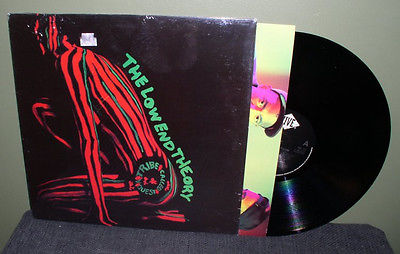
A Tribe Called Quest "The Low End Theory" LP HIP 117 UK NM Q-Tip De La Soul
$
50


Favourite Auctions
To save auctions to your favourites, please login
If you don't have an account, please register
Description
A Tribe Called Quest "The Low End Theory" LP Jive HIP 117 (UK)
Vinyl is NM, Jacket is NM still in shrink
Out of Print!!
Track Listing:
A1Excursions 3:53
A2
Buggin' Out 3:38
A3
Butter 3:39
A4
Verses From The Abstract 3:59
A5
Rap Promoter Bass [Jazz Bass] – Ron Carter Vocals – Ms. Vinia* 2:13
A6
Scenario Rap [Featuring] – Busta Rhymes, Charlie Brown, Dinco D 4:10
B1
The Infamous Date Rape 2:54
B2
Check The Rhime 3:36
B3
Everything Is Fair 2:59
B4
Jazz (We've Got) 4:09
B5
Showbusiness Rap [Featuring] – Diamond D, Lord Jammar*, Sadat X 3:53
B6
What? 2:29
A Tribe Called Quest is an American hip hop group, formed in 1985, and is composed of rapper/producer Q-Tip, rapper Phife Dawg aka Phife Diggy (Malik Taylor), and DJ/producer Ali Shaheed Muhammad. A fourth member, rapper Jarobi White, left the group after their first album but rejoined in 1991. Along with De La Soul, the group was a central part of the Native Tongues Posse, and enjoyed the most commercial success out of all the groups to emerge from that collective. Their innovative fusing of hip hop and jazz has had a lasting impact on hip hop music, helping to expand the art of hip hop production. Many of their songs, such as "Bonita Applebum", "Can I Kick It?", "I Left My Wallet in El Segundo", "Scenario", "Check the Rhime", "Jazz (We've Got)", "Award Tour" and "Electric Relaxation" are regarded as classics by the hip hop community.
They released five albums between 1990 and 1998. The first three LPs were highly acclaimed, but the group disbanded in 1998. In 2006, the group reunited and toured the U.S., and planned to release an album after some works in the studio. The group is regarded as iconic pioneers of alternative hip hop music, having helped to pave the way for innovative hip hop artists. John Bush of Allmusic called them "the most intelligent, artistic rap group during the 1990s," while the editors of About.com ranked them #4 on their list of the "25 Best Rap Groups of All Time." In 2005, A Tribe Called Quest received a Special Achievement Award at the Billboard R&B Hip-Hop Awards in Atlanta. In 2007, the group was formally honored at the 4th VH1 Hip Hop Honors.
The Low End Theory
Following People's Instinctive Travels, the group continued to gather a loyal fan base through touring and guest appearances such as on De La Soul's "A Roller Skating Jam Named "Saturdays"". "Check the Rhyme" was the lead single from the group's landmark second album, The Low End Theory, released on September 24, 1991. Based around a sample from Average White Band's "Love Your Life", the song largely established the now familiar tag-team interplay between Q-Tip and Phife, as until then, most of the group's songs had only featured vocals by Q-Tip.
The two MCs, known for their engaging, and free-wheeling lyrical styles, began to focus on a range of social issues, from date rape ("The Infamous Date Rape") to consumerism ("Skypager"). The songs were noticeably shorter, more abrupt, and bass-heavy. Guests on the album included Leaders of the New School (which included Busta Rhymes), Brand Nubian, and Vinia Mojica. By now, the group had mastered their pursuits of rare records from which to sample or gain ideas and inspiration. Their innovative sampling, layering, and structuring of jazz records led many critics to label their style as jazz rap - a term which Q-Tip disapproved of, as although he felt it described groups such as Stetsasonic quite well, it misinterpreted Tribe themselves, who (aside from the song "Jazz (We've Got)") did not base most of their songs around the topic of jazz.
Helping to gain exposure was a performance of the single "Scenario" with Leaders of the New School on The Arsenio Hall Show at the time, at the height of its popularity. The performance was particularly memorable for the expressive energy of Busta Rhymes, and his famous "raow! raow! Like a dungeon dragon!" line. Around this time, the group also began to make experimental and visually stylish music videos, one of the most memorable of which is the black-and-white promo clip for "Jazz (We've Got)", a duration of which is delegated to the song "Buggin' Out". This part of the video changes from black and white to color, and features the group members wearing prosthetics that make their eyeballs appear to be bulging out, relating to the song's theme about undergoing stressful situations.
Production wise, the album was a more confident effort than their debut, featuring less of a reliance on drum loops, and contributions from jazz great Ron Carter on upright bass. The album was produced by A Tribe Called Quest along with production from Skeff Anselm (co-production by A Tribe Called Quest), on two tracks. Producer Pete Rock also created the original rough draft version for "Jazz (We've Got)", and A Tribe Called Quest then recreated it. In contrast to most of the hip hop albums released in the early 90s, which featured rough beats that run at relatively fast tempos, such as the Bomb Squad-produced Amerikkka's Most Wanted, or the slow menacing funk beats of Dr. Dre's The Chronic, The Low End Theory featured low-key, bass-heavy, and plodding beats which emphasized the pensive nature of the record. The recording sessions and mixing for the album was handled by renown record engineer Bob Power at Greene Street Studios, and Soundtrack Studios, in New York City.
On its release, the album was met with a bevy of praises. Rolling Stone said of the album: "Each time Q-Tip rhymes over Carter's bass lines, the groove just gets deeper." The publication also named it #154 among the Best 500 Albums of All Time, and also as one of the Essential Recordings of the 90's. Further praises were given by Spin who listed it among the 90 Greatest Albums of the '90s. The praises continue to the present day with Allmusic calling it "one of the best hip-hop albums in history", and "a record that sounds better with each listen." Pop Matters music editor Dave Heaton has this to say about the album:
Anything really worth writing about is nearly indescribable; that's the conundrum of writing about music. Any 30-second snippet of The Low End Theory will go further to convince of the album's greatness than anything I can write. I could easily write an entire book on this one album and still feel like I've hardly said anything. Still, I could do worse things with my time than try to capture even an iota of the enthusiasm I feel each time I play this album. The Low End Theory is a remarkable experience, as aesthetically and emotionally rewarding as any work of music I can think of.Among the accolades awarded to the album were:
- 5 Mic Album award from The Source (1990)
- #2 in Ego Trip's Hip Hop's 25 Greatest Albums by Year 1980-98 (1999)
- #53 in Blender's 100 Greatest American Albums of All time (2002)
- #56 in Pitchfork Media's Top 100 Favorite Records of the 1990s (2003)
- #154 in Rolling Stone's Best 500 Albums of All Time (2003)
- Spin Magazine
- #32 in Top 90 Albums of the 90s (1999)
- #38 in Top 100 Albums of the Last 20 Years (2005)
- #87 in 100 Alternative Albums (1995)
Propelled by "Scenario", and positive word of mouth, The Low End Theory performed very well on the charts, being RIAA-certified gold on February 19, 1992 (it reached platinum status by 1995). It exceeded all expectations, most of all for an album that offered little to no concessions towards the mainstream. In the aftermath of their unqualified success, the group once again hit the road and contributed the song "Hot Sex" to the soundtrack for the Eddie Murphy vehicle Boomerang, in 1992.
Interrupting the proceedings was an encounter with new jack swing group Wreckx-N-Effect (W-N-E), who had taken an exception to some lines in the song "Jazz (We've Got)". Viewed as a premier new jack swing group, W-N-E had misinterpreted the following couplets by Phife as a sideway diss:
I'm all into my music cuz it's how I make papes Tryin' to make hits, like Kid Capri mix tapes Me sweat another? I do my own thing Strictly hardcore tracks, not a new jack swingThe misunderstanding resulted in a melee in which Q-Tip sustained an injury to one of his eyes. Thus, during the shooting of the promo clip for "Hot Sex", he wore a ski mask to cover up the abrasion. Soon after, Q-Tip was chosen to play the part of Markell, Janet Jackson's ill-fated partner, in the John Singleton-directed drama Poetic Justice, which also starred Tupac Shakur. The minor part would nevertheless showcase Q-Tip's natural flair for acting and he would later receive offers for more diverse supporting roles. This film also allowed for a friendship to blossom between Q-Tip and Jackson, and the pair would go on to collaborate on her song "Got 'Til It's Gone", from her album The Velvet Rope, in 1997.
During the ascendancy of ATCQ, other Native Tongue members were experiencing career-lows. The Jungle Brothers, once the trailblazers of the collective, were now becoming disaffected with their label due to the under-promotion of their previous effort. In addition, they distanced themselves from the collective, and their music began to lean towards the emerging, European-influenced trip hop sub-genre. However, ATCQ appeared to be maintaining an ongoing relationship with De La Soul.
Midnight Marauders
Trugoy of De La Soul appeared on the refrain of "Award Tour", the group's lead single from their third album Midnight Marauders, released on November 9, 1993. Coming on the heels of The Low End Theory, the album was highly anticipated and many were anxious to see if the group could maintain their artistic integrity in light of their commercial success. Boosted by their raised profile, "Award Tour" became the group's highest charting single to date, and helped to land the album within the US Top Ten. The critics proved to be as enthusiastic about the new set as the fans were. Entertainment Weekly said the album "sounds as fresh as their first... rappers Phife and Q-Tip manage to hold attention without resorting to gun references or expletives..." NME called it their "most complete work to date" Likewise, Melody Maker said "A Tribe Called Quest have expanded their vision with a lyrical gravitas and a musical lightness of touch that has hitherto eluded them across a whole album". The album was voted #21 by The Village Voice in that year's Pazz & Jop Critics Poll.
Musically, Midnight Marauders built upon many of the ideas that were present on The Low End Theory, although the results were noticeably different, and the music was more immediate. Whereas Theory had been an exercise in subdued minimalism, and simplicity, the grooves found on Marauders are mostly up tempo, and full of charging drums, suave basslines, melodious riffs, complementary horns, and catchy hooks, all delivered in an efficient 50 minute time frame. The intermittent voice of a tour guide (the titular 'midnight marauder') also serves to add further cohesion to the album.
The group was now famous for their unique choices of sample material on their albums and Midnight Marauders was no exception. Lead single "Award Tour" contained an infectiously sunny loop taken from Weldon Irvine's "We Gettin' Down". Irvine, a little known but well-respected jazz virtuoso was enthused to have been sought by the group and lent his assistance towards the sampling of the song. Another outside musician to contribute to the record was Raphael Saadiq (credited as Raphael Wiggins) of Tony! Toni! Toné!, on the song "Midnight". Aside from the aforementioned, producers Large Professor, and Skeff Anselm handled two tracks - "Keep It Rollin'" and "8 Million Stories" respectively, the former also rapping over his production.
Lyrically, the album benefited from an even more confident duo in Phife Dawg and Q-Tip, whose nimble verbal interplay is utilized to its fullest on songs like "Electric Relaxation" and "Oh My God". Opening song "Steve Biko (Stir It Up)" - which includes the lines "You know that I'm the rebel, throwin' out the wicked like God did the Devil" - is named after the slain South African human rights activist and political revolutionary Steve Biko. Some of the other topics on the album are police harassment and nocturnal activity ("Midnight"), religious faith ("God Lives Through"), and hip hop itself, as on the song "We Can Get Down" where Phife asks:
How can a reverend preach, when a rev can't define The music of our youth from 1979 We rap about what we see, meaning reality From people bustin' caps and like Mandela being free Not every MC be with the negativity We have a slew of rappers pushin' positivityAnother song, the sometimes controversial "Sucka Nigga", deals with the candid use of the word "nigga". In the song, Q-Tip notes the negative purpose of the word but subsequently emphasizes its subjective nature when he says:
It means that we will never grow, you know the word dummy Other niggas in the community think its crummy But I don't, neither does the youth cause we Em-brace adversity it goes right with the race And being that we use it as a term of endearment Niggas start to bug to the dome as where the fear wentThe three singles for the album received memorable music videos, such as the one for second single "Electric Relaxation" which was shot in black and white, and takes place mostly in a diner. The song was the cause of an amusing mystery, as few people were certain of what is said during the hook, which is more or less mumbled out by Q-Tip (although there is now a consensus that the words are "relax yourself girl, please settle down"). The third single to be released was "Oh My God", the video for which showed the group in a neighborhood setting and surrounded by young fans. It also included a cameo by a typically manic Busta Rhymes. The group performed as one of a handful of rap acts at the 1994 Lollapalooza Festival, among acts such as The Smashing Pumpkins, Stereolab and The Verve.
All records are shipped in professional 7” & 12” box mailers. All CDs are shipped in padded bubble mailers. Buy multiple items and save on shipping. Thanks for Visiting!!
price rating