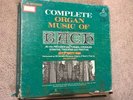
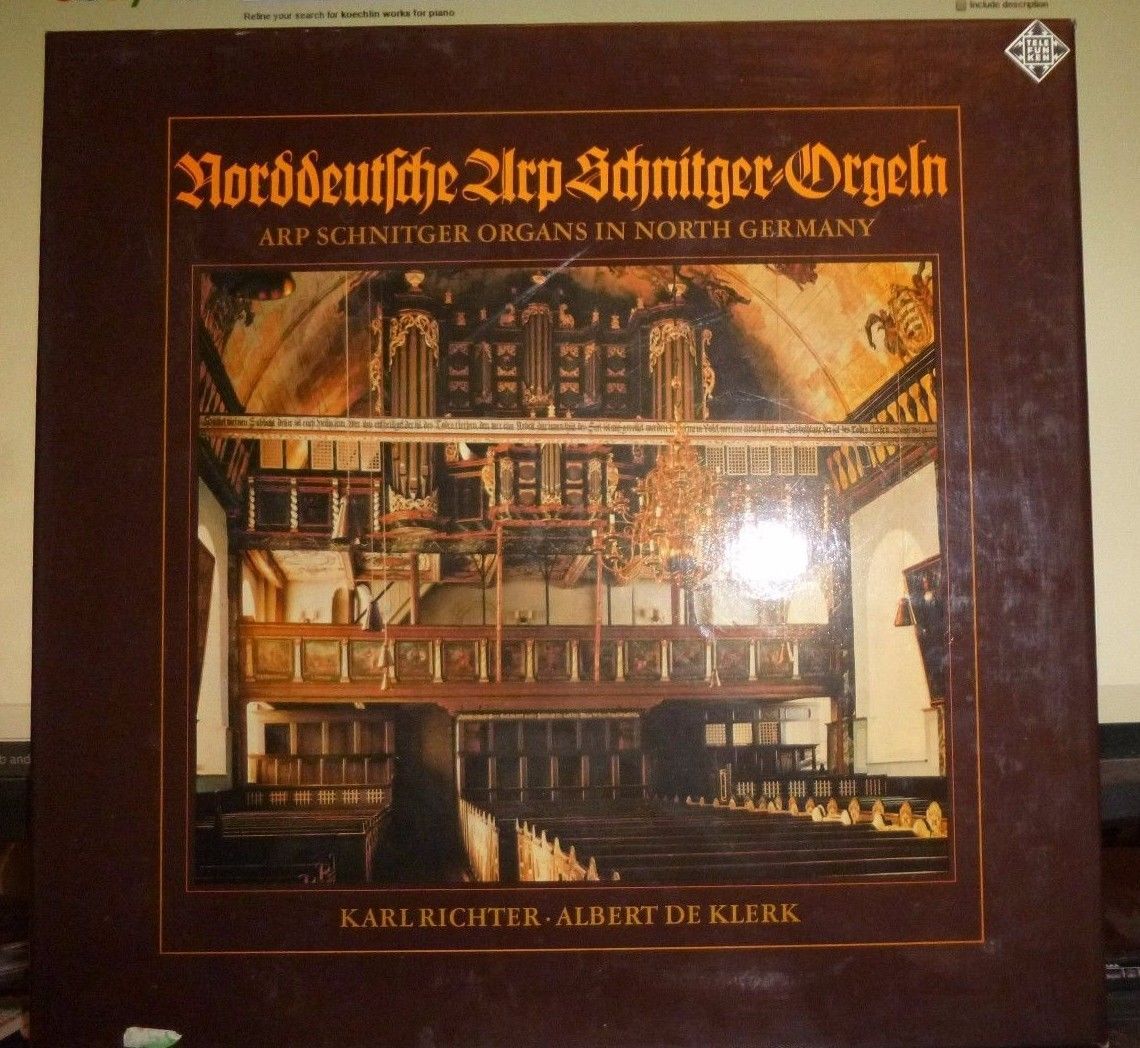
ARP SCHNITGER ORGANS North Germany 2 LP Telefunken Karl Richter, Albert De Klerk
$
25


Favourite Auctions
To save auctions to your favourites, please login
If you don't have an account, please register
Description
Condition: Translated from German
The fans of classical (baroque) organ music schnalzen presumably with tongue when they hear the name Arp Schnitger:
Arp Schnitger (* 1648, probably in Schmalenfleth; baptized 9 July 1648 Golzwarden today Brake; buried July 28, 1719 in New field, today Hamburg) was one of the most famous organ builder of his time and the perfecter of the North German Baroque organ. Its activities extended across northern Europe, where he created more than 100 new organs and set the style. Besides the main workshop in Hamburg worked fellows and staff in branches between Groningen and Berlin to build from there new organs or entertain older works or remodel. Schnitger conceived his works with rushing concoctions and powerful bass for an accompaniment for congregational singing. Secondly, they were the representation of the North German organ school that could develop in the activities organized by the Merchants Abendmusiken the Hanseatic cities. About 30 of his instruments are still preserved in their basic substance.
Handwritten signature "Arp Schnitger organ builder" with manu propria
And also the players on the Schnitger organ / had a sonorous name:
Karl Richter (* October 15, 1926 in Plauen; † February 15, 1981 in Munich) was a German conductor, choirmaster, organist and harpsichordist.
1926 Karl Richter, son of a Protestant pastor, Kruzianer in Dresden, born. After the war he studied at the conservatory in Leipzig and at the Church Music Institute at Karl Straube and Günther Ramin and developed there to Bach interpreters.In 1949 he became organist Thomas. 1951 he became cantor at the St. Mark's Church in Munich. In Munich, he taught at the Academy of Music and in 1956
Karl Richter
appointed professor. In 1951 he took over the Heinrich-Schütz-Kreis, the later Munich Bach Choir, 1953, the Munich Bach Orchestra and thus became one of the most internationally renowned Bach interpreters.
Karl Richter initiated in 1968 in Moscow and Leningrad performances of the St. John Passion and the B minor Mass by Johann Sebastian Bach. His interpretation of the 2nd Brandenburg Concerto cites the musical part of the record Voyager Golden Record, which has left a message of humanity aboard the probes Voyager 1 and Voyager 2 our solar system. Richter built his reputation as a Bach interpreter continuously. His views were determined by its origin from the Leipzig School: Comparatively large instrumental and choir Instrumentation, coined by the late Romantic musical tradition of expression, highly expressive design.inclusive The already incipient in his time, musicological findings "historical performance practice" was far judges. So he sat through a modern instrument.Of his students are Hedwig Bilgram, Günter Jena, Walther R. Schuster, Albrecht Haupt and Rudolf Kelber.With the Munich violinist Otto Büchner (1924-2008) was a particularly good musical and personal partnership.
Richter died in 1981 of heart failure. He was in the cemetery Enzenbühl (FG 81163) buried in Zurich.
And Albert de Klerk (born October 4, 1917 in Haarlem; † December 1, 1998) was a Dutch conductor, organist and composer.
Albert de Klerk at the organ of the Grote Kerk(Haarlem)
De Klerk is the son of musician Jos de Klerk (1885-1969), who acted as his first teacher. Albert de Klerk studied at the Conservatorium van Amsterdam organ and graduated in 1939 with a diploma with summa cum laude. In 1934 he followed Hendrik Andriessen as organist at St. Joseph Church in Haarlem, a post which he held until his death. From 1946 to 1964 taught de Klerk organ at the Institute of Catholic Church Music Utrecht before he taught as professor of organ at the Amsterdam Conservatory from 1965 to 1983. From 1956 to 1986 he covered with Piet Kee from the office of the city organist of Haarlem.
De Klerk composed works in the field of chamber music for organ, piano, glockenspiel, choral and solo singing. He also worked as a conductor and organ improviser. (Source: wikipedia)
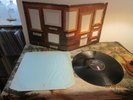
The listeners of these two LPs (which were published in a typical for those times LP box) so expect highest quality organ music (noise disturbance - the ravages of time - included).
Encouraging that even here with the classics like Bach and Buxtehude far less known composers resound: names like Samuel Scheidt, Sweelinck, Heinrich Scheidemann or Jacob Praetorius are certainly not everyone familiar ... but still sound splendid. Whoever has ears, listen!
God knows why, but right now I probably my organ-phase, and therefore more examples of this magnificent instrument will soon follow.
The Schnitger organ in Steinkirchen
Cast:
Albert de Klerk (organ at 05 -.)
Karl Richter (organ at 01 - 04)
Title:
Johann Sebastian Bach:
01. Fantasy in G major, BMW 572 (Trés vitement - Gravement - Lentement) 9:43
02. . Trio Sonata No. 6 in G Major, BMV 530 (Vivace - Lento - Allegro) 13:42
03. . Trio Sonata No. 3 in D minor, BMV 527 (Andante - Adagio - Vivace) 13:13
04th Pastorale F Major, BMV 590 12:28
Dietrich Buxtehude:
05th Prelude and Fugue in F major 6:21
Samuel Scheidt:
06th Psalmus "As Jesus was on the cross" (chorale) 10:23
Sweelinck:
07th Echo Fantasia (Fantasia in the manner of Echoes) 4:09
Heinrich Scheidemann:
08th Magnificat Fantasy (in VIII. Sound) 8:52
Jacob Praetorius:
09th Vater unser im Himmelreich (Chorale Variations) 5:20
Ferndale, Michigan 48220
See our other EBAY auctions by using search by seller and using “record collector michigan”
Phone: 248-548-9888
Hours: Monday thru Saturday NOON to 6:00 PM (Eastern)
GOLDMINE GRADING
MINT ---- It should appear to be perfect. No scuffs or scratches, blotches or stains, labels or writing, tears or splits. Mint means perfect.
NEAR MINT ---- Otherwise mint but has one or two tiny inconsequential flaws that do not affect play. Covers should be close to perfect with minor signs of wear or age just becoming evident: slight ring-wear, minor denting to a corner, or writing on the cover should all be noted properly.
VERY GOOD PLUS ---- The record has been handled and played infrequently or very carefully. Not too far from perfect. On a disc, there may be light paper scuffs from sliding in and out of a sleeve or the vinyl or some of the original luster may be lost. A slight scratch that did not affect play would be acceptably VG+ for most collectors.
VERY GOOD ---- Record displays visible signs of handling and playing, such as loss of vinyl luster, light surface scratches, groove wear and spindle trails. Some audible surface noise, but should not overwhelm the musical experience. Usually a cover is VG when one or two of these problems are evident: ring wear, seam splits, bent corners, loss of gloss, stains, etc.
GOOD ---- Well played with little luster and significant surface noise. Despite defects, record should still play all the way through without skipping. Several cover flaws will be apparent, but should not obliterate the artwork.
POOR ---- Any record or cover that does not qualify for the above "Good" grading should be seen as Poor. Several cover flaws.
price rating