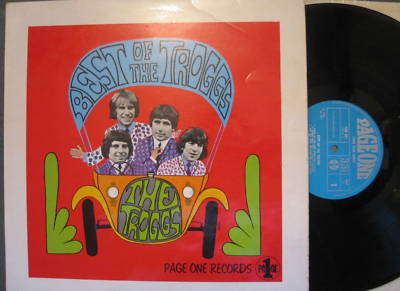
BEST OF THE TROGGS PAGE ONE FOUR STAR FOR 001 60'S BEAT
£
24
$
32


Favourite Auctions
To save auctions to your favourites, please login
If you don't have an account, please register
Description
YOU ARE BIDDING ON AN EXCELLENT CONDITION LP
THE TROGGS
BEST OF THE TROGGS
NIGHT OF THE LONG GRASS
GONNA MAKE YOU
ANY WAY THAT YOU WANT ME
66-5-4-3-2-1
I WANT YOU
WITH A GIRL LIKE YOU
I CAN'T CONTROL MYSELF
GIRL IN BLACK
GIVE IT TO ME
YOU'RE LYING
FROM HOME
WILD THING
RELEASED ON PAGE ONE RECORDS FOR 001
Remembered chiefly as proto-punkers who reached the top of the charts with the "caveman rock" of "Wild Thing" (1966), the Troggs were also adept at crafting power pop and ballads. Hearkening back to a somewhat simpler, more basic British Invasion approach as psychedelia began to explode in the late '60s, the group also reached the Top Five with their flower-power ballad "Love Is All Around" in 1968. While more popular in their native England than the U.S., the band also fashioned memorable, insistently riffing hit singles like "With a Girl Like You," "Night of the Long Grass," and the notoriously salacious "I Can't Control Myself" between 1966 and 1968. Paced by Reg Presley's lusting vocals, the group — which composed most of their own material — could crunch with the best of them, but were also capable of quite a bit more range and melodic invention than they've been given credit for.
Hailing from the relatively unknown British town of Andover, the Troggs hooked up with manager/producer Larry Page (who was involved in the Kinks' early affairs) in the mid-'60s. After a flop debut single, they were fortunate enough to come across a demo of Chip Taylor's "Wild Thing" (which had already been unsuccessfully recorded by the Wild Ones). In the hands of the Troggs, "Wild Thing" — with its grungy chords and off-the-wall ocarina solo — became a primeval three-chord monster, famous not only in its original hit Troggs version, but in its psychedelic revamping by Jimi Hendrix, who used it to close his famous set at the 1967 Monterey Pop Festival.
"Wild Thing" made number one in the States, but the Troggs' momentum there was impeded by a strange legal dispute which saw their early records simultaneously released on two different labels. Nor did it help that the band didn't tour the U.S. for a couple of years. As a consequence, the fine follow-up singles "With a Girl Like You" and "I Can't Control Myself" didn't do as well as they might have. In Britain, it was a different story — they were smashes, although "I Can't Control Myself" had such an open-hearted lust that it encountered resistance from conservative radio programmers all over the globe.
The Troggs tempered their image on subsequent ballads, which utilized a sort of pre-"power ballad" approach. These weren't bad, and a few of them were British hits, but they weren't as fine as the initial blast of singles which established the band's image. "Love Is All Around," which restored them to the American Top Ten in 1968, was their finest effort in this vein. It was also their final big hit on either side of the Atlantic.
But the Troggs would keep going for a long, long time. In a sense they were handicapped by their image — they were not intellectuals, certainly, but they weren't dumb either. They wrote most of their songs, and their albums were reasonably accomplished, if hardly up to the level of the Kinks or Traffic, containing some nifty surprises like the gothic ballad "Cousin Jane," or the tongue-in-cheek psychedelia of "Maybe the Madman." By 1970, though, they were struggling. They continued to release a stream of singles, most of which had a straightforward simplicity that was out of step with the progressive rock of the time, all of which flopped, though some were fairly good.
The Troggs' image as lunkheads couldn't have been helped by the notorious Troggs Tapes, a 12-minute studio argument that was captured on tape while the band were unawares. The Spinal Tap-like dialog helped keep their cult alive, though, and as punk gained momentum in the mid-'70s, they gained belated appreciation as an important influence on bands like the Ramones and (earlier) the MC5. They found enough live work (sometimes on the punk/new wave circuit) to keep going, although their intermittent records generally came to naught. In 1992, they rose to their highest profile in ages when three members of R.E.M., which had covered "Love Is All Around," backed the Troggs on the comeback album Athens Andover.
price rating