CADILLACS -Fabulous..LP (1957) BLUE LABEL Jubilee VG++
$
213


Favourite Auctions
To save auctions to your favourites, please login
If you don't have an account, please register
Description
PLEASE TAKE A LOOK AT MY OTHER eBAY AUCTION AND STORES LISTINGS - ALWAYS EXPECT THE UNEXPECTED
MANY NEW LISTINGS THIS WEEK OF RARE & OBSCURE ALBUMS IN MANY CATEGORIES
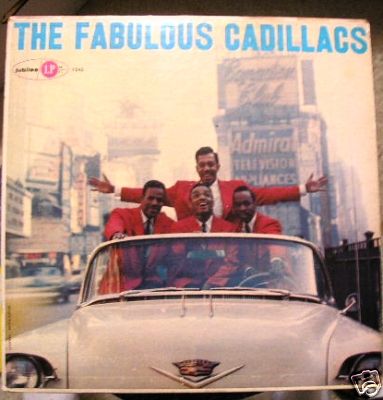
The Cadillacs-"The Fabulous Cadillacs" in mono on Jubilee 1045. First pressing from 1957 of this classic album by one of New York City's finest r&b vocal groups in nice condition.
Record Grade: VG++, the record retains almost all of its original gloss, there are surface marks on both sides but not an excessive amount; the hairlines should not effect play- overall a very nice disc, a 7 or better on a 1-10 scale
Cover Grade: VG+, color are vivid, minor wear, a bit more at the bottom (over the Caddy's white hood); paritally taped top seam
Labels: Blue and silver
Tracks
- 1Zoom Navarro 2:25
- 2I Wonder Why Patterson 2:10
- 3Sympathy Burns, Carroll, Navarro 2:31
- 4Woe Is Me Navarro 2:56
- 5That's All I Need Willis 2:35
- 6Wishing Well Navarro 2:30
- 7Speedoo Navarro 2:21
- 8Down the Road Navarro 2:29
- 9You Are Navarro 2:27
- 10The Girl I Love Navarro 2:31
- 11No Chance Burns 2:42
- 12Sugar Sugar Willis 2:22
About the Artist: by Bruce Eder
Earl Carroll, LaVerne Drake, and Robert Phillips were already singing together in the early '50s as the Carnations, whose lineup also included "Cub" Gaining. Carroll and Phillips were nearly as close as brothers, Carroll having been taken in by Phillips' family after the death of his own mother. The group — based in New York's Harlem in the area around 131st St. and Seventh and Eighth Avenues — had an energetic approach to music, but somewhat threadbare harmonies, and they were popular at dances held at the local public school they all attended. Their main influence was the Orioles, whose slow romantic numbers went over very well with the group members and the audiences of the period. Carroll's own musical roots included gospel, specifically the Five Blind Boys, the Swanee Quintet, and the Soul Stirrers, but also R&B vocal outfits such as the Clovers, the Ravens, the Swallows, and the Five Keys. The Carnations were heard in a performance at Public School 43 by Lover Patterson, a one-time associate of the Orioles who had organized a group called the Five Crowns (whose 1958-era membership would become the new Drifters, of "There Goes My Baby" fame), who was impressed enough with their singing to introduce the group to Esther Navarro, a secretary for the Shaw Artist Agency who also wrote songs. The audition itself brought about changes in the Carnations' lineup. Baritone Bobby Phillips wanted to switch to bass, partly to see if the novelty value of a 5' 4" bass singer would have some value (most basses were big guys), but Cub Gaining didn't like the idea and quit before the audition. Patterson replaced him with James "Poppa" Clark of the Five Crowns and Johnny "Gus" Willingham. It was this group — Earl Carroll (lead tenor), LaVerne Drake (tenor), James Clark (tenor), Johnny Willingham (baritone), and Bobby Phillips (bass) — that auditioned for Navarro. They were duly signed but had to give up their name, as the Carnations was already being used by a professional outfit. The Cadillacs was chosen for its association with automotive elegance and to separate the group from the spate of bird and flower names that were common among singing groups. The group brought a pair of songs, Navarro's "Gloria" and Patterson's "I Wonder Why," to Jubilee Records, an independent outfit owned by former bandleader Jerry Blaine. Their first single was in stores by the end of July 1954, and it proved to be a regional success, with strong sales on the East Coast from Baltimore to Boston, especially (no surprise) in New York. Patterson's more up-tempo "I Wonder Why" had more success than the more restrained and romantic "Gloria." By the time of the release of the group's second single, "Wishing Well," issued later that summer, the lineup had changed, with James Clark and Johnny Willingham replaced by baritone Earl Wade and tenor Charles "Buddy" Brooks. The group experienced modest success during the latter part of 1954 and early 1955, and then they had their breakthrough record, "Speedo." There have been several stories associated with the origins of the song, all of which surround Earl Carroll's attributes: Carroll has claimed that it originated with a nickname he got as a child, but also said that the beat and background were influenced by the group's appreciation of a Regals song called "Got the Water Boiling." Esther Navarro, whose name is signed to the song as writer, claimed at the time that it derived from Carroll's derisive nickname "Speedy," earned by his slow-moving demeanor; she claimed that he said to her, "They often call me Speedy but my real name is Mr. Earl." The song was recorded in September of 1955, and released in October of that year. It became a monster hit, but only after laying dormant for weeks. The turning point came when Cleveland-based disc jockey Alan Freed booked the group onto his Christmas show at the Academy of Music. The group by that time was completely professional, and had added dance routines choreographed by Cholly Atkins, who later trained most of the Motown acts in their stage presentations. The group swept the board during the two weeks of appearances in the Freed show, which, itself was a major turning point in the history of rock & roll. There had been showcases of that kind going on for several years, but mostly before black audiences; the Freed show broke the theater's box-office record, and in the process drew in a major contingent of white teenagers. "Speedo" finally broke out in early December, and it entered the Billboard pop charts before it reached the R&B charts, something that had never happened before with an R&B single. The music industry began taking notice not only of this phenomenon, but also of the Cadillacs. The song rode the charts for four months, well into 1956, by which time the Cadillacs were established as one of the top R&B groups in the country. They also had a membership change early in that year, with Jimmy Bailey replacing founding member LaVerne Drake. Their attempts at a follow-up hit failed despite some initial encouraging signs from the trade papers, but this didn't slow their momentum on-stage; they remained one of the most heavily and prominently booked groups among the package tours that were the norm, and the bookings were still good into the late winter of 1957. Unfortunately, nothing was that straightforward for the group itself. At some point, they split with Esther Navarro, and the group also split into two rival sets of Cadillacs. Earl Carroll led the Original Cadillacs, as they became known — consisting of Carroll, Charles Brooks, Bobby Phillips, and Earl Wade — while Navarro had Jimmy Bailey leading Bobby Spencer, Bill Lindsay, and Waldo "Champ Rollow" Champen under the name the Cadillacs. The groups both continued recording, both on Jubilee (which was caught in the middle of the dispute), and effectively canceled each other out. Navarro's Bailey-led Cadillacs (who only recorded once officially, doing "My Girlfriend" in May of 1957) went on the road in an abortive attempt to carry on, but they were pulled out of the late-1957 package tour before it was half over. By November of 1957, the two groups had made a sort of peace: Champ Rollow and Bill Lindsay were out, and Carroll, Bailey, Brooks, Phillips, and Wade were working together in the studio as the Cadillacs. Brooks was soon replaced by Bobby Spencer, but there were other changes as well: Earl Carroll was pushed into the background of the group's vocals by Jimmy Bailey and Bobby Spencer. Of course, it didn't matter that much, because in their search for a sound that would sell, the group had changed into a comedic doo wop outfit in the mold of the Coasters, specializing in humorous novelty numbers. They hardly resembled the outfit that Earl Carroll had co-founded in the early '50s. The sad thing, in some respects, is that this worked. They were back on the national charts for the first time in over two years in October of 1958 with "Peek-A-Boo," a sort of "Yakety Yak"-type number that made the Top 40 and gave the group a new lease on life as a concert attraction. Having succeeded once with a comic novelty tune, they mined this vein again with a pair of singles, "Jay Walker" and "Please Mr. Johnson." Both were recorded early in 1959 and featured (in very effective performances) in the 1959 Alan Freed-starring jukebox classic Go Johnny Go, which also featured Jimmy Clanton, Sandy Stewart, Chuck Berry, Jackie Wilson, Eddie Cochran, Ritchie Valens, and Jo-Ann Campbell. The group's string of hits had ended, however. Earl Carroll left the group that he had founded in 1959; the Cadillacs kept working for a few more years, recording unsuccessfully for a number of labels before packing it in during the early '60s. Carroll fared reasonably well, however, remaining in music and eventually joining the Coasters in 1961, where he remained for more than 20 years. He later re-formed the Cadillacs, with Bobby Phillips the only other veteran member of the group, and he kept the new group going throughout the 1980s and into the 1990s, even doing a well-received comeback record early in the '90s.
All of my records are shipped in sturdy cardboard LP or 45 rpm mailers with appropriate padding (heavy cardboard fillers or bubble wrap or "peanuts" or some combination thereof". With the exception of sealed LP's, all LP's are removed from their outer sleeves to prevent seam splitting. Upon request, I will give your sealed LP's the same treatment. (once an LP is shipped sealed, it cannot be returned once opened).
All records are carefully graded. In an attempt to give customers an accurate impression of condition rather than adhere to somewhat arbitrary criteria, I give an "overall presentation" grade, supplemented when necessary with additional remarks. Please refer to my grading system below for a more detailed explanation.
MY GRADING SYSTEMS: I’ve been told that I grade conservatively. My NM (near mint) is my highest grade for opened records (which would also include unplayed records). It’s a 9 or 10 on a 1-10 scale. M- would be equivalent to an 8; VG++ to a 7; VG+ to a 6; VG to a 5; VG- to a 4; G to a 3; F to a 2 and P to a 1. The same scale applies when I grade covers (jackets). Significant defects are specifically noted and taken into consideration in the grade.
GRADING DESCRIPTIONS
RECORDS:- GRADING Grading is based on the following criteria
- Sealed = store stock new
- Near Mint = like new or near new with only one or two small insignificant defects, a 9 or better on a 1-10 scale
- Mint- = extremely nice. Would be Near Mint, except for a couple of light hairlines or scuffs, which do not affect play
- VG++ = still a very nice record with all or nearly all of its original gloss but may have a few more light, surface marks, hairlines, needle tracks or the like which should not materially effect play
- VG+ = a nice, but used record that may have a series of light scuffs or scratches. It probably plays with a few pops, but has no serious problems.
- VG = a well-used record that still should sound OK when played, but may have moderate surface noise, pops, etc.
- VG- = a very well-worn record that plays through without skipping, but will do until a better copy comes along.
- Good = not actually good at all but probably will play through but with much in the way of surface noise, pops, crackles, etc. Still, will have no cracks, chips or the like
- Fair = you’re getting this record just to own but not to play
- Poor = the sky’s the limit, generally I will discard a record this bad (and sell the cover, jacket or sleeve alone) unless the label holds some particular interest
VISUAL GRADING: All records are visually graded only unless I state that they are play-graded. Some major labels were pressed on better quality vinyl and will sound better than a record which visually appears the same on "budget" labels which were pressed on lower quality vinyl. Recording techniques also varied. The sound on live albums may be far inferior to studio recordings. There may also be defects in the pressing which are invisible. The point is that an album on a high quality label that was visually graded VG+ may sound better than an album on a budget label that was visually graded Mint- or even Near Mint. Please refer to my return policy, below. But please don’t be shocked if a record visually graded Near Mint doesn’t sound state of the art. If I base my grade on a PLAY GRADE, I will state this specifically in my grading section.
COVERS: There are really too many possible defects regarding covers to be as specific in my definitions as I had been with my record grades. But please keep in mind these general grading guidelines:
- I will give greater weight to the condition of the front cover than back cover when assigning an overall grade
- No cover with a cut out hole or saw mark will be graded Near Mint even if it is still in factory shrink and there is no other wear
- I will not reduce the grade of a cover for stickers which are glued to the jacket by the record company (eg. Contains the hit song Expressway to Your Heart); but will reduce the grade for stickers glued on the cover by stores, previous owners, etc.
- If I write that a cover has a bb hole, I’m talking about a small cut out hole
- A saw mark is a narrow cut in the perimeter of the cover, could be anywhere and vary in length from 1/2” to 2” at the most.
- The overall grade takes into consideration any stated defects. For example, if I grade a cover VG+ and then state it has 6” top and bottom seam splits - I’ve already reduced the grade because of the seam splits. If the seams weren’t split, the cover would be graded higher such as VG++ or Mint-.
Shipping Costs: NEW SHIPPING RATES AS OF September 5, 2008.
The buyer pays for shipping. I am now using eBay's shipping calculator. Cost of postage will vary by weight. The charge is determined by actual cost plus a small charge for professional packing materials. On all domestic packages, delivery confirmation is included in the postage.Save money when I mail 2 or more records in the same package.
Insurance is optional for purchases of $10.00 or more shipped within the U.S.but it is highly recommended for “high ticket” purchases.
International Shipments: Overseas customers are welcome to bid. I ship worldwide. Express international is offered on expensive items and required on international shipments of $300 or more. In addition, I may require Express International shipping in my discretion of certain international shipments valued under $300. Save on shipping cost per record when I mail two or more records in one package. The cost of postage for additional (single) LP's is $5.00. Please note that this applies only to packages that weigh 4 lbs. of less (generally 5 or fewer albums); packages that weigh more than 4 lbs. cannot be mailed "small packet" and the only choices are Priority Mail International or Express Mail International. This may result in a slight "jump" in postage at the point where the package exceeds 4 lbs. As a rule, I can mail up to 16 albums in a large record mailer.
SHIPPING - "HIGH END PURCHASES" - PLEASE READ CAREFULLY -
Standard shipping rates may not apply to expensive purchases. This is both for your benefit and mine. Here are the changes and additions:- All shipments within the U.S. over $500 must be insured (under $500, insurance is still optional).
- All shipments of records totalling over $300.00 sent overseas will be mailed EXPRESS MAIL INTERNATIONAL (which provides a tracking number); while the postage costs will be substantially higher, this should ensure safe delivery of these valuable items
- All packages where the purchase exceeds $1,000 will be double boxed. This applies to both domestic and foreign shipments. Shipments within the U.S. may be sent either via priority mail or media rate - the choice is up to the buyer. All "high end" overseas shipments must be sent via Express Mail International.
- The postage charges for these "high end" shipments will be the actual cost plus an approximate 15% mark-up to cover the cost of packing supplies and handling.
Sorry, but I do not give refunds for items damaged or lost in the mail - U.S. buyers have the option of obtaining insurance for purchases over $10.
Please check out my other eBay auctions and stores listings.
. I’ve been listing all types of records - mostly LP’s - including 50’s and 60’s rock ‘n’ roll, country, folk jazz, blues, personalities, new wave and punk, surf, psych, spoken word, comedy, etc., etc....... I try to list unusual, unique or obscure records, not the ones that you see all the time. While a majority of my listings are albums, you’ll often find a nice selection of 45’s, EP’s or picture sleeves...and an occasional 78 or two.My return policy: . You may return an item if it's not in the conditon described. You may not return items if you decide you don't like the music. I will return the base price of the item unless I make an error in shipment such as sending you the wrong record or cd. In that case, you will be reimbursed for the cost of the item and shipping both ways. In addition, the item must be returned in its original condition , i.e. the way it was shipped when it left my hands. While a very high percentage of my records arrive safe and sound (I use professional mailers and a filler or two, more for 78’s), they occasionally are damaged in transit. If that happens, I won’t accept the return of the record or other item - that’s why you have the option of obtaining insurance for purchases $10 or more.
Sealed Records: After a sealed record is paid for, I will gladly open it before mailing to make sure that the record is new & unplayed. If the record is not, I will give a full refund. Even though it is easy to spot most resealed records from the 50's and 60's [I will mention that in the desription if it looks like a possibility], not all records from the 70's & 80's are quite as obvious. Please ask for any details about the seal of a particular record & I will be happy to answer.
My Feedback Policy: I'll be glad to return positive feedback if you would be so kind to leave me same.
Any other questions? About anything? Please e-mail me at ibuyvinyl@nc.rr.com .

![David Bowie Space Oddity UK 1st Press on RCA LP [Not Philips ]+ Inner + Poster](https://www.popsike.mobi/php/thumbnail.php?url=https://www.popsike.pics/pix/20170821/132302717484.jpg)