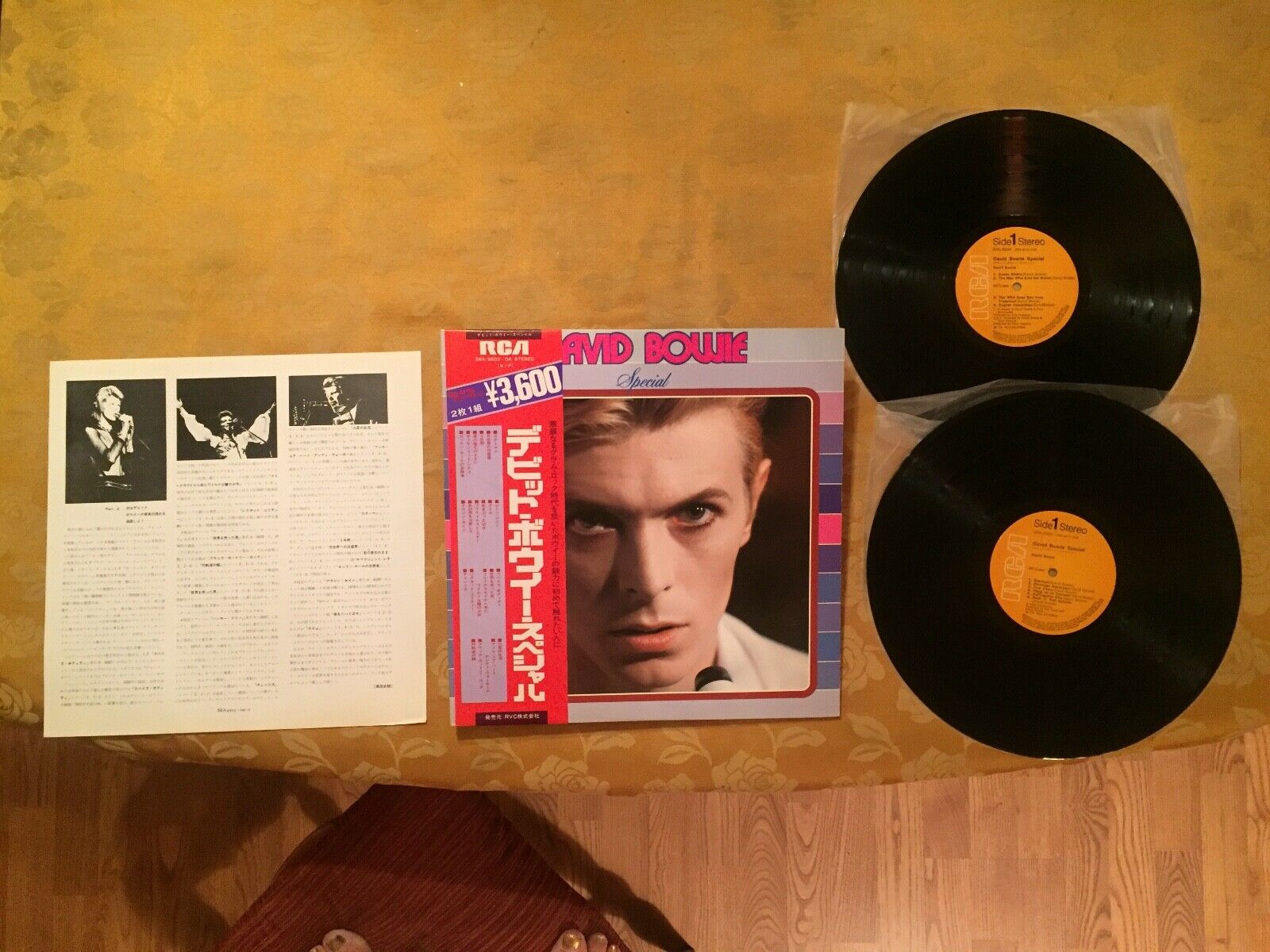
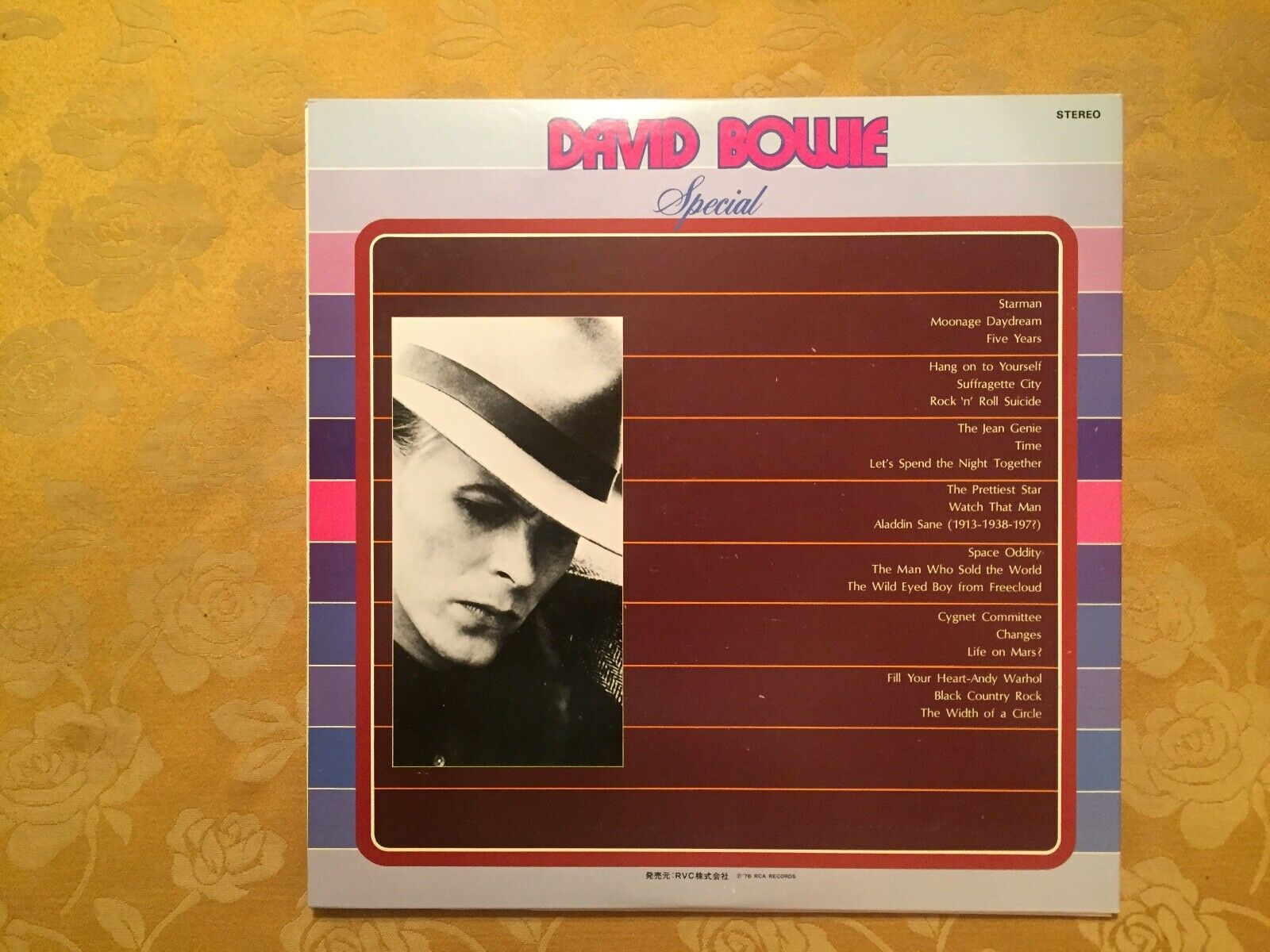
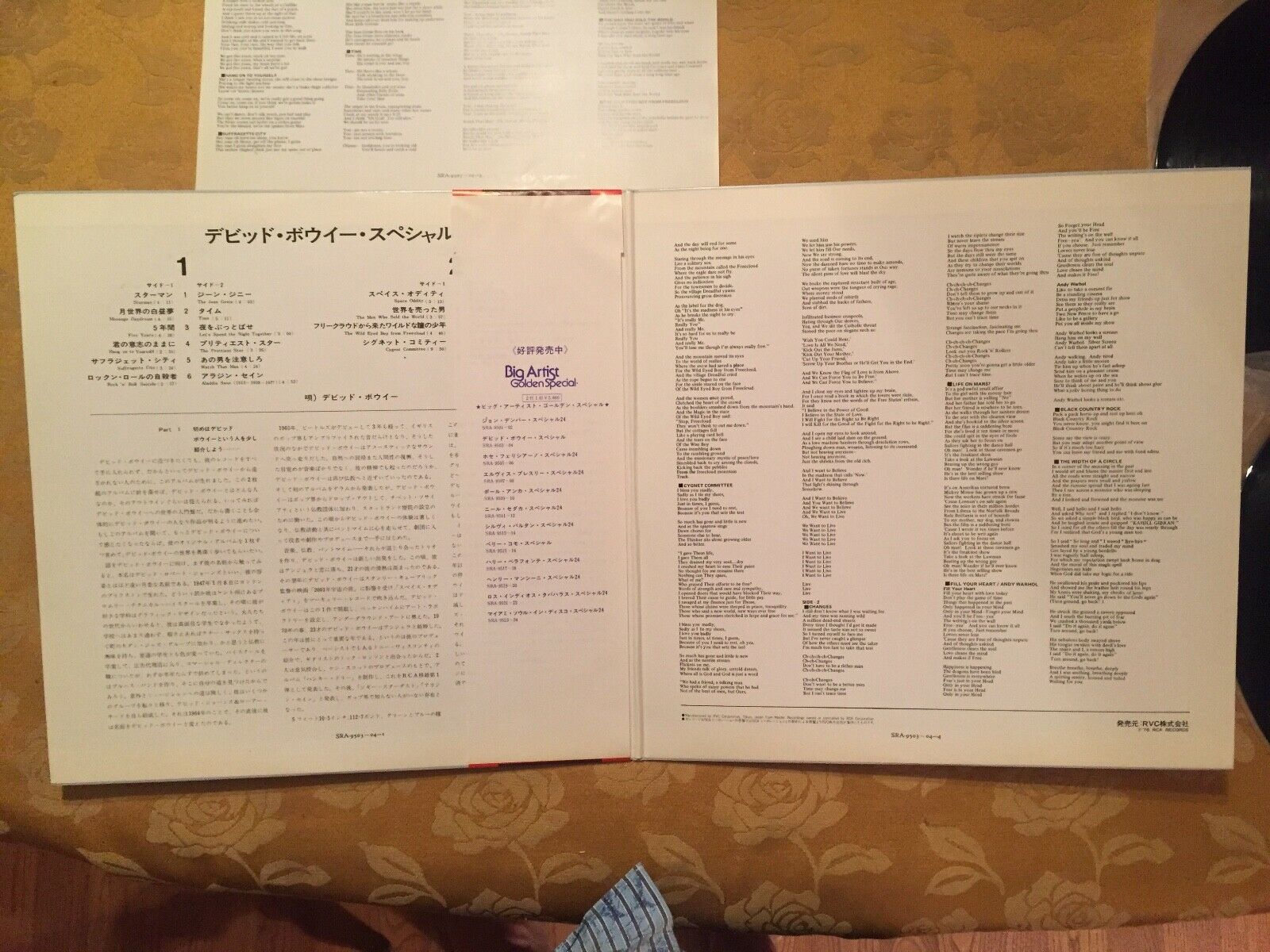
DAVID BOWIE Special MINT '76 Japan 2LP 1ST PRESS Obi & Inserts SR-9503
$
53


Favourite Auctions
To save auctions to your favourites, please login
If you don't have an account, please register
Description
Vinyl: MINT! Appears Unplayed! NEW OLD STOCK! TOP COPY! Super high gloss vinyl. Japan RCA Labels are Clean and Bright. This is the Original 1976 Japan RCA Audiophile 1st Pressing! SR-9503-04. Classic Bowie! Japan did not use shrink-wrap on their records in the 70s. This is a NEW Record received from a former record shop owner, who ran a shop in the 1980s. Classic Bowie! Instant Party! A great collection from Ziggy to his Thin White Duke phase!
See Biography Below!
Cover: MINT! TOP COPY! (see photos) Gatefold. Includes both lyric/credits inserts. Has the obi in sharp shape. This album is NEW OLD STOCK! Nice high gloss on cover. Front and back of cover artwork and text are rich, clear and bright. Seams and spine are solid and clean, essentially flawless. No splits. No writing. Spine print is crystal clear.
Goldmine Standards.
U.S. Shipping: $4 Media Mail. Tracking included. 50 cents additional shipping per additional item, when the shipment is combined. If you wish to take advantage of my COMBINED SHIPPING deal, simply select your items by clicking on "ADD TO CART" on the main listing page. Do this for all of your selections and then go to your cart to checkout. Your combined shipping discount will be computed automatically. Free domestic shipping if you spend $100 or more!
All records are packaged securely with the vinyl outside the jacket (to avoid seam split in transit). The vinyl and jacket are sandwiched between two cardboard stiffeners and shipped in a custom cardboard record mailer box.
INTERNATIONAL BUYERS! I CAN COMBINE SHIP FOR YOU AND MINIMIZE SHIPPING COSTS!!! IF YOU TELL ME WHICH ITEMS YOU WANT TO BUY, I CAN WEIGH THEM AND THE PACKAGING TOGETHER AND THEN GO IN AND ADJUST THE LISTINGS ACCORDINGLY TO REFLECT THE EXACT WEIGHT OF THE COMBINED SHIPMENT! THIS WILL SAVE YOU A LOT OF MONEY!!! IF YOU'RE INTERESTED IN THIS, SEND ME A MESSAGE TELLING ME WHICH ITEMS YOU WOULD LIKE TO PURCHASE AND WE'LL GO FROM THERE.
I ship internationally through EBay's Global Shipping Program. Check to be sure that they ship to your country. Feel free to ask any questions and happy shopping!
Once you're satisfied with your purchase, please leave positive feedback and I will do the same for you. If you're unsatisfied, please let me know so we can resolve it. I do not give partial refunds. Take a look at my previous feedback and buy with confidence. I've qualified for the "Top Rated Plus" seal from eBay, awarded to the most reputable sellers who consistently deliver outstanding customer service. Check my other items this week, check back often & CLICK ON "SAVE THIS SELLER" at the top of my listings page to be notified of New Listings as I will be adding more Rare items in the coming weeks! Thanks!
Why buy a first or early pressing and not a re-issue or a ‘re-mastered’ vinyl album?
First and early pressings are pressed from the first generation lacquers and stampers. They usually sound vastly superior to later issues/re-issues (which, in recent times, are often pressed from whatever 'best' tapes or digital sources are currently available) - many so-called 'audiophile' new 180g pressings are cut from hi-res digital sources…essentially an expensive CD pressed on vinyl. Why experience the worse elements of both formats? These are just High Maintenance CDs, with mid-ranges so cloaked with a veil as to sound smeared. They are nearly always compressed with murky transients and a general lifelessness in the overall sound. There are exceptions where re-masters/re-presses outshine the original issues, but they are exceptions and not the norm.
First or early pressings nearly always have more immediacy, presence and dynamics. The sound staging is wider. Subtle instrument nuances are better placed with more spacious textures. Balances are firmer in the bottom end with a far-tighter bass. Upper-mid ranges shine without harshness, and the overall depth is more immersive. Inner details are clearer.
On first and early pressings, the music tends to sound more ‘alive’ and vibrant. The physics of sound energy is hard to clarify and write about from a listening perspective, but the best we can describe it is to say that you can 'hear' what the mixing and mastering engineers wanted you to hear when they first recorded the music.
BIOGRAPHY
David Jones began performing music when he was 13 years old, learning the saxophone while he was at Bromley Technical High School; another pivotal event happened at the school, when his left pupil became permanently dilated in a schoolyard fight. Following his graduation at 16, he worked as a commercial artist while playing saxophone in a number of mod bands, including the King Bees, the Manish Boys(which also featured Jimmy Page as a session man), and Davey Jones & the Lower Third. All three of those bands released singles, which were generally ignored, yet he continued performing, changing his name to David Bowie in 1966 after the Monkees' Davy Jones became an international star. Over the course of 1966, he released three mod singles on Pye Records, which were all ignored. The following year, he signed with Deram, releasing the music hall, Anthony Newley-styled David Bowie that year. Upon completing the record, he spent several weeks in a Scottish Buddhist monastery. Once he left the monastery, he studied with Lindsay Kemp's mime troupe, forming his own mime company, the Feathers, in 1969. The Feathers were short-lived, and he formed the experimental art group Beckenham Arts Lab in 1969.
Bowie needed to finance the Arts Lab, so he signed with Mercury Records that year and released Man of Words, Man of Music, a trippy singer/songwriter album featuring "Space Oddity." The song was released as a single and became a major hit in the U.K., convincing Bowie to concentrate on music. Hooking up with his old friend Marc Bolan, he began miming at some of Bolan's T. Rex concerts, eventually touring with Bolan, bassist/producer Tony Visconti, guitarist Mick Ronson, and drummer Cambridge as Hype. The band quickly fell apart, yet Bowie and Ronson remained close, working on the material that formed Bowie's next album, The Man Who Sold the World, as well as recruiting Michael "Woody" Woodmansey as their drummer. Produced by Tony Visconti, who also played bass, The Man Who Sold the World was a heavy guitar rock album that failed to gain much attention. Bowie followed the album in late 1971 with the pop/rock Hunky Dory, an album that featured Ronson and keyboardist Rick Wakeman. Following its release, Bowie began to develop his most famous incarnation, Ziggy Stardust: an androgynous, bisexual rock star from another planet. Before he unveiled Ziggy, Bowie claimed in a January 1972 interview with Melody Maker that he was gay, helping to stir interest in his forthcoming album. Taking cues from Bolan's stylish glam rock, Bowie dyed his hair orange and began wearing women's clothing. He called himself Ziggy Stardust, and his backing band -- Ronson, Woodmansey, and bassist Trevor Bolder -- were the Spiders from Mars. The Rise and Fall of Ziggy Stardust and the Spiders from Mars was released with much fanfare in England in late 1972. The album and its lavish, theatrical concerts became a sensation throughout England, and helped him become the only glam rocker to carve out a niche in America. Ziggy Stardust became a word-of-mouth hit in the U.S., and the re-released "Space Oddity" -- which was now also the title of the re-released Man of Words, Man of Music -- reached the American Top 20. Bowie quickly followed Ziggy with Aladdin Sane later in 1973. Not only did he record a new album that year, he also produced Lou Reed's Transformer, the Stooges' Raw Power, and Mott the Hoople's comeback All the Young Dudes, for which he also wrote the title track. Given the amount of work Bowie packed into 1972 and 1973, it wasn't surprising that his relentless schedule began to catch up with him. After recording the all-covers Pin-Ups with the Spiders from Mars, he unexpectedly announced the band's breakup, as well as his retirement from live performances, during the group's final show that year. He retreated from the spotlight to work on a musical adaptation of George Orwell's 1984, but once he was denied the rights to the novel, he transformed the work into Diamond Dogs. The album was released to generally poor reviews in 1974, yet it generated the hit single "Rebel Rebel," and he supported the album with an elaborate and expensive American tour. As the tour progressed, Bowie became fascinated with soul music, eventually redesigning the entire show to reflect his new "plastic soul." Hiring guitarist Carlos Alomar as the band's leader, Bowie refashioned his group into a Philly soul band and recostumed himself in sophisticated, stylish fashions. The change took fans by surprise, as did the double-album David Live, which featured material recorded on the 1974 tour. Young Americans, released in 1975, was the culmination of Bowie's soul obsession, and it became his first major crossover hit, peaking in the American Top Ten and generating his first U.S. number one hit in "Fame," a song he co-wrote with John Lennon and Alomar. Bowie relocated to Los Angeles, where he earned his first movie role in Nicolas Roeg's The Man Who Fell to Earth (1976). While in L.A., he recorded Station to Station, which took the plastic soul of Young Americans into darker, avant-garde-tinged directions, but it was also a huge hit, generating the Top Ten single "Golden Years." The album inaugurated Bowie's persona of the elegant "Thin White Duke," and it reflected Bowie's growing cocaine-fueled paranoia. Soon, he decided Los Angeles was too boring and returned to England; shortly after arriving back in London, he gave the awaiting crowd a Nazi salute, a signal of his growing, drug-addled detachment from reality. The incident caused enormous controversy, and Bowie left the country to settle in Berlin, where he lived and worked with Brian Eno.price rating