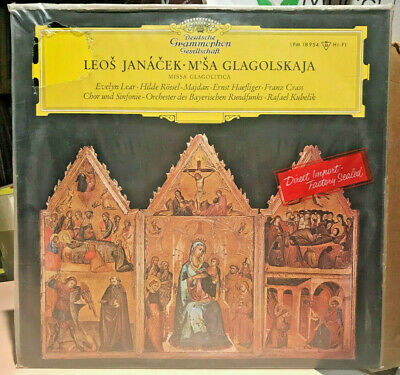
DGG LP LPM-18-954: Janáček - Missa Glagolitica - KUBELIK - 1965 GERMANY SEALED
$
50



Favourite Auctions
To save auctions to your favourites, please login
If you don't have an account, please register
Description
****Welcome to our listing, thanks very much for looking!
****See our own website! We have lots of out of print LPs and CDs! Find us on the web at -
hearthedifference.net
****Please see our other listings - new items added daily!
****Shipping cost is only an estimate - it depends on the actual weight and size of the package as well as the service required. We do not profit from shipping costs, so if we overcharge, we will refund the difference back to you. It's always best to wait for our invoice before paying for your item. We will combine shipping for multiple items purchased.
Background -
One NEVER sees factory sealed LPs from the 1960s - from September 1965 to be exact! This is a super rare item, assumed to be in MINT condition. Never touched by a cartridge/stylus - how rare is that? Because this item is Factory Sealed, we can't be certain of the label vintage, although, based on the weight, we are assuming this one to be a TULIP pressing. DGG LPs are terrific because of their reference performances, high quality and sound (not always spectacular, but most of the time the sound is superb). We consider the DGG LPs made in Germany to be outstanding bargains with superb sound....get them while you still can!A top conductor of large orchestral works of the late nineteenth century, Rafael Kubelik was born near Prague in 1914. The son of violinist Jan Kubelik (1880-1940), he studied violin, piano, composition, and conducting at the Prague Conservatory. He made his debut before the Czech Philharmonic Orchestra at age 19, and in 1939 became the music director of the National Opera in Brno, Czechoslovakia. In 1941, he became the music director of the Czech Philharmonic Orchestra, a post he held until 1948. In 1948, with the establishment of a Communist dictatorship in Czechoslovakia, Kubelik left his homeland and became an exile for the next 40 years.
Kubelik's three years with the Chicago Symphony Orchestra, beginning in 1950, were frustrating. A persuasive rather than a dictatorial figure and a diplomat rather than a martinet, he lacked the ability to control the orchestra. Additionally, Kubelik's musical sensibilities had been shaped in the early twentieth century rather than the late nineteenth, as had been the case with his immediate predecessors, and he programmed far too much modern music for the taste of critics and subscribers. Kubelik was fortunate that his appointment coincided with the orchestra making its first move into long-playing records for the Mercury label. Among his two dozen recordings with the Chicago Symphony Orchestra was a riveting performance of Mussorgsky's Pictures at an Exhibition and one of Smetana's My Fatherland. Ultimately the fit just wasn't right between Kubelik and the orchestra, and he gave up the appointment.
Kubelik served for three years, from 1955 through 1958, as music director of the Covent Garden Opera in London, where he conducted the British premieres of Janácek's Jenufa and Berlioz's Les troyens. From 1961 until 1979, he was music director of the Bavarian Radio Symphony in Munich, with which he also recorded extensively (for Deutsche Grammophon), and was the principal conductor of the Metropolitan Opera in New York during the 1973-1974 season as well. He was a most-welcomed guest conductor in Chicago on many occasions throughout his later career, appeared with virtually all of the world's major orchestras, and recorded extensively in England, America, and Germany. In 1973, he became a Swiss citizen.
Rafael Kubelik embodied a tradition of robust post-Romantic music-making that was ideally suited to the recording medium as well as the concert hall. He was celebrated as a master of rich orchestral color, which was brought out most vividly in the late Romantic and post-Romantic scores for which he was most popular. This included much of the Russian repertory and virtually all of the nationalist music of the era, especially the work of his fellow countrymen Antonin Dvorák, Leos Janácek, and Bedrich Smetana. He recorded the latter's Má Vlast at least four times on as many different labels, the last at a live performance in Prague during 1990 at a concert commemorating the liberation of the country from Communist rule released on the Supraphon label. The sheer number of his recordings that remain in print, and their equal distribution between the "historical" and modern sections of classical music departments, speaks volumes about his enduring popularity and the validity of his performances and interpretations. His complete Beethoven and Mahler cycles remained in print for many years. Although relatively little of his operatic work was preserved on record, the small number of these are also well-regarded, especially his Rigoletto.
With the fall of the Communist dictatorship, Kubelik, who had been intermittently ill for several years, returned to Czechoslovakia for the first time in four decades with the intention of resuming composing full-time. As it was, he had authored five operas, several symphonies, and various works for soloist and orchestra, vocal works, and chamber pieces. - Bruce Eder
-
LP made by DGG (Deutsche Grammophon Gesellschaft) Records, in GERMANY
-
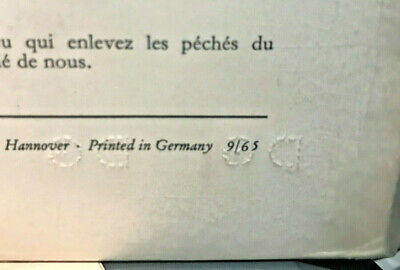
LP released in 1965 - September 1965 per the back of the jacket.
-
LP is recorded in MONO
-
Record Catalog Number: LPM 18 954 Hi-Fi
-
Record Labels are are assumed to be primarily YELLOW with BLUE & RED lettering, featuring the early DGG Records logo, with TULIPS around the circumference of the record labels.
- Center Labels info:
Made in GERMANY
Yellow labels, RED & BLUE print - with TULIPS (assuming).
- SLEEVE:
- No flip-backs
- Sleeve notes - Czech, German, English & French on back of the jacket. - CATALOG NUMBERS:
- LPM 18 954 M/33 Hi-FI on the front of the jacket / 18 954 Hi-Fi on back of jacket
- LPM 18 954 on spine
Leos Janacek // Rafael Kubelik
LP Title -
MIssa Glagolitica
Track Listing -M´ša Glagolskaja
A1. 1. Úvod (Introduction)
A2. 2. Gospodi Pomiluj (Kyrie)
A3. 3. Slava (Gloria)
B1. 4. Věruju (Credo)
B2. 5. Svet (Sanctus)
B3. 6. Agneče Božij (Agnus Dei)
B4. 7. Varhany Solo (Orgel-Solo)
B5. 8. Intrada
Other Information -
• Alto Vocals – Hilde Rössel-Majdan
• Bass Vocals – Franz Crass
• Chorus – Chor Des Bayerischen Rundfunks
• Composed By – Leoš Janáček
• Conductor – Rafael Kubelik
• Engineer [Toningenieur] – Günter Hermanns
• Liner Notes – Kamil Šlapák
• Orchestra – Symphonie-Orchester Des Bayerischen Rundfunks
• Organ – Bedrich Janáček
• Recording Supervisor – Hans Weber
• Soprano Vocals – Evelyn Lear
• Tenor Vocals – Ernst Haefliger
Missa Glagolitica
Gesellschaft tulip label
Gate-fold cover
Printed in Germany 9/65
• Rights Society: GEMA
• Rights Society: BIEM
CONDITION Details:
The LP jacket is still in the original plastic outer sleeve. The plastic outer wrap has a small tear at the top, front, left corner area - see pictures with this listing as they are of the actual item being offered. This Item is assumed to be in mint condition - as it's FACTORY SEALED!
The LP is assumed to be in mint condition - it's FACTORY SEALED and never played! A Short Note About LP GRADING -
- Mint = Only used for sealed items.
- Near Mint = Virtually flawless in every way.
- Near Mint Minus = Item has some minor imperfections, some audible.
- Excellent = Item obviously played and enjoyed with some noise.
- Very Good Plus = Many more imperfections which are noticeable and obtrusive.
For best results, always thoroughly clean your LPs before playing them.
LPs can be audiophile quality pressings (any collector of fine MFSL, half speeds, direct to discs, Japanese/UK pressings etc., can attest to the difference a quality pressing can make to an audio system).
Do not let this rarity slip by!price rating


