DIETER SCHNEBEL+BERND ALOIS ZIMMERMANN LP ENSEMBLE MUSICA NEGATIVA-EXPERIMENTAL
$
65


Favourite Auctions
To save auctions to your favourites, please login
If you don't have an account, please register
Description
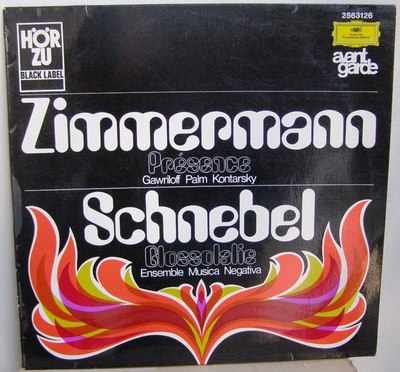
DIETER SCHNEBEL / BERND ALOIS ZIMMERMANN
GLOSSOLALIE / PRESENCE LP
Hor Zu Black Label
Rare original from the early 70's, features pioneer experimental avant-garde works from Dieter Schnebel and Bernd Alois Zimmermann.
Some info on the release: Rare original issue, released in Germany back in 1971 on the great Hor zu label a sub-label of Deutsche Grammophon (Iannis Xenakis, Hans-Joachim Hespos, etc.). Performers include the Ensemble Musica Negativa, Siegfried Palm, Aloys Kontarsky and others. A great phonetic / text sound work from Schnebel (Glossolalie) and a great avant-garde piece from Zimmermann (Presence).
Schnebel has become one of the many important postmodern composers through a unique craft, challenging our definitions of music, its limits, and even its unusual sound capabilities from humans themselves. But before developing into a professional expresser of music as an art form, Schnebel underwent vigorous studies in various fields.
He began with a general private music study with Wilhelm Sibler from 1942 until 1945, when he started piano lessons with another Wilhelm Resch, and lasted with him until 1949 at the age of 19. He continued then with music history through 1952, under Eric Doflein. Simultaneously he began composition (in 1950) under several musicians, including Ernst Krenek, Theodor W. Adorno, and Pierre Boulez. This led to his attendance at the University of Tübingen, where he studied musicology under Walter Gerstenberg, as well as theology and philosophy, while picking up further piano study as well. In 1955 however, the degree he left with was in fact theology, but with a dissertation about Arnold Schoenberg. Soon after, Camilla Riegger became his wife (in 1956), which led to a son and daughter. He became a minister, and taught theology and religion until 1963, when he added philosophy and psychology to his teaching practices. Then in Berlin, starting in 1970, he became a professor of experimental music and music research, with subsequent visits to the U.S. for other opportunities. Since 1976 he’s been teaching composition on and off in Berlin.
And although the majority of his works are considered material aimed toward the “vocal experiment” and 12-tone side of music, his pieces do have a wide range of styles, even with such a small size of composed repertoire. For instance, he put forth many arrangements of Bach, Beethoven, Webern and Wagner; sometimes using their traditional concepts to the idea of untraditional techniques and ways of listening to them.
Theories self-created and inherited were/are often practiced at performances. He believed that you could increase a student’s vocal range through the use of specific psychological methods, or physical placement. For example, placing singers far apart in a triangular shape causes a musically spatial feeling, and therefore sounds much different from the density when singers are close together. Other times he may just take a traditional piece and turn it into an improvised 13-voice canon. Pieces using such theories can be found in his most famous works’ set; the “Fur Stimmen (...missa est)” choral pieces, like “:! (madrasha 2)” and “AMN”. The first, an unpronounceable title, means “a non-verbal outburst or exclamation”, and used to explore the options in human phonetic sounds, such as vocal and musical versions in lips, tongue, glottus, nasal and other pressures through pitches. The second (unvocalized Hebrew) emphasizes the idea of musical space, with several large gaps in the piece, as well as bizarre vocal experiments.
Bernd Alois Zimmermann was a post-WWII German composer. He is perhaps best known for his opera Die Soldaten which is regarded as one of the most important operas of the 20th century. As a result of his individual style, it is hard to label his music as avant-garde, serial or postmodern. His music employs a wide range of methods including the twelve-tone row and musical quotation. From 1948 to 1950, he was a participant in the Kranichsteiner/Darmstädter Ferienkursen für Neue Musik (lit. Kranichstein/Darmstadt Vacation Course for New Music) where he studied under René Leibowitz and Wolfgang Fortner, among others. In the 60s, he received more attention and success as a composer (including a second scholarship to the Villa Massimo in 1963 and a fellowship in the Berlin Academy of the Arts), especially after his opera Die Soldaten (The Soldiers) finally premiered in 1965. The opera had previously not been performed due to the enormous number of people required and the musical difficulty—the Cologne Opera had considered it "unspielbar" (not performable).
In his own compositional growth, he took his place in the progression of new music, from which the German composers were mostly separated during the Nazi regime. He began writing works in the neoclassical style, continued with free atonality and twelve-tone music and eventually arrived at serialism (in 1956). His affection for jazz can sometimes be heard in some of his compositions (more so in his Violin Concerto or Trumpet Concerto). In contrast to the so called Darmstadt School (Stockhausen, Boulez, Nono, etc.), Zimmermann did not make a radical break with tradition. At the end of the 1950s, he developed his own personal compositional style, the pluralistic "Klangkomposition" (German word referring to the compositional style that focuses on planes (or areas) of sound and tone-colors). The combination and overlapping of layers of musical material from various time periods (from Medieval to Baroque and Classical to Jazz and Pop music) using advanced musical techniques is characteristic of Klangkomposition. Zimmermann's use of this technique ranged from the embedding of individual musical quotes (seen somewhat in his orchestral work Photoptosis) to pieces that are built entirely as a collage (the ballet Musique pour les soupers du Roi Ubu). In his vocal works, especially his Requiem, the text is used to progress the piece by overlapping texts from various sources. He created his own musical stance using the metaphor "the spherical form of time". Bernd Alois Zimmermann cites composers Bartok, Hindemith, Stravinsky, Schoenberg, and Webern and writers James Joyce and Ezra Pound as his influences.
Condition: Vinyl lies in excellent condition, looks super clean and plays nicely, while cover lies in excellent- shape, with slight lamination problems (see picture).
Tracklist
Bernd Alois Zimmermann - Présence (1961) A1 Introduction Et Pas D'Action A2 Pas De Deux A3 Solo A4 Pas De Deux A5 Pas D'Action Et Finale Dieter Schnebel - Glossolalie (1959-60, Version 1961) B1 Introduktion Und Teil I B2 Teil II B3 Teil III B4 Teil IV Mit Epilog-Coda Credits- Cello – Siegfried Palm (tracks: A1 to A5)
- Conductor – Rainer Riehn (tracks: B1 to B4)
- Ensemble – Ensemble Musica Negativa (tracks: B1 to B4)
- Performer [Instr.1] – Sava Savoff
- Performer [Instr.2] – Werner Bärtschi
- Performer [Instr.3] – Hartmut Schumann
- Performer [Instr.4] – Thomas Gross
- Performer [Recit.1] – Doris Sandrock
- Performer [Recit.2] – Dieter Strobel
- Performer [Recit.3] – Michael Mendl
- Performer [Recit.4] – Dieter Schnebel, Rainer Riehn
- Piano – Aloys Kontarsky (tracks: A1 to A5)
- Violin – Saschko Gawriloff (tracks: A1 to A5)
- ~
SHIPPING & PAYMENT
Shipping: Shipping for this LP is 7$ airmail in Europe / 9$ for the rest of the world
Registered mail: +5$
Insurance: optional
Combined shipping: BIG discounts
Payment: Paypal
Packaging: I am a collector too and i know


![THE SOULETTES - I LOVE YOU BABY // SKATALITES - INSTRUMENTAL [ MAY443 ]](https://www.popsike.mobi/php/thumbnail.php?url=https://www.popsike.pics/pix/20220601/175303361129.jpg)