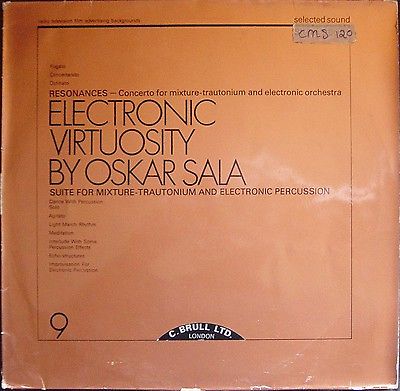
Electronic Virtuosity by Oskar Sala L.P. (CMS Music Library 120)
£
19
$
25


£ 19
Sold For
Nov 3, 2014
Sold Date
Oct 24, 2014
Start Date
10
Number Of Bids
Great Britain
Country Of Seller
eBay
Auctioned at
Favourite Auctions
To save auctions to your favourites, please login
If you don't have an account, please register
Description
Electronic Virtuosity by Oskar Sala L.P. (CMS Music Library 120)
Record near mint / the cover has come unglued and there is some wear round the edges.From Discogs:
Oskar Sala ?– Electronic Virtuosity Label: Selected Sound ?– 9009 Format: Vinyl, LP Country: Germany Released: 1970 Genre: Electronic Style: Modern Classical, Musique Concrète, Experimental Tracklist Suite For Mixture-Trautonium And Electronic Percussion 17:45 B1 Dance With Percussion Solo 4:58 B2 Agitato 2:22 B3 Light March Rhythm 1:43 B4 Meditation 1:59 B5 Interlude With Some Percussion Effects 1:25 B6 Echo-Structures 1:42 B7 Improvisation For Electronic Percussion 3:36 Resonances - Concerto For Mixture-Trautonium And Electronic Orchestra 18:17 A1 Fugato 5:12 A2 Concertando 7:35 A3 Ostinato 5:30 Credits Composed By – Oskar Sala Played By – Oskar Sala Notes Original on Sound-Library Record
From Wikipedia:
Oskar Sala (18 July 1910 – 26 February 2002) was a 20th-century German physicist, composer and a pioneer of electronic music born in Greiz. He played an instrument called the Trautonium, a predecessor to the synthesizer.
Sala studied piano and organ during his youth, performing classical piano concerts as a teenager. In 1929, he moved to Berlin to study piano and composition with composer and violinist Paul Hindemith at the Berlin conservatory. He also followed the experiments of Dr. Friedrich Trautwein, at the school’s laboratory, learning to play with Trautwein's pioneer electronic instrument, the Trautonium.
On 20 June 1930 Sala and Paul Hindemith gave a public performance at the Berliner Musikhochschule Hall called “Neue Musik Berlin 1930? to introduce the Trautonium. Later Sala toured Germany with the Trautonium; in 1931 he was the soloist in a performance of Hindemith's Concert for Trautonium with String Quartet.[1] He also soloed in the debut of Hindemith student Harald Genzmer's “Concert for Trautonium AND Orchestra”.
Sala studied physics at the University of Berlin between 1932 and 1935. He helped to develop the "Volkstrautonium",[4] a Trautonium that Telefunken hoped to popularize. In 1935 he built a "Radio-Trautonium", and in 1938 a portable model, the "Konzerttrautonium".
Mixtur-Trautonium, 1952 In 1948 Sala further developed the Trautonium into the Mixtur-Trautonium. The Mixtur-Trautonium allowed for the first time in music history the execution of sounds which had only been known in theory since the Middle Ages, but were never actually playable. Sala's invention opened the field of subharmonics, the symmetric counterpart to overtones, so that a thoroughly distinct tuning evolved.
Sala presented his new instrument to the public in 1952 and would soon receive international licenses for its circuits. That same year, Harald Genzmer delivered the score to the first Concert For Mixtur-Trautonium And Grand Orchestra.
In the 50’s Sala also built the Quartett-Trautonium.
Film work In the 1940s and 1950s he worked on many film scores. In 1958 he established his own studio at Mars film GmbH (4th incarnation) in Berlin. There he produced electronic soundtracks for such films as Veit Harlan’s “Das Dritte Geschlecht” (1957), Rolf Thiele’s “Das Madchen Rosemarie” (1959), and Fritz Lang’s "Das Indische Grabmal" (1959).[1]
He created the non-musical soundtrack for Alfred Hitchcock's film The Birds. He received many awards for his film scores, but never an Oscar. He also did much work on German commercials, most notably one referred to as HB's little man.
Go to the Cordelia Records web site, have a look at our own releases and download a free sampler album.
On 21-Apr-06 at 17:35:41 BST, seller added the following information: Pay instantly with your debit or credit card through PayPal.price rating


![[LP] '73 Rice Orig/ Frank Wess/ Flute Of The Loom/Enterprise/ ENS-5006/Soul-Jazz](https://www.popsike.mobi/php/thumbnail.php?url=https://www.popsike.pics/pix/20251122/397305520584.jpg)